- Position the head restraint according to the occupant's
height ~
page 74. For maximum protection, the top of
the head restraint should be at least at eye level, prefer-
ably higher and ideally level with the top of the head
~
page 169, fig. 160.
& WARNING
Never place any objects in the driver's footwell. An object could
get into the pedal area and interfere with pedal function. In case
of sudden braking or an accident, you would not be able to brake
or accelerate. •
Front passenger's seat
Always move the front passenger seat into the rearmost
position.
To avoid contact with the airbag while it is deploying, do not
sit any closer to the instrument panel than necessary and
always wear the three-point safety belt provided adjusted
correctly. We recommend that you adjust the passenger's
seat in the following manner:
- Bring the backrest up to an (almost) upright position.
Do
not ride with the seat reclined.
- The ideal position for the head restraint is with the upper
edge of the restraint level with the top of your head
~
page 74. You should not lower the top of the restraint
below the level of your eyes.
- Place your feet on the floor in front of the passenger's
seat . •
Cont rols and equip-
ment
Vehicle OP-eration
Seats and storage
Adjusting front seats manually
Applies to vehicles: with manually adjustab le seats
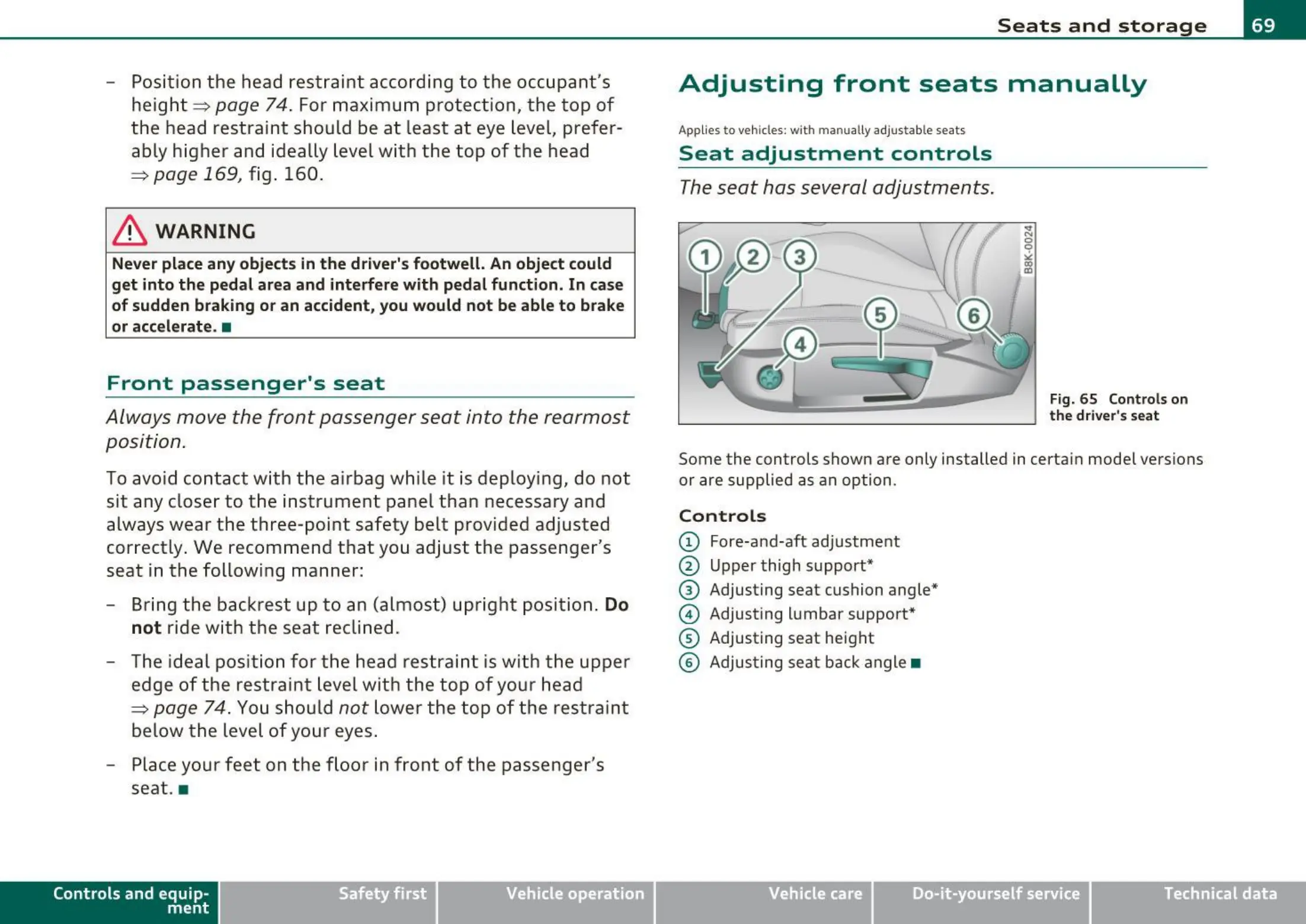
Seat adjustment controls
The seat has several adjustments.
(
-
-
;:?;
0
0
l&
a,
Fig. 65 Controls on
the driver's seat
Some the controls shown are only installed in certain model versions
or are supplied as an option.
Controls
© Fore-and-aft adjustment
@ Upper thigh support*
® Adjusting seat cushion angle*
© Adjusting lumbar support*
© Adjusting seat height
© Adjusting seat back angle •
Vehicle care Do-it-yourselt service iTechnical data



 To Next Page