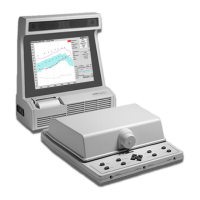
Verifit
®
User's Guide Version 3.12
November 2015
This message may be displayed when starting an On-ear test. It indicates that the Verifit is not measuring any
sound at the on-ear probe reference microphone.
• Check that a probe microphone assembly is securely plugged into the PROBE socket of the side (Right or
Left) you are trying to calibrate, and that the cable has not become damaged.
• Try switching right and left probe microphone assemblies.
• Try switching the right and left cables connecting the rear display unit to the test chamber. Carefully
observe the pins in the test chamber connector for any that are bent or pushed in.
Invalid on-ear calibration
Invalid on-ear microphone calibration!
This message may be displayed during the on-ear calibration procedure. It indicates that the calibration curve is
significantly different from what is expected. It may be accompanied by an on-ear reference microphone error.
• Check that a probe microphone assembly is securely plugged into the PROBE socket of the side (Right or
Left) you are trying to calibrate, and that the cable has not become damaged.
• Try using a new probe tube. Ensure it is correctly attached and positioned.
• Try switching right and left probe microphone assemblies.
• Try switching the right and left cables connecting the rear display unit to the test chamber. Carefully
observe the pins in the test chamber connector for any that are bent or pushed in.
Sound-field speaker overdriven
Sound-field speaker overdriven! or External sound-field speaker overdriven!
This message may occur in on-ear directional or on-ear unaided or aided tests if:
• No external front speaker is connected but one has been selected in Setup. See External display, printer,
speaker, External sound-field speaker setup.
• No back speaker has been connected but an on-ear directional test is being attempted. See External sound-
field speaker setup.
• The test environment is too reverberant for the distance between the client and the speaker(s). Move the
on-ear speaker(s), internal or external, and client away from walls and hard objects. Move the client closer
to the speaker(s).
• The speaker or connecting cable (external speakers only) is defective. If this is the case, you should not
hear any sound coming from the internal or external speaker(s) during any test. Try a different speaker or
cable.
Invalid RECD transducer coupler calibration
Invalid RECD transducer coupler calibration.
128



 To Next Page