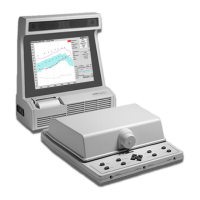
Verifit
®
User's Guide Version 3.12
November 2015
25 References
AAA Clinical Practice Guidelines: Remote Microphone Hearing Assistance Technologies for Children and
Youth Birth-21 Years. Supplement A: Fitting and Verification Procedures for Ear-level FM. Draft 2007.
American National Standards Institute. (1997). American National Standard Methods of Measurement of Real-
Ear Performance Characteristics of Hearing Aids. ANSI S3.46-1997. New York: American National Standards
Institute.
American National Standards Institute. (1996). American National Standard Specification of Hearing Aid
Characteristics. ANSI S3.22-1996. New York: American National Standards Institute.
Bagatto, M., Moodie, S. T.,Scollie, S., Seewald, R., Moodie. K.S., Pumford, J. & Liu, R. (2005). Clinical
protocols for hearing instrument fitting in the desired sensation level method. Trends in Amplification, 9-4,
199-226.
Bentler, R.A. & Pavlovic, C.V. (1989). Transfer functions and correction factors used in hearing aid
evaluation and research. Ear and Hearing, 10(10),58-63.
Byrne, D. (1977). The speech spectrum - Some aspects of its significance for hearing aid selection and
evaluation. British Journal of Audiology, 11,40-46.
Cole, W.A. & Sinclair, S.T. (1998). The Audioscan RM500 Speechmap/DSL fitting system. Trends in
Amplification, 3(4):125-139.
Corliss, E. L. R. (1990) The ear as a mechanism of communication. Journal of Audio Engineering Society,
38(9):640-652.
Cornelisse, L.E., Gagne, J-P & Seewald, R.C. (1991). Ear level recordings of the long-term average spectrum
of speech. Ear and Hearing, 12(1),47-54.
Cornelisse, L.E., Gagne, J-P & Seewald, R.C. (1991). Long-term average speech spectrum at chest-level
microphone location. Journal of Speech, Language, Pathology and Audiology, 15(3):7-12.
Cornelisse, L.E., Seewald, R.C., & Jamieson, D.G. (1994). Wide-dynamic-range compression hearing aids: The
DSL[i/o] approach. The Hearing Journal, 47(10), 23-29.
Cornelisse L.E., Seewald R.C., & Jamieson D.G. (1995). The input/output (I/O) formula: A theoretical
approach to the fitting of personal amplification devices. Journal of the Acoustical Society of America, 97(3),
1854-1684.
Cox, R.M. & Moore, J.N. (1988). Composite speech spectrum for hearing aid gain prescriptions. Journal of
Speech and Hearing Research, 31:102-107.
Dunn, H. K., & White, D. S. (1940). Statistical measurements on conversational speech. Journal of the
Acoustical Society of America, 11:278-288.
Feigin, J.A., Kopun, J.G., Stelmachowicz, P.G. & Gorga, M.P. (1989). Probe-tube microphone measures of
ear-canal sound pressure levels in infants and children. Ear and Hearing, 10(4), 254-258.
Fikret-Pasa, S. & Revit, L.J. (1992). Three experiments to validate new probe-measurement practices in
prescribing customized hearing aids. Journal of Speech and Hearing Research, 35:384-400.
Freed, D.J., & Soli, S. D (2006). An objective procedure for evaluation of adaptive antifeedback algorithms in
hearing aids. Ear & Hearing, 27(4).
Hawkins, D.B., Cooper, W.A., & Thompson, D.J. (1990). Comparisons among SPLs in Real Ears, 2cc and 6cc
couplers. Journal of the American Academy of Audiology 1:154-161.
140



 To Next Page