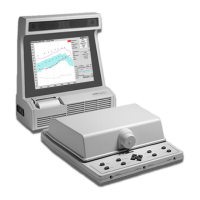
Verifit
®
User's Guide Version 3.12
November 2015
Hawkins, D.B., Walden, B.E., Montgomery, A.A., & Prosek, R.A., (1987). Description and validation of an
LDL procedure designed to select SSPL90. Ear and Hearing ,8:162-169.
Killion, M. C., & Monser, E. L. (1980). "Corfig: Coupler response for flat insertion gain." In G. A. Studebaker
and I. Hochberg (Eds.),. Acoustical Factors Affecting Hearing Aid Performance. Baltimore: University Park
Press.
Lewis, D.E., Feigin, J.A., Karasek, A.E., & Stelmachowicz, P.G. (1991). Evaluation and assessment of FM
systems. Ear and Hearing, 12:268-280.
Martin, H.C., Munro, K.J., & Langer, D.H. (1997). Real-ear to coupler differences in children with grommets.
British Journal of Audiology 31:63-69.
Moodie, K.S. (1996). A practical approach to hearing aid selection. BSA News 18:6-8.
Moodie, K.S., Seewald, R.C. & Sinclair, S.T. (1994). Procedure for predicting real-ear hearing aid
performance in young children. American Journal of Audiology, 3(1), 23-31.
Moore, BrianC.J.& Glasberg, Brian R. (2004). A revised model of loudness perception applied to cochlear
hearing loss. HearingResearch, 188 (2004), 70-88.
Mueller, H.G. & Bright, K.E. (1994). Selection and verification of maximum output. In Valente M (ed.):
Strategies for Selecting and Verifying Hearing Aid Fittings. New York: Thieme Medical Publishers, 38-63.
Pavlovic, C. V. (1991). Speech recognition and five articulation indexes Hearing Instruments 42(9):20-23.
Pearsons, K.S., Bennett, R.L., & Fidell, S. (1977). Speech levels in various noise environments, Project Report
On Contract 68 01-2466. Washington, DC: US Environmental Protection Agency.
Platz, Rainer, (2004). SNR Advantage, FM Advantage and FM Fitting, Proceedings from the 1st International
FM Conference. www.phonak.com.
Scollie, S.D., Seewald, R.C., Cornelisse, L.E. & Jenstad, L.M. (1998). Validity and repeatability of level-
independent HL to SPL transforms. Ear and Hearing 19(5):407-413.
Scollie, S.D., Seewald, R.C., Moodie, K.S., Dekok, K. (2000). Preferred listening levels of children who use
hearing aids: Comparison to prescriptive targets. JAAA 11:230-238.
Scollie, S., Seewald, R., Cornelisse. L., Moodie, S. T., Bagatto, M., Laurnagaray, D., Beaulac, S. & Pumford, J.
(2005). The Desired Sensation Level Multistage Input/Output Algorithm. Trends in Amplification, 9-4, 159-197.
Seewald, R.C. (1994a). Current issues in hearing aid fitting. In J-P Gagne and N. Tye-Murray (Eds.), Research
in Audiological Rehabilitation: Current Trends and Future Directions. Journal of the Academy of
Rehabilitative Audiology Monograph, XXVII.
Seewald, R.C. (1994b). Fitting children with the DSL method. The Hearing Journal, 47(9), 10,48-51.
Seewald, R.C., Moodie, K.S., Sinclair, S.T. & Cornelisse, L.E. (1996). Traditional and theoretical approaches
to selecting amplification for infants and young children. In Bess, F.H., Gravel, J.S. &
Tharpe, A.M. (eds.): Amplification for Children with Auditory Deficits, Nashville: Bill Wilkerson Center Press,
161-191.
Seewald, R.C. & Ross, M. (1988). Amplification for young hearing-impaired children. In M.C. Pollack (Ed.),
Amplification for the Hearing-Impaired, Third Edition (pp. 213-271). Orlando: Grune & Stratton.
Seewald, R.C., Ross, M. & Spiro, M.K. (1985). Selecting amplification characteristics for young hearing-
impaired children. Ear and Hearing, 6(1), 48-53.
Seewald, R.C., Ross, M. & Stelmachowicz, P.G. (1987). Selecting and verifying hearing aid performance
141



 To Next Page