2.1 Narrow-band signals
2.1.1 Sinusoidal (pure tones)
Sinusoidal signals are used in the ANSI hearing aid
tests, in Multicurve 2 cm
3
frequency response tests
(gain or output), in 2 cm
3
and on-ear single frequency
(manual) tests, in Insertion gain tests and in tone-
burst maximum output (MPO) tests. The MPO stimu-
lus consists of a series 128ms tone bursts with 128ms
gaps at an SPL of 90 dB SPL in the test box and 85
dB in the sound eld. Frequencies used are 1/12 oc-
tave except for the MPO test which uses 1/3 octave
frequencies. Levels from 40 to 90 dB SPL are available
at the reference microphone. Control of the level at
each frequency is maintained by measuring the fre-
quency response of the signal path to the reference
microphone 256 ms before each test using a 256 ms,
50 – 55 dB SPL, multi-tone complex or a 256 ms chirp,
depending on the test to follow. Drive levels at each
frequency are then set to achieve the desired band
levels at the reference microphone. For on-ear mea-
surements, tones are frequency modulated (triangle,
± 3% over 128 ms).
2.2 Broad-band signals
2.2.1 Pink Noise signal
The pink noise signal is available for Multicurve 2 cm
3
coupler gain and output frequency response mea-
surements and for Insertion gain and Speechmap
on-ear measurements. It is a pseudo-random sig-
nal composed of 1024 simultaneous tones summed
to provide a crest factor of 12 dB. The spectrum of
the pink noise signal is controlled by the reference
microphone in conjunction with a digital feedback
loop with a frequency resolution of 1/12 octave and
a response time of about 1/3 of a second. Pink noise
was selected as a test signal because it has equal en-
ergy per octave, producing a at spectrum when ana-
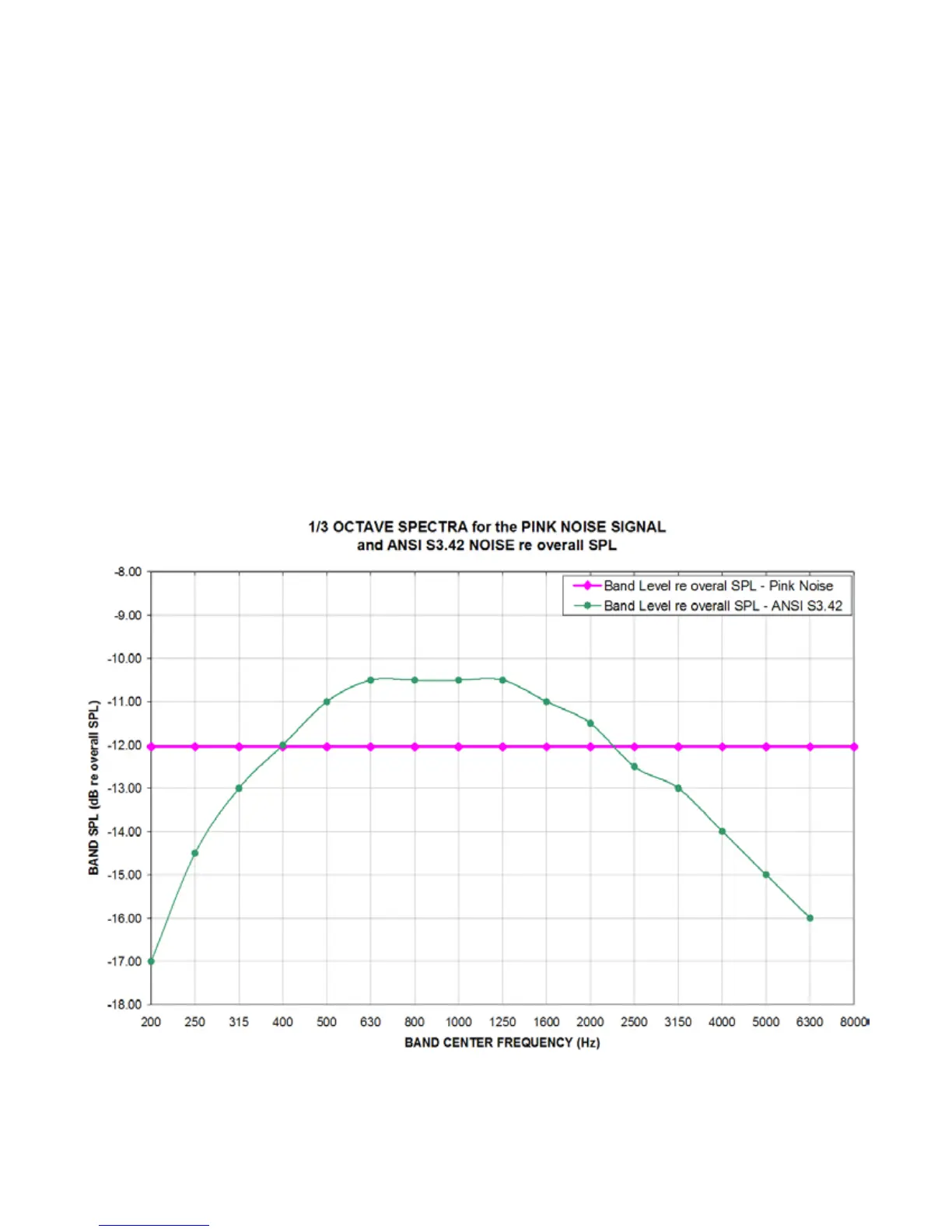
lyzed in 1/12 or 1/3 octave bands. Figure 1 shows the
1/3 octave spectrum of the pink noise signal and the
noise signal specied in ANSI S3.42-1997. Note that
the ANSI S3.42-1997 spectrum represents speech
peaks not the long-term average.
09/01/29 © Etymonic Design Incorporated, 20 Ludwig St., Dorchester, ON, Canada N0L 1G4
USA 800-265-2093 519-268-3313 FAX 519-268-3256 www.audioscan.com
2
Figure 1: 1/3 octave spectra for the pink noise signal and the noise signal specied in ANSI S3.42-1997.



 To Next Page