4-22
(b) Reverse action type
(1) Fix the bottom diaphragm case and yoke with the bolts.
(2) Insert the actuator rod (to which the diaphragm is connected) into the hushing, exercising
care not to damage the bushing inside surface or dust seal with the thread section of the
rod. (For example, cover the threaded section with adhesive tape to prevent damaging the
bushing.)
(3) Make the stopper (in the diaphragm plate) in parallel with the yoke by turning the rod.
(4) Install the springs on the spring plate. The quantities of springs are as follows:
Model HA2 ..................... 4 springs
Model HA3, HA4 ........... 8 springs
Except particular models as follows:
Model HA2, 38 mm stroke,
80 - 240 kPa (0.8 - 2.4 kgf/cm
2
).......Total 8 springs (with double springs)
Model HA3, 50 mm stroke,
80 - 240 kpa (0.8 - 2.4 kgf/cm
2
)....... Total 16 springs (with double springs)
Model HA4, 75 mm stroke,
80 - 240 kPa (0.8 - 2.4 kgf/cm
2
)...... Total 16 springs (with double springs)
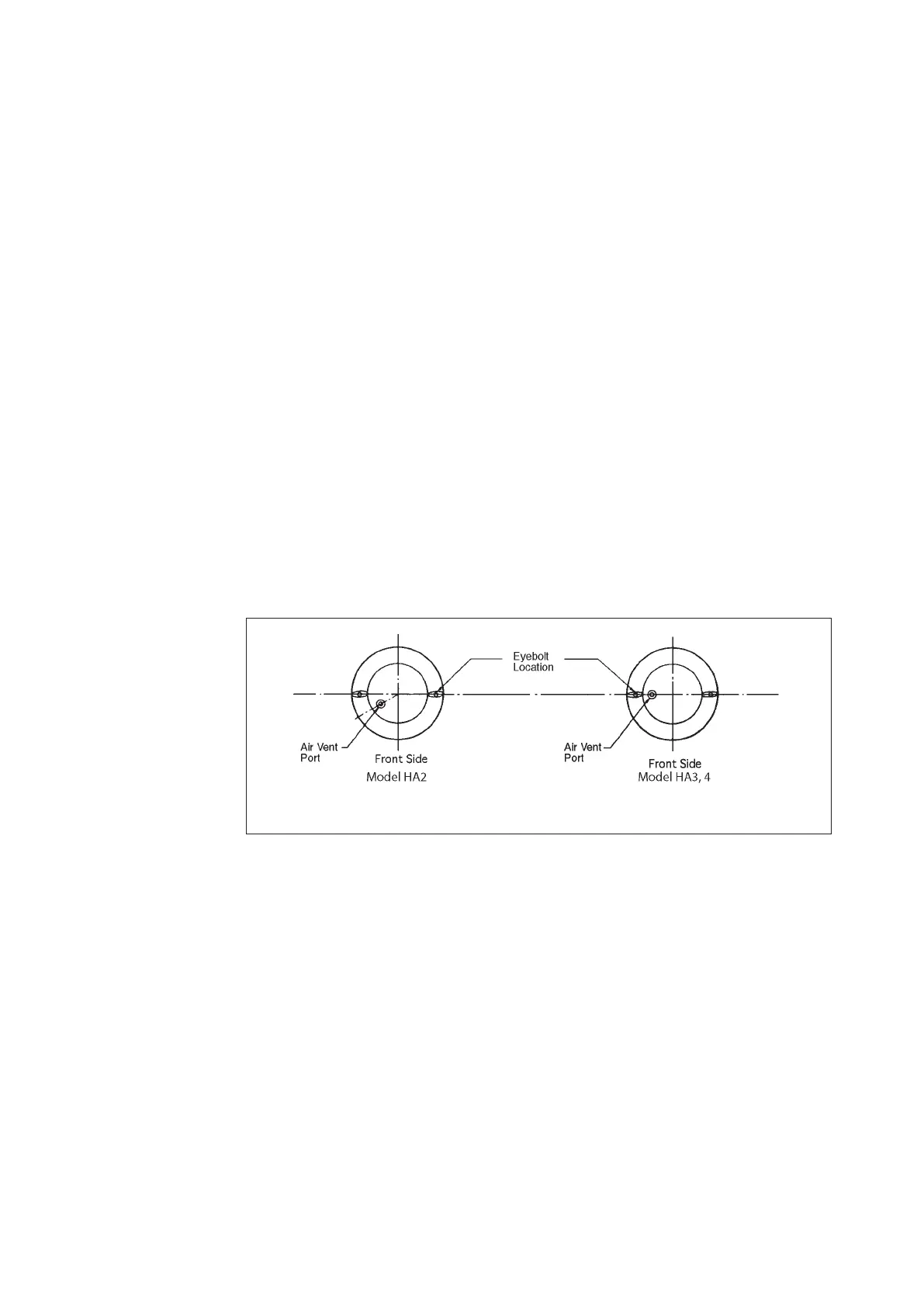
(5) Place the top diaphragm case and fix it with the pair of eyebolts. Set the air vent hole in
the location shown in the illustration (Figure 4-19). Uniformly and alternately tighten the
eyebolts. The initial setting of the springs is complete by tightening of these eyebolts.
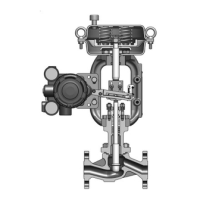
Figure 4-19 Reverse Action Type
(6) Clamp the diaphragm case with other clamping-bolts than the pair of eyebolts.
(7) Install the pointer, secure the lock nut, and install the stem connector.
(8) Install the rain cap on the air vent port.
(9) Connect the air pipe to the air piping connection port of the bottom diaphragm case.
(10) After the assembly is complete as above, check the following.
1. Applying an air pressure of 490kPa (5kgf/cm
2
) via the air Piping connection port
of the bottom diaphragm case, check the diaphragm periphery for air leak by using
soapsuds.
2. Check that the actuator smoothly operates for its full stroke.
Note: Check this operation by operating the actuator as an independent unit.


 To Next Page
 Loading...