20 PROTON User Manual
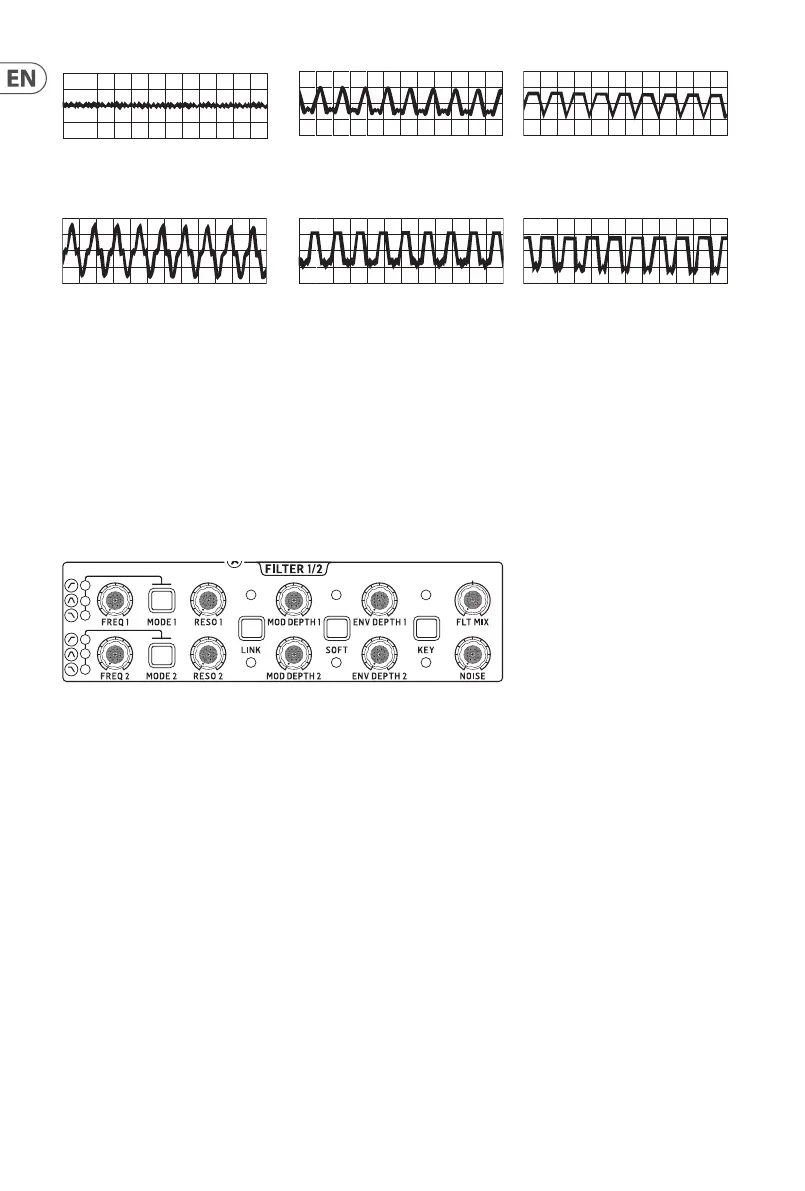
Sym fully CCW Sym midway Sym fully CW
And with the folds control fully CW:
Sym fully CCW Sym midway Sym fully CW
4.3 Bypass
When the wavefolder is in BP (bypass) mode neither of the controls have any eect, and the incoming waveform is passed to the VCFs
unaltered. Please note that when the wavefolder is used to process an external signal, which can be done using its in and out sockets on
the patchbay, setting the mode to BP will allow the internal oscillator mix to feed into the VCFs.
4.4 Modulation
Both folds and sym can be modulated by any modulation source, unipolar or bipolar in the range -5 V to +5 V via the dedicated
sockets on the In patchbay. The modulation source(s) are summed with the internal controls and can be used to produce even more
pronouncedeects.
5. Filters
The Proton has two, independent, 12 dB/octave VCFs, which can also have some of their functions linked together.
5.1 Mode
Each of the lters can be switched into either low pass, band pass or high pass mode. The current mode is indicated by an LED next to the
appropriate panel graphic.
5.2 Frequency
The lters’ cuto frequencies can be set using the freq 1 and 2 controls and can also be externally controlled by a voltage in the range -5V
to +5 V via the In patchbay. Both have a range of 10 Hz to 15 kHz. The frequency of each lter can also be modulated by a voltage in the
range -5 V to +5 V via the In patchbay, which will replace LFO 1 as the modulation source.
5.3 Resonance
The resonance of the lters can be adjusted using the reso 1 and 2 controls, and can also be externally controlled by a voltage in the range
-5 V to +5 V via the In patchbay. Increasing the resonance emphasizes a band of frequencies around the lter cuto frequency, until at
the highest settings the lter will self-oscillate.
5.4 Link
The link button has dierent eects, according to whether the red or the white LED is lit. When neither is lit it has no eect.
Red: VCF 2 will be modulated by the VCF 1 modulation source rather than that of VCF 2.
White: VCF 2 will be modulated by an inversion of the VCF 1 modulation source.




 To Next Page