12 WAVE User Manual
About this manual
This manual oers a comprehensive guide to the Wave synthesizer, detailing
its functionality and features. Additionally, it includes a brief introduction to
wavetable synthesis, providing insight into the theory behind this synthesis
method. We highly recommend reading through this manual to fully acquaint
yourself with the controls and enhance your experience with the instrument.
Introduction
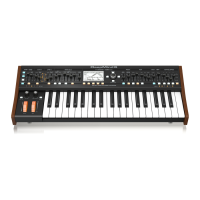
The Wave is an 8-voice hybrid wavetable synthesizer that combines digital and
analog sound generation techniques to deliver rich and complex sounds. Unlike
conventional analog synthesizers that rely on voltage-controlled oscillators,
The Wave employs digitally crafted waveforms housed in wavetables for sound
generation. Each voice in this system is composed of a pair of oscillators, the
main and the sub. These oscillators are combined and then transformed into
analog signals via a Digital-to-Analog Converter (DAC). Following this conversion,
the signal is directed through a Voltage-Controlled Filter (VCF) and a Voltage-
Controlled Amplier (VCA), completing the sound production process.
voice diagram (x8)
main osc wavetable
sub osc wavetable
DAC VCF VCA
OUTPUT
MIX
To further enhance sound design capabilities, the Wave includes a comprehensive
modulation matrix, three envelope generators, and a low-frequency oscillator
with four waveforms and adjustable delay. Creative possibilities are expanded
with an extensive set of keyboard modes and split points, allowing the synth to
be used in standard 8-voice polyphony, unison, or bi-timbral congurations with
a layered keyboard.
The Wave oers 30 factory wavetables and 64 user-dened wavetables,
each containing 64 waveforms. Additionally, there are 32 slots available for
user-dened transients. Both user-dened wavetables and transients can be
downloaded using the SynthTribe app.
How Wavetable synthesis works
Wavetable synthesis is a digital sound generation technique based on the
periodic reproduction of single-cycle waveforms. Introduced for the rst time in
the eighties and pioneered by artists such as Depeche Mode, Tangerine Dream
and Tears for Fears, wavetable synthesis is widely used today by musicians and
sound designers for the versatility it oers. In a wavetable synthesizer, single-
cycle waveforms are stored in tables called wavetables. What sets wavetable
synthesis apart from other generation techniques is the ability to sweep through
the wavetable, generating complex, evolving sounds. Like any other modulation
destination, wavetable sweeping can be controlled by various modulation
sources such as envelopes and LFOs, expanding the sonic possibilities. The
image graphically depicts how the output sound changes when sweeping
the wavetable using a four-stage ADSR envelope. For the sake of simplicity, a
wavetable with four waveforms is considered.
When transitioning from one waveform to the next, artifacts can be generated
due to phase discontinuities between waveforms resulting in abrupt transitions.
This characteristic is typical of the rst wavetable synthesizers and contributes
to their distinctive sound. The Wave oers the option to reduce these artifacts
through the Osc setting in the User menu. With this setting engaged, the
adjacent waveforms are morphed together resulting in smoother transitions.
Each of the Wave synthesizer wavetables contains 64 single cycle waveforms.
In each wavetable the last four waveforms emulate the typical analog
waveforms: Sawtooth, pulse, square and triangle. In addition to the envelope,
the waveform position can be further modulated by many sources including the
LFO, Aftertouch, Modulation wheel, Pitch wheel, expression pedal and keyboard,
further extending the expressiveness of the instrument. The Wave also oers
the possibility to store and reproduce up to 32 transient sounds, adding to its
sonic capabilities.
Each voice consists of two independent oscillators, one main oscillator and a
secondary sub oscillator. The position of each oscillator inside the wavetable can
be controlled using the Waves-Osc and Waves-Sub controls. When sweeping
through the wavetable the sub oscillator waveform can be set to run in parallel
with the main oscillator or to be manually controlled.
In addition to the wavetable selected from the Program menu, each program has
an additional wavetable called the Upper wavetable, which can be enabled via
the UW option in the Digital menu. These two wavetables are linked in a looping
sequence, meaning that when any modulation source exceeds the wavetable
lower or upper limits, the upper wavetable will become audible.
Working with transients
The Wave also supports transient sounds, which are short audio samples you
can import using the SynthTribe app. When a transient slot is selected from the
Program menu, the WAVE text is replaced with TRAN. In this mode, Waves-
Osc and Waves-Sub set the start points for the main and sub oscillators, while
ENV1>WAVES sets the loop point for both oscillators. The loop size is xed to 128
samples. For information on how to import custom transients, please refer to the
section "User Waves and Transients".
WAVES-OSC
WAVES-SUB
ENV1>WAVES
CW CW
start point loop point
loop duration
128 samples
loop duration
128 samples
time



 To Next Page