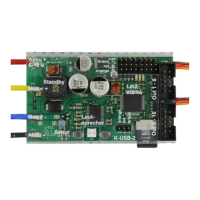
GB Double Sound Speed Controller SFR-1-D
44 BEIER-Electronic 01.03.2020
Servo outputs
The SFR-1-D offers four servo outputs (X5/1 - X5/4).
The servo outputs deliver usual pulses from 1,000 - 2,000 ms, so you can connect
standard servos or speed-controllers.
The power supply for these servo outputs is the integrated BEC of the SFR-1-D.
There are two different ways to control the servo outputs:
1. Driving to fixed positions
2. Direct, proportional control via a prop. channel
3. Running through a programed sequence
Driving to fixed positions:
For each servo, up to five positions can be specified in the Sound-Teacher (see
page 79), which can be approached via the freely assignable functions of the sound
module. The positions have the following names:
• Home position
• Position #1
• Position #2
• Position #3
• Position #4
Direct, proportional control via a prop. Channel:
Any desired prop. Channel can be assigned in the Sound-Teacher, which is to be
used for the "direct servo control". The servo then behaves as if it were connected
directly to the receiver. However, this makes it easy to play a sound as soon as the
servo moves.
Running a programed sequence:
A flow sequence can be programmed for each servo output in the Sound-Teacher.
Conceivable applications are e.g. a recoil system for a tank or an easy windshield
wiper for a truck.
A servo sequence can be triggered with the functions “Servo 1 sequence“, “Servo 2
sequence“ or with a sound (e.g. a cannon shot). A detailed description of the servo
sequence can be found on page 82.
A servo output can only be controlled either to a fix positions or as a sequence. Both
versions are not possible at one servo output.
The servo movement can also trigger a sound. The additional sounds “Sound from
servo 1-4“ are responsible for this. It also distinguishes between left and right
movement. So you can play for every direction of running a different sound.
If you don’t want sounds while moving the servos, just leave these sound-slots
empty.


 To Next Page