GB Sound module USM-RC-3
11.10.2021 BEIER-Electronic 7
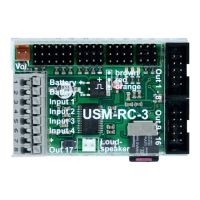
• Programming interface for data cable
• Port for infrared diode of light modules
SM-IR-16-2 / LM-IR-16-4 or Bluetooth
transmitter module LM-BT-S
•
Port for Kraftwerk EasyBus
• Short circuit protection at switching outputs
• Battery voltage monitoring
• Failsafe for proportional inputs
• For battery: 2 x 1,5 mm², length approx. 15
cm (with Deans T male connector)
• For Motor: 2 x 1,5 mm², length approx. 15
cm
• For receiver: servo patch 3 x 0,14 mm²,
Permissible ambient
temperature:
Permissible relative air
humidity:
65 x 43 x 17 mm (with SD card: 65 x 46 x 17
mm)
Operating modes: Digital, Digital mode with UFR speed
controller, Analogue and Mix mode
To make the sound module universal usable, four different operating modes are
available. The operating mode is important for the possible functions and especially
for connecting the sound module. Therefore you should decide at the beginning
which operating mode is best for your model. The operating mode of the sound
module is set in the USM-RC-3 Sound-Teacher (see page Fehler! Textmarke nicht
definiert.).
If possible, please use Digital or Mix mode, owing to their extended selection of
functions.
Digital mode:
The Digital mode is always applied if you use standard RC remote control radios and
receivers (for example 35 MHz, 40 MHz or 2,4 GHz). In this case the sound module
is connected directly to the RC receiver, and it recognizes the driving speed directly
from one or two proportional channels (parallel to the speed controller). Via 6 or 7
additional proportional channels (and the 4 switching inputs) it is possible to control
different functions of the sound module (see page 66).


 To Next Page