Need help?
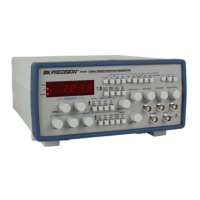
Do you have a question about the BK Precision 4040 and is the answer not in the manual?
Describes the fundamental input circuitry of a function generator.
Explains the core waveform generation process involving capacitor charging/discharging.
Describes how to select sine, square, or triangle waveforms from the output.
Details the amplifier circuits responsible for the generator's output signal.
Discusses extra features beyond the basic generator loop and output stages.
Explains the circuit responsible for generating frequency sweeps.
Details the operation of the gated burst or tone burst mode.
Describes the amplitude modulation circuitry within the generator.
Describes the frequency modulation circuitry and its operation.
Method to diagnose faults by injecting signals and checking outputs at each stage.
Technique to locate defective stages by substituting signals from the speaker inwards.
Utilizing DC offset to bias amplifiers and provide AC input signals for testing.
Using triangle waves to detect amplifier overload points by observing waveform distortion.
Measuring amplifier and filter frequency response using sweep and an oscilloscope.
Evaluating the effect of tone controls on amplifier frequency response.
Measuring device frequency response using both linear and logarithmic sweep modes.
Using DSOs for efficient frequency response testing with single-cycle triggering.
Assessing amplifier transient response and harmonic content using square waves.
Measuring speaker and network impedance and resonance frequency.
Explains AM modulation principles and waveforms, including sideband suppression.
Using a sweep generator to align AM receiver IF stages and the detector.
Aligning FM receiver IF stages and discriminators using a sweep generator.
Using square waves and pulses to test digital logic circuits like TTL and CMOS.
Using VCF inputs and switches to select predefined frequencies for repetitive testing.
Testing tone burst decoders for proper delay time, frequency response, and sensitivity.
Measuring attack time and effectiveness of compression amplifiers using tone bursts.
B&K Precision's Guidebook to Function Generators provides a comprehensive overview of these versatile test instruments, detailing their operation, controls, and numerous applications in electronics. Function generators are essential tools for technicians and engineers, capable of producing a wide variety of signals to simulate normal circuit operation in both design and troubleshooting scenarios. Modern units typically offer sine, square, and triangle waveform outputs, with adjustable frequency, amplitude, and DC offset, often extending to higher frequencies, variable symmetry, frequency sweep, AM/FM modulation, and gated burst modes.
At its core, a function generator develops a triangle wave by alternately charging and discharging a capacitance (CT) using two constant current sources. The charge/discharge cycle is regulated by a feedback loop involving a level detector/flip-flop, which changes state when specific voltage thresholds are reached. This feedback mechanism, coupled with diode switching, connects the capacitor to the appropriate current source, thus controlling the waveform generation. The basic waveform, a triangle, is then buffered and passed to an output amplifier. A square wave is derived from the TTL output of the level detector/flip-flop, with its DC bias shifted for symmetry. Sine waves are produced by applying the buffered triangle to a sine shaper, which may consist of a transistor array or diode bridges, before being sent to the output amplifier. The FUNCTION switch allows selection among these three primary waveforms.
The output amplifier, which can range from a simple circuit to a complex configuration with pre-amp and power amp sections, controls the signal amplitude via the OUTPUT LEVEL control. DC OFFSET is implemented as a bias adjustment in this circuit, allowing a settable DC voltage to be superimposed on the signal output. An attenuator, if present, provides precise attenuation without altering output impedance.
Additional features include a sweep circuit, which produces a ramp voltage to vary the output frequency. This ramp can be externally generated or created internally by a sweep generator, which can be configured for linear or logarithmic sweeps. The sweep width and rate are adjustable, allowing control over the frequency band covered and the repetition rate of the sweep.
Gated burst operation, or tone burst, is achieved by a shunt switch circuit that prevents the main timing capacitor from charging. This switch is controlled by a gating signal (internal or external) and a zero crossover detector, ensuring that the gated output consists of integral whole- or half-cycles. AM modulation is performed by varying the amplitude of one signal according to another, typically a lower-frequency signal. This is often done using an IC that performs the modulation, possibly with discrete transistor circuitry for DC level shifting. FM modulation is achieved by applying an external signal to the VCF input, which directly influences the current summing amplifier and thus the output frequency. A dedicated TTL output provides a buffered square wave signal, independent of the main output level and DC offset controls, with levels suitable for TTL circuits.
Function generators are highly versatile, finding applications in research and development, educational institutions, and electronic repair shops.
For troubleshooting, signal tracing involves injecting a signal from the generator at the input of a device under test and using an oscilloscope to check the output at each stage. Signal substitution is a variation where an audio signal is injected at various points in the circuit to substitute for the normal signal, moving from the output towards the input until no sound is heard. For these methods, it's crucial to match the DC offset to the normal operating voltage of the injection point and ensure the signal amplitude simulates normal circuit levels. Using sweep or tone burst operation can help distinguish test signals from other signals present in the circuit.
As a bias and signal source, modern function generators can superimpose a DC offset voltage on their AC signal output. This allows for biasing transistor amplifiers while simultaneously providing the AC input signal, enabling optimization for maximum undistorted output and exploration of different bias types (Class A, B, C).
For amplifier overload characteristics, the triangle waveform is ideal for determining the peak overload condition, as any departure from absolute linearity is easily detectable.
Frequency response measurements are a key application, using the sweep capability to check devices like amplifiers, filters, and impedance networks. The GCV output can be connected to an oscilloscope's horizontal input for X-Y operation, with markers placed on the screen to indicate frequencies of interest. Both linear and logarithmic sweeps are available, with logarithmic displays providing more detail at lower frequencies. Digital-storage oscilloscopes (DSOs) further enhance this by allowing slower sweeps and permanent record-keeping.
Amplifier performance evaluation using square waves provides insight into transient response due to their harmonic content. Proper termination at the device input is essential to eliminate ringing effects.
Testing speakers and impedance networks involves using the generator to provide information on input impedance versus frequency and to determine resonant frequencies. This can be done by logging voltage measurements across speaker terminals or by using a variable resistor in series with the network to determine its impedance at resonance.
AM receiver alignment utilizes the sweep function to display IF response curves. The generator's output, modulated as desired, is injected into the mixer or antenna, and the response is observed at the AM detector input. Tuning adjustments are made to achieve the desired IF response curve.
FM communications receiver alignment similarly uses sweep operation to align IFs and discriminators. The generator's signal is applied to the IF section, and the response curve (e.g., an "S" curve for discriminators) is observed and balanced around a marker frequency.
Testing digital logic circuits benefits from the generator's ability to supply square waves, pulses, or gated pulse trains. Variable symmetry allows for narrow clock pulses, and dedicated TTL-level outputs ensure correct voltage levels for injection into TTL circuits. The square wave output can also determine logic thresholds for TTL and CMOS circuits.
Preset frequency selection can be achieved by using the VCF input with preset voltages and a frequency selector switch, allowing for quick switching between commonly used frequencies. Similarly, digitally programmed frequency selection can be implemented for applications like frequency shift keying (FSK) systems.
Testing tone burst decoders involves using the generator's tone burst capability to test delay times, frequency response, and sensitivity. The duration and repetition rate of the tone burst are adjusted to match the decoder's specifications, and the turn-on/turn-off delay periods are measured on an oscilloscope.
Testing modulation limiters and compression amplifiers uses the tone burst output to measure attack time—the delay from initial signal application until full compression takes effect. The input and output waveforms are displayed on an oscilloscope to observe the compression characteristics and measure attack time against manufacturer specifications.
While the guidebook does not explicitly detail maintenance features, it emphasizes the importance of understanding the unit's controls, features, and operating modes for optimal use. It also advises consulting the manufacturer's manual for specific procedures, such as determining safe input voltage limits for the VCF input jack and following alignment procedures for tuned circuits. The use of a frequency counter for initial frequency calibration and ensuring the frequency dial is set to an end stop for repeatability in preset frequency selection are also highlighted, suggesting best practices for maintaining accuracy and consistency in measurements. The general principles of operation and application described are universal, but specific implementation details and maintenance considerations would be found in the individual product manuals.
 General
| AC Voltage | 120 V |
|---|---|
| Engine Type | 4-Stroke OHV |
| Noise Level | 68 dB |
| Fuel Tank Capacity | 4.0 gal (15.1 L) |
| Outlet Types | 2x 120V 20A GFCI, 1x 120V 30A Twist Lock |

 To Next Page