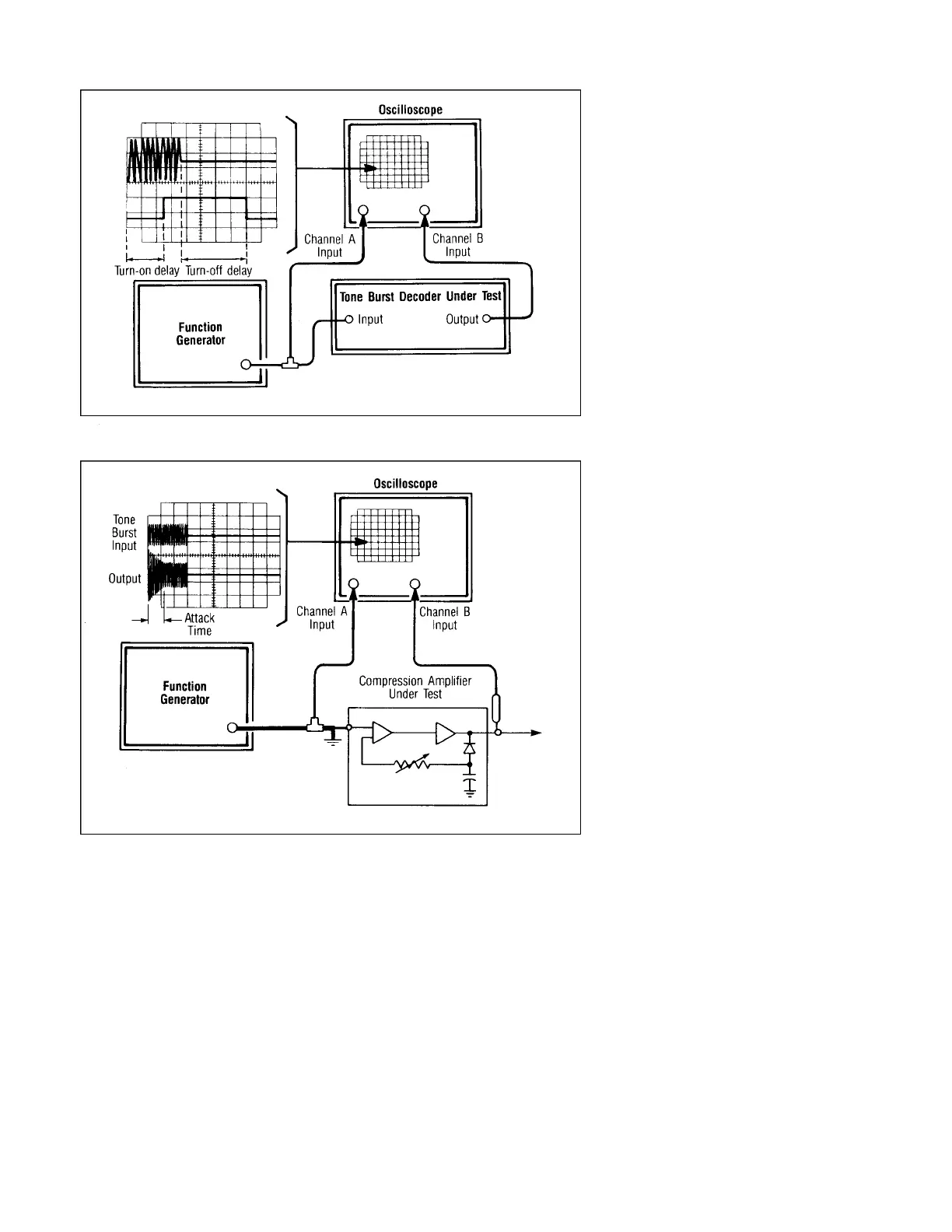
7. Decoder sensitivity can be measured by
varying the amplitude of the tone burst
signal. Adjust the amplitude to the level
that will barely activate the decoder out-
put. That amplitude is the decoder’s
threshold sensitivity.
8. Alignment and off-frequency rejection
may be checked by performing a fre-
quency response measurement on the
tone burst decoder. Output frequency can
be varied minutely up and down until the
device begins to function marginally. At
those points, the generator can be tem-
porarily switched back to continuous run,
and a counter used to determine the fre-
quencies of interest.
T E S T I N G M O D U L ATION LIMITERS
AND COMPRESSION AMPLIFIERS
Compression amplifiers are often used in
communications equipment to provide better
audibility over a wide range of input condi-
tions. One very common application is mod-
ulation limiting in CB radio transmitters.
Attack time, the time delay from initial appli-
cation of signal until full compression takes
effect, is a primary consideration in compres-
sion amplifiers. The tone burst output of
many function generators can provide an
effective method of testing attack time, which
cannot be measured with continuous signal
applied.
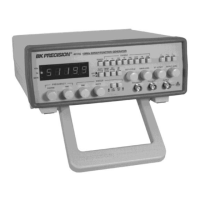
1. Connect equipment as shown in Fig. 21.
Using a dual-trace oscilloscope, display
the input of the compression amplifier on
one trace and the output on the other
trace.
2. Place the function generator in tone burst
mode.
3. Observe the output waveform on the
scope, synchronizing the display with the
beginning of the tone burst. Note that the
amplitude of the waveform is maximum
at the beginning of the tone burst, and
decreases until full compression takes
e ffect. At that point, the amplitude
becomes constant.
4. Allow enough tone burst width for full
compression to take effect. Also allow
sufficient time between tone bursts for
the bias of the compression amplifier cir-
cuit to revert to the full gain state.
5. Using a calibrated time scale on the oscil-
loscope, measure the attack time, as
shown in Fig. 21, and compare with the
manufacturer’s specifications.
6. The effectiveness of the compression
amplifier also may be tested by applying
various amplitude input tone bursts and
measuring the output amplitude.
Specifications for compression amplifiers
are often stated in this manner. For exam-
ple, “30 dB variation in input level will
produce no more than 3 dB variation in
output level”.
7. Testing may be performed at various fre-
quencies of the compression amplifier’s
passband.
Fig. 20. Tone burst decoder testing.
Fig. 21. Measuring attack time of a compression amplifier


 To Previous Page