Subject to change without prior notice Revised 11-11
6720220327
non-conditioned space to prevent damage from
condensation runoff. It is recommended that
units installed in non-conditioned spaces be
insulated with 1” thick berglass with the vapor
barrier on the outside.
7. While designed to operate quietly when
properly installed, several steps should be
taken insure this. Use of isolation pads when
mounting unit, exible duct collars for
discharge, and use of acoustical duct liners are
all good installation practices that promote
quite operation.
8. Cabinet insulation is rated for R-4.2 (standard).
Some jurisdictions require R-6.0 on installations
in a non-conditioned space. Add insulation 1”
thick to exterior of unit to comply in these
jurisdictions, putting the vapor barrier on the
outside.
9. Upon leaving the factory, the refrigerant piping
system is pressurized with nitrogen. Relieve
pressure before opening up the system for pipe
soldering or TXV removal by depressing the
Schrader valve on coil manifold.
Hotwatercanscald.Waterheatedtoa
temperaturewhichwillsatisfyspaceheatingcan
scaldandpermanentlyinjureapersonupon
contact.Somepeoplearemorelikelytobe
permanentlyinjuredbyhotwaterthanothers;
includingtheelderlyandchildren.Checklocal,
State,andNationalcodesrequiringcertain
temperaturewateratthehotwatertap.Special
precautionsmustbeusedinadditiontousingthe
lowestpossibletemperaturesettingthatsatises
yourhotwaterneeds.Atemperingdevicesuch
asamixingvalveshouldbeusedatthehotwater
taps,orwaterheater.
These units have a 0” (zero inch) minimum
clearance to combustible materials rating from all
cabinet surfaces unless electric heat is installed;
then a minimum of 1" clearance all around must be
adhered to. The unit should be installed with
serviceability clearance of 30" from the front of the
unit. The unit can be serviced entirely from the
front, including replacing the lter. Be sure to route
primary and secondary condensate drain piping so
as not to obstruct replacement of lter.
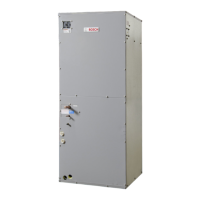
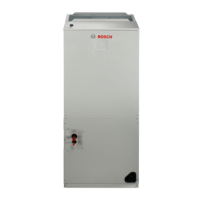
Units are shipped from the factory arranged to be
installed in an upow or horizontal right to left air
ow position. Horizontal right to left means, when
facing the front of the unit, when the unit is laid on
its side, the supply air opening is to the left and the
return opening is to the right. These models are
eld convertible to a horizontal left to right air ow
position.
In an upow installation the discharge outlet is at
the top. Care should be taken to insure unit is level
to permit proper condensate drainage. Normal
upow installation will be in a closet or basement.
If installed in a closet, the closet should have a
platform framed in, with an opening at the top of
the platform centered in the closet. Connect the
supply air outlet to a plenum. Install return air
grilles from outside the closet to space below the
platform. Platform must be at least 12” above the
oor. If installed in a basement, run supply and
return duct work in accordance with local codes.
Install the lter rack provided prior to placing the
air handler on the bottom plenum
Horizontal applications will normally be used in an
attic or crawl space. This type of installation
requires a return air duct be attached to the unit
inlet. The opposite end of the return air duct is
attached to a return air lter grille through the
ceiling or wall. Remove air lter from unit if lter
grille is used. The unit is shipped in right to left
conguration. For left to right applications (before
connecting drains, refrigerant or water piping)
remove coil and doors and move horizontal pan to
right side. Reinstall coil and doors.
Iftheairhandleristobeinstalledinan
unconditionedspace,ensurethatallrefrigerant
pipingisfullyinsulatedwithatleast½"insulation,
andthatbothsupplyandreturnductsarefully
insulatedwithaminof1"insulation.



 To Next Page