page heading
6 SAVE THESE INSTRUCTIONS
Do not drive fasteners into unsuitable materi-
als. Materials that are too hard can cause the
fastener to deflect. Brittle materials can crum-
ble and allow the fastener to break through. Ma-
terials that are too soft can allow the fastener
to break through. These conditions can result in
property damage or serious personal injury.
Do not pull the trigger or depress the nose-
piece when loading the nailer. Pulling the trig-
ger or depressing the nosepiece may cause mis-
firing of the tool resulting in personal injury and
property damage.
Load only one single shot fastener at a time.
Loading multiple fasteners can cause misfiring
and damage the nailer.
Do not use the utility hook or its mounting lo-
cation for tether attachments. The utility hook
and its mounting location are not intended to
support tethering loads.
Do not use the utility hook if it appears dam-
aged or deformed. A damaged or deformed util-
ity hook may result in unstable hanging and the
tool unexpectedly falling, causing property dam-
ages and personal injury.
Never wedge the nosepiece between two or
more surfaces. Gap between the nosepiece and
multiple work surfaces may allow deflection of
the fastener and property damage or personal
injury.
Never hold back the nosepiece during opera-
tion. Holding the nosepiece back can result in
unexpected actuation and may cause property
damage or serious injury.
Never position your face or body over the
nailer top cap during operation. The nailer will
recoil when driving a fastener.
Do not operate the nailer if it
does not pass daily inspec-
tion and testing. Operating a nailer that does not
pass the daily inspection and testing may result
in property damage and personal injury.
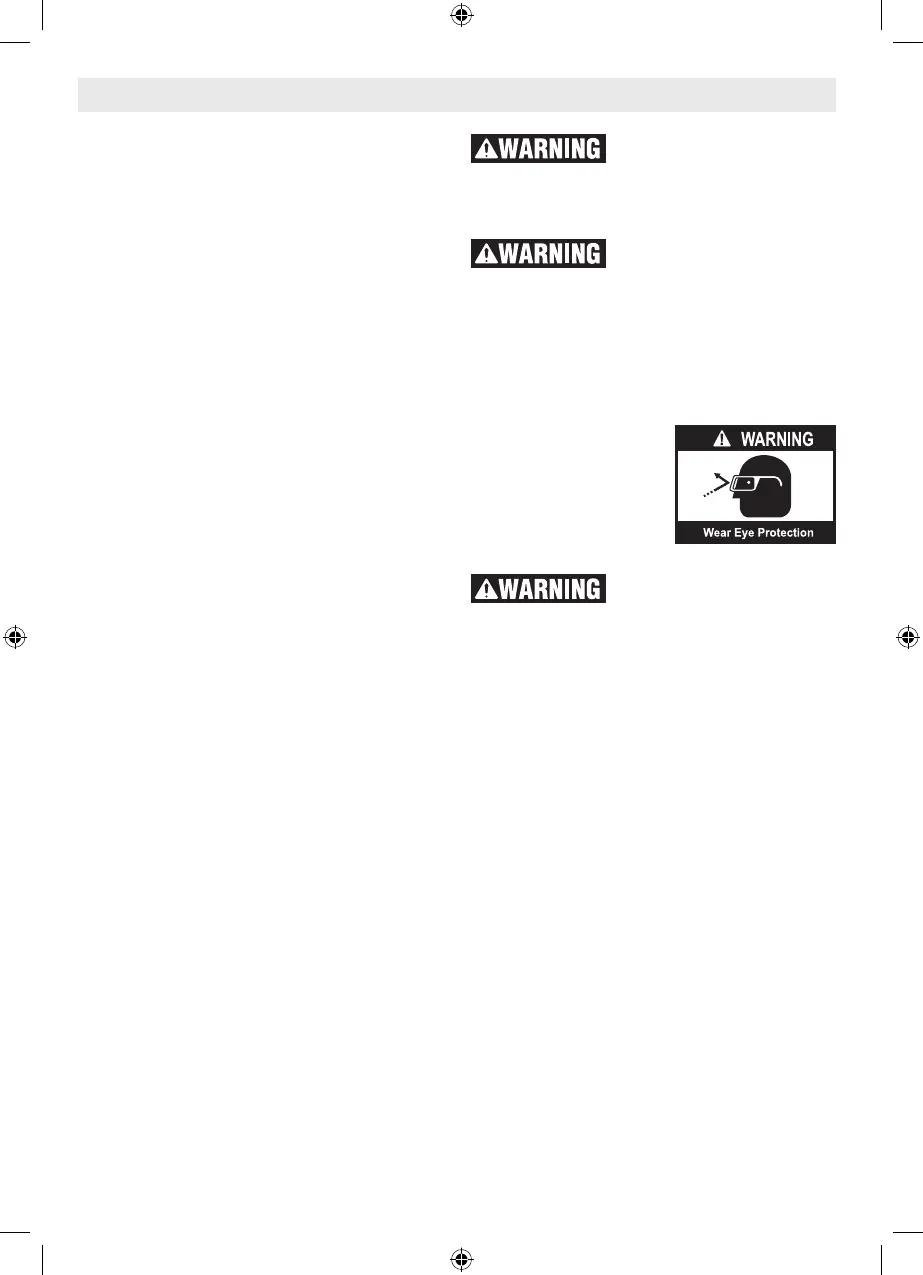
To reduce the risk of injury,
always wear safety goggles
or glasses with side shields. The operator and
other people in the work area must wear eye
protection in accordance with ANSI Z87.1. Eye
protection does not fit all operators in the same
way. Make sure the eye protection chosen has
side shields or provides protection from flying
debris both from the front and sides. The em-
ployer is responsible for
enforcing the use of eye
protection by the opera-
tor and other people in
the work area. When re-
quired, wear head pro-
tection in accordance
with ANSI Z89.1.
Some dust created by power
sanding, sawing, grinding,
drilling, and other construction activities con-
tains chemicals known to cause cancer, birth
defects or other reproductive harm. Some ex-
amples of these chemicals are:
• Lead from lead-based paints,
• Crystalline silica from bricks and cement and
other masonry products, and
• Arsenic and chromium from chemically-treat-
ed lumber.
Your risk from these exposures varies, depend-
ing on how often you do this type of work. To re-
duce your exposure to these chemicals: work in
a well ventilated area, and work with approved
safety equipment, such as those dust masks
that are specially designed to filter out micro-
scopic particles.
Additional Safety Warnings
1605A001CD GNB18V-12 202301.indd 6 1/9/23 2:07 PM


 To Next Page