2-1
OPERATION
SAFETY RULES
GENERAL:
1. Since the manufacturer has no direct control over machine application and
operation, conformance with good safety practice is the responsibility of the user and
his operating personnel.
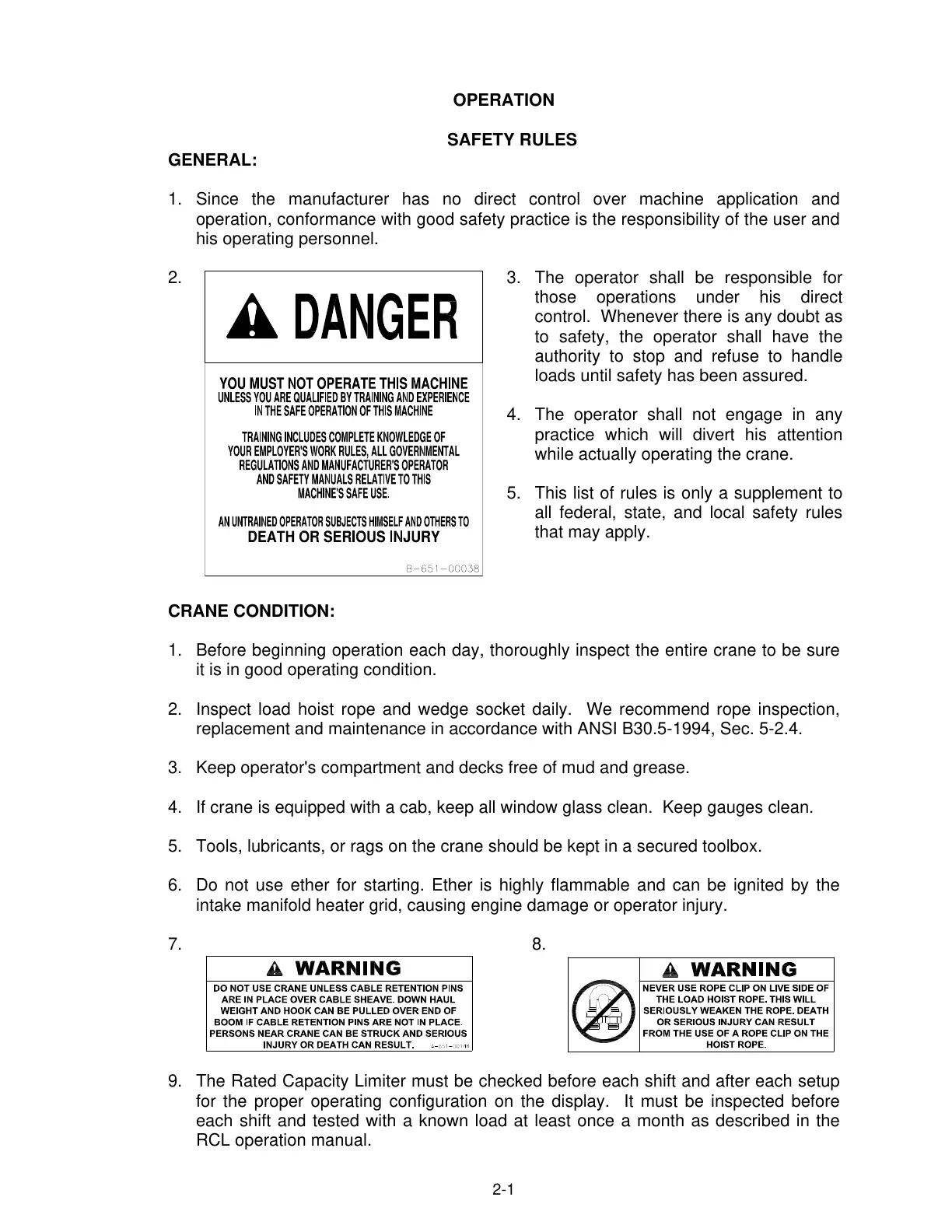
2.
3. The operator shall be responsible for
those operations under his direct
control. Whenever there is any doubt as
to safety, the operator shall have the
authority to stop and refuse to handle
loads until safety has been assured.
4. The operator shall not engage in any
practice which will divert his attention
while actually operating the crane.
5. This list of rules is only a supplement to
all federal, state, and local safety rules
that may apply.
CRANE CONDITION:
1. Before beginning operation each day, thoroughly inspect the entire crane to be sure
it is in good operating condition.
2. Inspect load hoist rope and wedge socket daily. We recommend rope inspection,
replacement and maintenance in accordance with ANSI B30.5-1994, Sec. 5-2.4.
3. Keep operator's compartment and decks free of mud and grease.
4. If crane is equipped with a cab, keep all window glass clean. Keep gauges clean.
5. Tools, lubricants, or rags on the crane should be kept in a secured toolbox.
6. Do not use ether for starting. Ether is highly flammable and can be ignited by the
intake manifold heater grid, causing engine damage or operator injury.
7. 8.
9. The Rated Capacity Limiter must be checked before each shift and after each setup
for the proper operating configuration on the display. It must be inspected before
each shift and tested with a known load at least once a month as described in the
RCL operation manual.
Courtesy of Crane.Market








 To Next Page