similar way
to
the
human brain.
The
German
Standard
DIN
45
633
Part 2
and
the
I
EC
draft
for
the
extension
of
Pub I ication
179
have been
attempts
to
make these specifications, and no fundamental differences exist
between
the
two
recommendations.
The
main
points
of
the
IEC
draft
are summarised
below:
Impulse
Sound
Level Meters must have
the
same characteristics and
response
to
steady sinusoidal signals as Precision
Sound
Level Meters
described
in
IEC Publication 179.
To
safeguard against harmonic
distortion
caused by
the
overdriving
of
amplifiers
by
the
peaks
of
high crest
factor
signals, overload indicators
should be placed
at
the
amplifier stage prior
to
a filter and
at
the
input
to
the
meter rectifier.
The
minimum crest factor capability
of
the
rectifier circuit
is
specified
as 5.
Response
time
constant
of
the
rectifier should
be
35
msec.
±0.5
msec.
The
rise
time
of
this storage circuit must be less
than
that
of
the
recti-
fier.
The
recommendation also lays
down
the
test
procedure which should
be employed
in
checking
the
compliance
of
an instrument with
these
requirements.
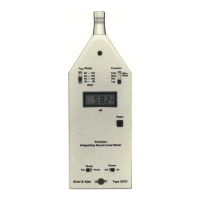
It can be seen,
that
an Impulse
Sound
Level Meter
is
an instrument
that
approximates
a subjective impression
of
a
short
duration
sound. It
cannot
be used
for
the
objective analysis
of
shocks and
other
pulses, which
must
be
analysed
in
a conventional manner.
1.3. FREQUENCY WEIGHTING NETWORK D
Since
the
introduction
of
the
Perceived Noise Level scale (PNdB)
by
Kryter
in
1959 (Ref.
1-
developed
by
Ref. 2), it has been used in
the
field
of
aircraft noise with considerable success. Evaluation
of
the
perceived noise
level
of
a side spectrum noise involves weighting an octave band analysis
of
the
noise according
to
a set
of
equal noisiness
contours,
and adding
the
weighted level according
to
a rule suggested by Stevens (Ref. 3).
The
equal
noisiness
contours
were built
on
subjective assessments of
the
noisiness
of
bands
of
noise with
width
equal
to
the
critical bands
of
the
ear. Their scale
of
units,
"Noys",
is
the
analogue
of
the
pure
tone
loudness scale
of
Sones,
and PNdB
is
the
analogue
of
loudness level, Phons. One Noy
is
the
7


 To Next Page
 Loading...