SAFETY STANDARD
OPERATOR MANUAL 14
stop in a safe manner.
Travel with load-engaging means or load low and, where possible, tilted back. Do not elevate
the load except during stacking. This does not apply to trucks that are intended normally to be
operated with the load or load-engaging means elevated.
Make starts, stops, turns, or direction reversals in a smooth manner so as not to shift load
and/or overturn the truck.
Do not indulge in stunt driving or horseplay.
Slow down for wet and slippery floors.
Before driving over a dockboard or bridge plate, be sure that it is properly secured. Drive
carefully and slowly across the dockboard or bridge plate, and never exceed its rated capacity.
Do not drive trucks onto any elevator unless specifically authorized to do so. Verify the
combined weight of the powered industrial truck including the battery and the load does not
exceed the maximum floor capacity of the elevator before entering. Do not exceed the capacity
of the elevator. Approach elevators slowly, and then enter squarely after the elevator car is
properly leveled. Once on the elevator, neutralize the controls, shut off power, and set brakes. It is
advisable that all other personnel leave the elevator before truck is allowed to enter or leave.
Avoid running over loose objects on the roadway surface.
When negotiating turns, reduce speed to a safe level consistent with the operating
environment. Make the turns smoothly. Except when maneuvering at a very low speed, turn the
steering control at a moderate, even rate.
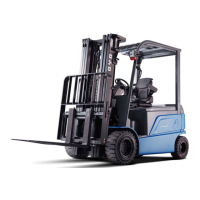
The operation of a counterbalanced, center control, high lift truck with a sit-down, nonelevating
operator requires special safety considerations, as follows:
1. An industrial truck, loaded or unloaded, may tip over if an operator fails to slow down to
a safe speed before making turns. Indications that a truck is being driven at an excessive
speed during turning maneuvers include
(1) tire skidding
(2) truck side sway
(3) wheel lift
(4) the need to grip the steering wheel tightly to keep from sliding out of the seat
2. The likelihood of lateral tipover is increased under any of the following conditions, or
combinations of them:
(1) overloading
(2) traveling with the load elevated
(3) braking or accelerating sharply while turning
(4) rearward tilt or off-center positioning of the load
(5) traveling on an uneven surface
https://www.forkliftpdfmanuals.com/



 To Next Page