Note: Sentinel will only discipline if the disciplining source selected is producing a valid disciplining output and
so Internal Reference Disciplining Mode can be left to
Always
even if the source is not available. If
the source is re-connected during a measurement, then there may be a phase shift in the timebase
reference.
GNSS
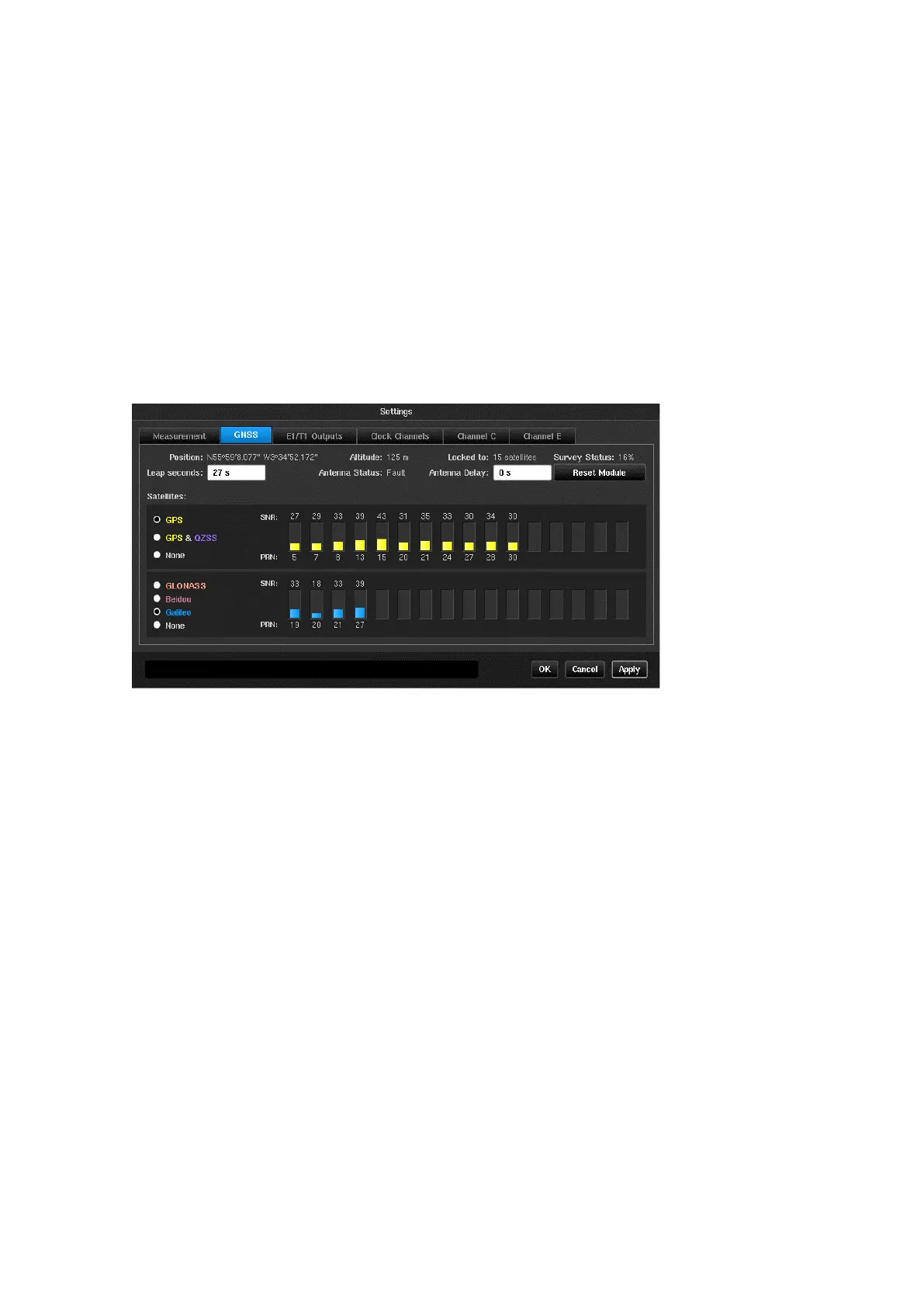
This page allows selection of GNSS constellation and displays general GNSS information received: position,
altitude, number of satellites that receiver is locked to, antenna status and signal levels for all visible satellites.
The top constellation selection determines whether GPS is used and if GPS is selected, whether QZSS is also
used. If GPS is not selected, a constellation must be selected in the lower selection area. For multi-constellation
operation, select GPS or GPS and QZSS and a secondary constellation.
Press Apply. This will cause the GNSS module to reset and begin a new site survey using the new
constellation(s).
NOTE: Changing constellations will cause the Rb timebase to unlock and it may experience a step input from
the GNSS 1 PPS output. It is recommended that Sentinel remains disciplining to GNSS for at least 6
hours after changing constellations. This period should be at least 12 hours if Sentinel has not been
disciplined for more than a week.
Satellite SNR status is shown in the same colour as the text in the constellation name. The Locked to status
displays the total number of locked satellites over all selected constellations.
GPS, Galileo and Beidou satellites transmit information that allows Sentinel to calculate the number of leap
seconds that have occurred, and this is used to determine the offset between TAI and UTC. The Leap seconds
value is updated automatically whenever this information is received.
GLONASS does not transmit leap second information and the Leap seconds must be manually entered if the
current value is not correct. PTP uses TAI as the time base for its timestamps and if the Leap seconds value is
incorrect it will show as whole seconds of offset in the FwdPDV, RevPDV and 2WayTE graphs.
Survey status shows progress of the GNSS receiver site survey.
Reset Module allows the GNSS receiver to be reset.
Antenna Delay setting is used to compensate for antenna cable length.
NOTE: Support for multiple GNSS constellations is dependent on the correct revision of GNSS module hardware
being fitted. If, after installing R9.1, no additional constellations can be configured then please submit a problem
report to support@calnexsol.com requesting information on whether multi-constellation operation can be added.


 To Next Page