50 ARGO Digital Broadcast IP Production Console
Connection Information
Testing / certification
Calrec strongly recommend that all IP
network cabling is properly tested or
certified prior to on-site commissioning of
the system. Simple test devices that only
check the pin-out of the terminations are
not sufficient to prove the performance
and reliability of high speed data cabling.
Certification level test equipment can give
a simple pass / fail response but in doing
so will test various important factors as
well as pin-out.
Slide on outer boots offer additional
strain-relief protection but are not
sufficient on their own. In order to be able
to crimp the cable jacket inside the RJ45
and land the data cores on the terminals,
the amount that the jacket is stripped
back in relation to the cores needs to be
quite accurate. Cables with exposed data
cores should not be used as they will be
unreliable.
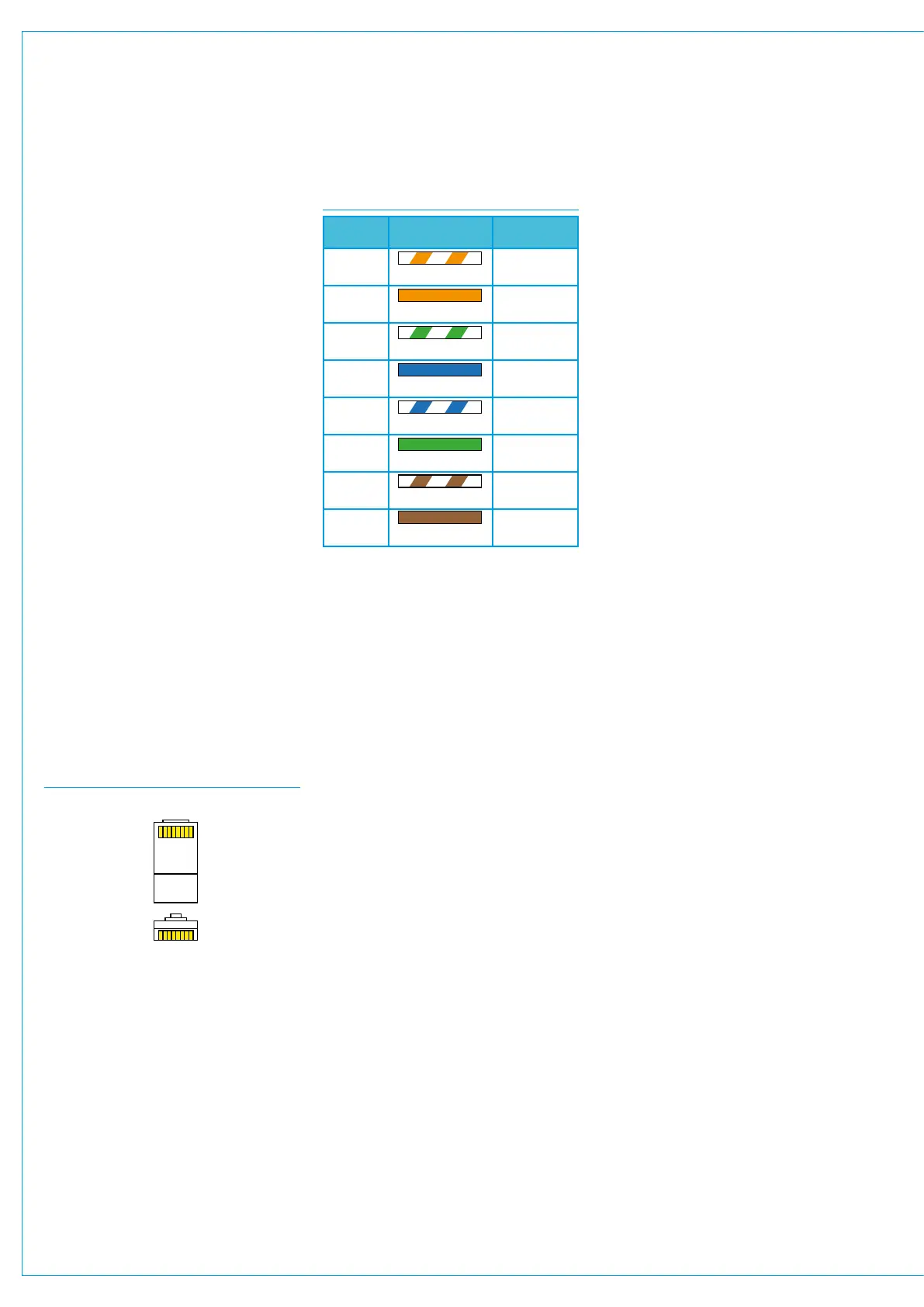
Termination - pin-out
IP network cables use the standard
gigabit ethernet pin-out. Performance
relies on the positive and negative leg
of each signal pair using cores that are
twisted together. Calrec recommends
that 'straight-through' or 'pin-for-pin'
cables are used. 'Cross-over' style
cables can be used, however they must
be gigabit standard cross-over. Older
pin-outs, designed for use with slower
ethernet standards only use two of the
four pairs, even though all four pairs are
terminated. Cross-over variants of this
style only cross the pairs that are used (A
& B). Gigabit cross-over cables require
that the blue (C) pair is crossed with the
brown (D) pair as well as the orange (A)
pair being crossed with the blue (B) pair.
STANDARD RJ45 PIN-OUT
Pin Colour Signal
1
Orange-White
A+
2
Orange
A -
3
Green-White
B+
4
Blue
C+
5
Blue-White
C -
6
Green
B -
7
Brown-White
D+
8
Brown
D -
Top
Front
RJ45 PIN NUMBERING
• For standard wiring, both
ends of the cable should be
terminated as above
Certification type tests include
determining cable length, measuring skew
(timing differences between pairings
due to variations in length caused by
intentional differences in twist rate),
measuring for loss, signal to noise ratio
and BERT error checking on data.
Cables that fail certification tests or fail
to perform, may appear to function fine
in other applications, such as a PC LAN
connection where errors leading to retries
and therefore delays are acceptable and
often unnoticed.
Temporary / reusable cables
Cabling that is not part of a permanent
infrastructure, such as temporary runs
used for outside broadcasts should be
carefully coiled and uncoiled to avoid
kinking and they should be regularly
tested. Cables showing any sign of
damage should be replaced.



 To Next Page