EasyManua.ls Logo

Canon UC800 - Condensation Prevention and Handling

Canon UC800
56 pages
Print Icon
To Next Page IconTo Next Page
To Previous Page IconTo Previous Page
Loading...
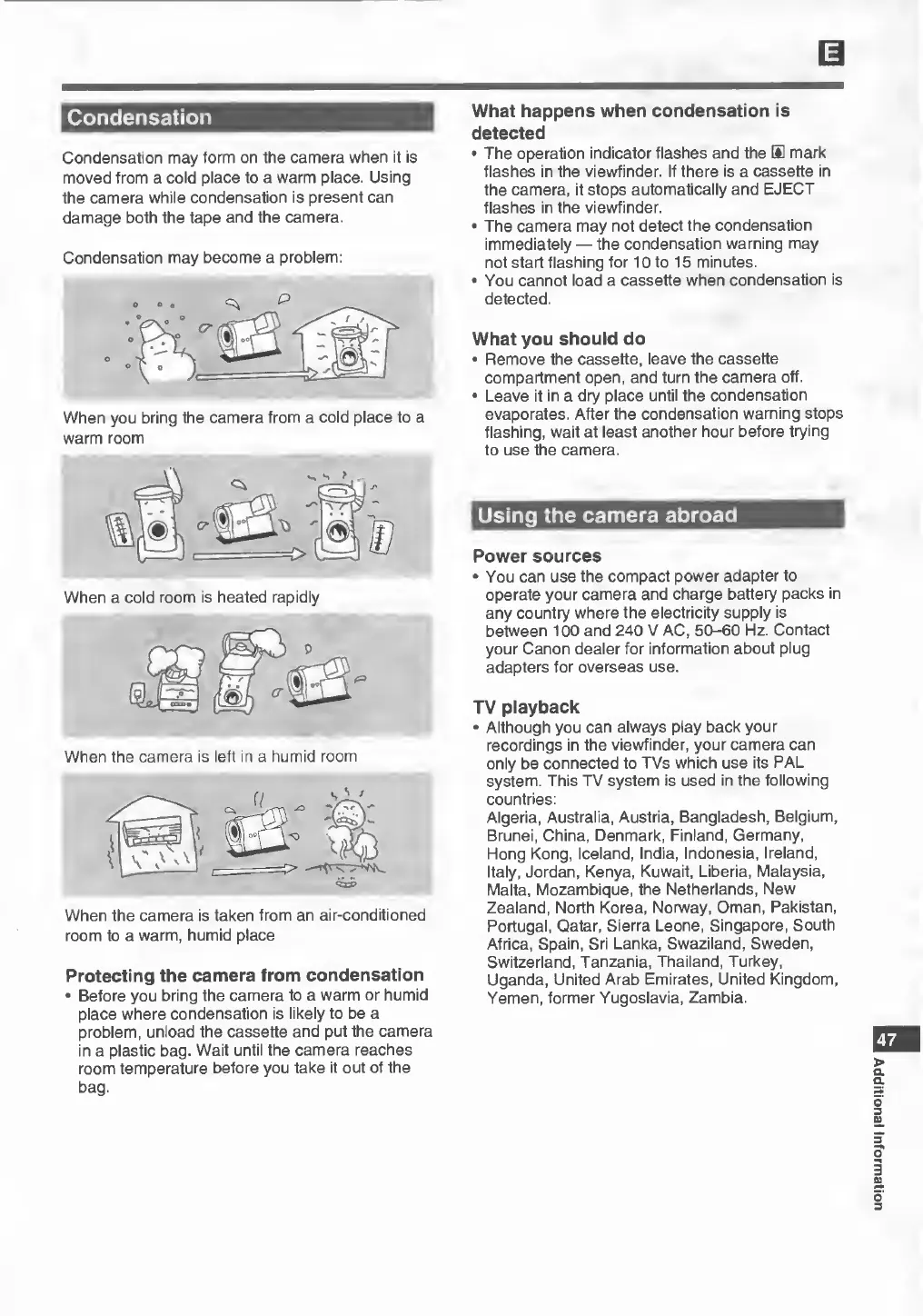
Condensation
Condensation
may
form
on
the
camera
when
it
is
moved
from
a
cold
place
to
a
warm
place.
Using
the
camera
while
condensation
is
present
can
damage
both
the
tape
and
the
camera.
Condensation
may
become
a
problem:
When
you
bring
the
camera
from
a
cold
place
to
a
warm
room
When
a
cold
room
is
heated
rapidly
When
the
camera
is
left
in
a
humid
room
When
the
camera
is
taken
from
an
air-conditioned
room
to
a
warm,
humid
place
Protecting
the
camera
from
condensation
•
Before
you
bring
the
camera
to
a
warm
or
humid
place
where
condensation
is
likely
to
be
a
problem,
unload
the
cassette
and
put
the
camera
in
a
plastic
bag.
Wait
until
the
camera
reaches
room
temperature
before
you
take
it
out
of
the
bag.
What
happens
when
condensation
is
detected
•
The
operation
indicator
flashes
and
the
ffi
mark
flashes
in
the
viewfinder.
If
there
is
a
cassette
in
the
camera,
it
stops
automatically
and
EJECT
flashes
in
the
viewfinder.
•
The
camera
may
not
detect
the
condensation
immediately
—
the
condensation
warning
may
not
start
flashing
for
10
to
15
minutes.
•
You
cannot
load
a
cassette
when
condensation
is
detected.
What
you
should
do
•
Remove
the
cassette,
leave
the
cassette
compartment
open,
and
turn
the
camera
off.
•
Leave
it
in
a
dry
place
until
the
condensation
evaporates.
After
the
condensation
warning
stops
flashing,
wait
at
least
another
hour
before
trying
to
use
the
camera.
Using
the
camera
abroad
Power
sources
•
You
can
use
the
compact
power
adapter
to
operate
your
camera
and
charge
battery
packs
in
any
country
where
the
electricity
supply
is
between
100
and
240
V
AC,
50-60
Hz.
Contact
your
Canon
dealer
for
information
about
plug
adapters
for
overseas
use.
TV
playback
•
Although
you
can
always
play
back
your
recordings
in
the
viewfinder,
your
camera
can
only
be
connected
to
TVs
which
use
its
PAL
system.
This
TV
system
is
used
in
the
following
countries:
Algeria,
Australia,
Austria,
Bangladesh,
Belgium,
Brunei,
China,
Denmark,
Finland,
Germany,
Hong
Kong,
Iceland,
India,
Indonesia,
Ireland,
Italy,
Jordan,
Kenya,
Kuwait,
Liberia,
Malaysia,
Malta,
Mozambique,
the
Netherlands,
New
Zealand,
North
Korea,
Norway,
Oman,
Pakistan,
Portugal,
Qatar,
Sierra
Leone,
Singapore,
South
Africa,
Spain,
Sri
Lanka,
Swaziland,
Sweden,
Switzerland,
Tanzania,
Thailand,
Turkey,
Uganda,
United
Arab
Emirates,
United
Kingdom,
Yemen,
former
Yugoslavia,
Zambia.
47
Additional
Information