CEBORA S.p.A. 5
3.302.002 03/08/00
2 - SYSTEM DESCRIPTION
2.1 - Introduction.
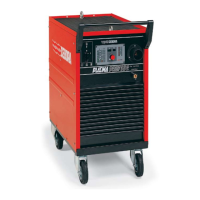
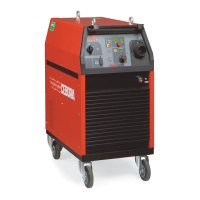
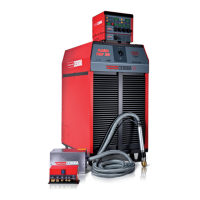
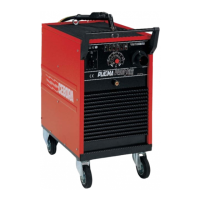
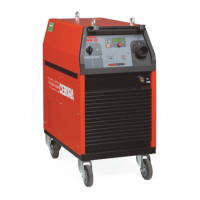
The PLASMA PROF 162 is a plasma arc system for cutting electrically conductive materials,
which includes the electronic power source art. 952, and a set of torches and accessories, for use
in both manual applications and automated systems (see list in Sales Catalogue).
The power source is controlled by a microprocessor circuit, which manages the operative
functions of the cutting system and operator interface.
2.2 - Technical specifications.
To verify the technical specifications, see the machine plate, Instruction Manual, and Sales
Catalogue.
2.3 - Description of power source art. 952.
Art. 952 is a direct current power source with controlled current, consisting of a three-phase
rectifier bridge and a DC/DC (Chopper) IGBT converter.
Referring to the electrical diagram in par. 5.1, the drawing in par. 4.1 and table 4.2, we can
identify the main blocks that make up the power source.
The switch (60) acts on the service transformer (8), which powers the electronic boards and
internal services through the fuse board (8).
The power transformer (79) has the primary circuit consisting of six windings which,
appropriately switched by the voltage change, allow the power source to function at 230, 400 or
440 VAC at 50/60 Hz. Near the main voltage change is also the voltage change of the service
transformer (8).
From one of the primary circuit windings comes the voltage, always 230 VAC, for the fan
(77) and the socket (21) for the cooling unit art. 1339.
The transformer (79) is powered via the remote switch (5), which is closed by the control
board (62), once the DC capacitor (40) has been pre-charged and the transformer itself pre-
magnetized.
The rectifier bridge (78), which powers the DC capacitor (40) and the IGBT module (72), is
connected to the secondary circuit of the transformer (79).
Inside the module (72) is the switching element, the IGBT, and the recirculation diode,
connected in a “Chopper” configuration.
The snubber board (75), mounted alongside the module (72), contains the RC IGBT
protection network.
At the negative output (1) of the module (72) is connected the choke (43), to level the arc
current. Next is connected the secondary circuit of the HF transformer (69) to light the pilot arc.
At the positive output (3) of the module (72) are connected the resistor (74) and the coil with
reed (14). The resistor (74) generates the potential difference needed to switch from pilot arc to
transfer arc, while the reed (14) detects the passage of the transfer arc current and provides this
information to the control board (62).
The Hall-effect current transducer (71) is inserted on their connector cable. It sends the
current reaction signal to the driver board (9) to stabilize the cutting current.
By effect of the signal from the reed (14), the control board (62) opens the remote switch (18),
closed during the pilot arc phase, to stabilize the maintained transfer arc and eliminate
unnecessary dissipation of energy on the resistor (74).



 To Next Page