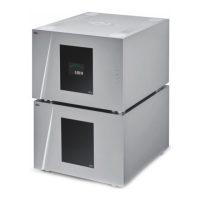
(1) Output coil for HF immunity
(2) Argento Audio speaker terminals
(3) Monaural analog input boards (each A1 can be equipped with 1 or 2 such boards)
(4) Mains switch and power cord receptacle
(5) USB (firmware update) and RJ-45 (control) board
(6) Adjustment shafts and screws
(7) Power supply regulation boards
(8) Heatsink-mounted monaural amplifier boards
(9) User interface buttons
(10) Rectifying diode bridges, mounted onto the front panel
(11) Custom rectifying capacitors
(12) Main analog star-ground oxygen-free copper plate
(13) AMOLED display (on front panel)
(14) Standby power transformer (ensures green mode Standby)
(15) Main power transformer
1.1 Unmatched flexibility
The A1 offers unmatched system integration flexibility. Not only does it provide multiple modes of operation (stereo, mono,
bridged and active or passive bi-amp) but is also provides adjustments to match speaker impedance and sensitivity through
feedback and gain controls. Operating modes can be selected by the user from the A1's front panel. In addition, multiple A1s can
be daisy-chained for ultimate performance in multi-amplification systems.
1.1.1 Operation modes
The A1 integrates two power amplification channels and provides the option to support a single or dual input boards. In its default
configuration, the A1 is delivered with a single input board and provides following modes of operation:
• Bridge mode: In this mode, the A1 operates as a very high power mono power amplifier, where both amplification
channels are used in balanced mode for a single audio channel. When configured in Bridged Mono Mode, the A1 can
deliver up to 350 W under 8 Ohm. It is optimal for high impedance speakers in large rooms, requiring large voltage
swings.
• Monaural mode: In this mode, the entire power of the transformer is dedicated to a single output channel. In Left or
Right Mono Mode, the A1 can deliver 550 W under 1 Ohm. It is optimal for low impedance speakers, requiring large
amount of current.
• Passive bi-amplification mode: In this mode, the A1 operates its two power amplification stages in parallel, each channel
driving a different speaker terminal with the same signal. Feedback and gain can be adjusted independently for each
channel to best match the individual speaker sections. In Passive Bi-Amp Mode, each channel delivers 100 W under 8
Ohm. It is optimal with speakers with more than one binding post pair on its passive crossover filter network.
By adding a second input board, the A1 provides following additional operating modes:
• Stereo mode: In Stereo Mode, each amplification stage is driven by its dedicated input board and the amplifier operates
as a standard stereo power amplifier. Feedback and gain settings are shared among both amplification channels and the
8 A1 User Manual Rev 2.0



 To Next Page