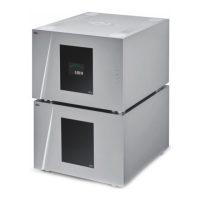
A1 delivers 100 W under 8 Ohm per channel. It is the configuration used when a single A1 drives a pair of speakers.
• Active bi-amplification mode: As for Stereo Mode, Active Bi-Amp Mode links each amplification stage to its dedicated
input board. Feedback and gain can however be adjusted individually for each channel in order to best match the
requirements of each driver. An active cross-over is generally used to split the signal into different frequency bands
between the system controller/preamplifier (such as CH Precision's L1) and the power amplifiers. In the Active Bi-Amp
Mode, the A1 delivers 100 W under 8 Ohm on each channel. It is optimal if the speaker has an external active crossover
filter network.
1.1.2 Feedback control
One of the A1's most unique features is its user controllable feedback. This feature provides control over the ratio between global
and local feedback applied in the A1's amplification stage. Global feedback takes a portion of the output signal after the power
stage and feeds it back to the input of the amplifier. This ensures a very low output impedance and low distortion figures. Local
feedback, on the other hand, does not include the output stage and lets the latter operate in open loop mode. This favors small
signal details and timing. As a rule of thumb, a higher ratio of global feedback is preferred for grip and control in the low
frequencies whereas a lower ratio is preferred for speed and details in the high frequencies. This rule is however not absolute as
each speaker and cross-over are different and we highly recommend to try out various settings to find the best match with the
connected loudspeakers, especially if the A1 is driving a complete full bandwidth loudspeaker. In multi-amplification systems,
different feedback settings are commonly used for the various speaker sections opening a whole new level of performance. We
recommend to start with pure local feedback and increase the global feedback until the bass are tight enough for your personal
taste. Feedback settings can be adjusted on the fly from the A1's front panel.
1.1.3 Gain control
The A1 provides an integrated gain control with a 24 dB range and 0.5 dB steps. This gain control allows for optimal matching of
speaker sensitivity, room size, and preamplifier output level. In multi-amplification systems it can be used to match the sensitivity
of the individual speaker sections. Gain is conveniently accessed by a front panel control and can be set on the fly.
1.1.4 Bias adjustment
The A1 provides an advanced bias control circuitry that not only follows slow temperature variations, but also accurately takes into
account all the dynamic aspects induced by transients in the musical content.
1.2 Advanced monitoring circuit
1.2.1 Power monitoring
Each power amplifier board is equipped with a DSP that monitors the instantaneous voltage and current output of each A1's
channel. Both values are sampled at around 100 kHz, ensuring peak values are properly detected. This circuitry has several
purposes: give the user a feedback of the peak power fed to the speakers, and detect malfunctions such as short-circuits or
amplifier damage.
Rev 2.0 A1 User Manual 9



 To Next Page