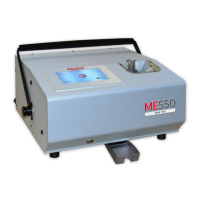
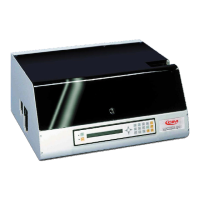
The ME1500 is an automatic feeder embossing and punching machine designed for metal plates, primarily used for the identification of industrial products. It operates under the control of a microprocessor, which manages internal counters and stores data such as formats and text in an onboard CMOS memory. A small backup battery ensures that all stored information is retained even when the machine is switched off, allowing for immediate use upon power-up.
Function Description:
The ME1500 system can operate in two primary modes:
- Operator Mode (On-Line): In this standard mode, embossing commands are transmitted from a Host Computer via a USB to serial interface (using a virtual COM port). The embossing layout is defined on the Host Computer using the dedicated CIM software named "Powertag."
- Setting Mode (Off-Line): This mode is designed for testing, setting, and advanced operations, making it suitable for expert operators or technical personnel. It allows for setting up formats and producing plates directly from the machine without requiring a computer or software. Commands are transmitted via a keyboard connected to the rear panel DIN connector. This mode enables modification of setup parameters and execution of pre-defined jobs (CARD TEST) to verify settings and functionality. The LCD edit instructions are used for plate production in this mode.
Upgrade Firmware:
The machine features a service port on the rear panel, allowing for easy firmware upgrades at any time through a few simple operations.
Important Technical Specifications:
- Power Supply:
- 117V 60Hz (Power Absorbed: 900W, Current Max: 8A)
- 230V 50Hz (Power Absorbed: 600W, Current Max: 8A)
- Fuses: (2) 5x20 mm, 10A
- Logic: Microprocessor, 8-bit
- Backup Power: Lithium Battery 3.6V
- PC Interface: USB to RS232
- Working Noise: Lower than 75 dB (A) (measured at 1m distance, 1.60m height during normal working use).
- Installation Category: II
- IP Protection: IP 20
- Standard Reference: IEC EN 61000-6-2, IEC EN 61000-6-3, IEC EN 60950-1, IEC EN 60204-1
- Operating Temperature: +5°C to +40°C
- Operating Humidity: 30% to 90%
- Operating Altitude: 1000m
- Transportation and Storage Temperature: -25°C to +55°C
- Dimensions: Height: 425mm, Width: 730mm, Depth: 750mm
- Weight: 85kg
- Performance: 1 plate in 28 seconds (45 characters)
- Input Hopper Capacity: 390 plates (0.4mm) variable dimensions
- Dot Density: 300dpi
- Output Hopper Capacity: Manual + dividers for plates type
- Plate Dimensions: Width: min. 30mm - max 115mm, Height: min. 21mm - max. 90mm, Thickness: 0.4 - 1.0mm
- Embossing Area: Up to 65mm from the top edge of the plate, leaving 4mm from the bottom. Measurements are defined according to the base of the character.
- Standard Fonts: Simplex 2: Blocco USA; Blocco 5mm; Embossing or Indenting.
- Software/Firmware: Powertag PC application proprietary software. Automatic date/time, plate archive, DBF, DBN, Excel, MS Access file compatibility. Self-diagnostic, automatic repetition of faulty plate personalization, clearable and nonclearable counters, setup procedures (via external keyboard).
- Available Options: Drum capacity 60 Char.
Usage Features:
- Unpacking and Installation: The machine is delivered in a wooden packing case, weighing approximately 122kg, requiring two persons or a forklift for displacement. Unpacking involves removing side screws, lifting the machine, and removing cellophane and internal elastic bands. Accessories include a power supply cable, USB cable, software/manual on flash drive, and keys for the front cover and software hardlock.
- Electrical Connections: The rear control panel provides sockets for USB, power supply (PA80), identification plate, key selector (for technical use), 5-pole DIN for keyboard, and serial service port. It's crucial to connect the USB cable and power supply cable when the machine is switched off to prevent circuit damage. The machine must be earthed to a ground circuit conforming to national standards.
- Working Place: The machine should be installed at a height of at least 0.6m, with at least 0.3m clearance from walls or barriers for air conditioning and access. The support surface must be strong enough to hold 85kg and stable to prevent noise amplification.
- Switching On: After installation, switch on the machine. A graphics initialization will occur, followed by a "E-00 POWER ON STAND BY STATUS - PRESS START" message. Pressing the START key initiates a general reset, leading to a "ME1500 V.Y.YY READY" message, indicating the machine is ready.
- Operator Console: The front panel features an LCD display (2 rows, 40 characters each) and two buttons:
- PAUSE/START: Switches between normal operating mode and pause, and resets errors.
- RETRY: Retries the last operation after an error.
- Stored Configuration: LCD EDIT format and SETUP configuration parameters are stored in memory with a lithium backup battery. A "BATT LOW" alarm indicates low battery, which should be replaced with the same or equivalent type to avoid data loss and explosion risk.
- Producing a Plate: Before production, the internal devices (loader, unloader, embosser) must be adjusted to the plate sizes. The front panel opens with a key to access these units.
- Loader Adjustment: Black knobs on the right side adjust the right support for plate tolerance. Wing knobs adjust rear supports. Four knobs adjust gate height to prevent feeding multiple plates.
- Embossing Pressure Adjustment: The machine is factory-configured for 0.5mm aluminum plates. For steel or thicker plates, pressure needs to be increased by loosening a nut, turning a knob clockwise, and then retightening. Decreasing pressure involves turning the knob anti-clockwise. This adjustment should ideally be done by qualified personnel or Technical Support.
- Off-Line Mode (LCD EDIT): An external keyboard allows off-line embossing. Operators can create and store up to 20 formats (00-19), each with an 8-character name. Format "01" is the default for off-line use. Data entry is done via the keyboard.
- Format Menu: Accessed by pressing F2, displays stored formats.
- Format Change: Allows selecting and editing formats.
- Emboss Data Entry: Data is entered field by field. The F10 key initiates embossing.
- Edit Embossed Plates: The last embossed plate's data can be recalled (F1) and edited.
Maintenance Features:
- Scheduled Lubrication:
- Load and unload unit: Every 100 hours
- Carriage unit: Every 100 hours
- Embossing unit: Every 100 hours
- Motor embossing unit: Every 12,000 hours
- Recommended Lubricants:
- Oils: Sewing machine oil, 70/50 friction reducer, 3-in-1 oil or equivalent.
- Grease: High heat lithium complex grease (red or white).
- General Maintenance by Operator:
- Carriage Clamp Oiling: Every six months (for 8 hours/day operation), use vaseline oil to lubricate the clamp's guide (top and bottom) and the carriage guide. Oil the motor pulley.
- Plate Loader Oiling: Oil the holes of the plate loader group every 20 days or every 1500 produced plates.
- Technical Maintenance: These operations should only be performed by technical personnel.
- Oiling the Jaws: Oil the red-painted holes around the jaws group of the embosser, including points behind the jaws (using a long spout). Grease the cams.
- Lubricating the Motor Pulley Bearing: Lubricate the bearing in the motor pulley with very light grease.
- Safety Interlock Switch Functional Test: Before each work session, open the top cover to verify the machine switches to PAUSE mode. If it doesn't, the interlock switch is damaged, and service should be called.
- Reset of Parameters: In case of electrical disturbances causing errors, parameters can be reset to default values using specific key sequences (F10 - Right Arrow - F5 - F5 for configuration parameters; F10 - Down Arrow - Start - Start for all other parameters and memory). Manual restoration of mechanical parameters from sample plates is required after a reset.
- Displaying Counters: The machine tracks statistical data through partial and total counters. The partial counter can be reset.
- Card Tests: A keyboard connected to the rear DIN connector allows for various card tests (0: all characters, 1: "L" in each angle, 5: all machine setup values, 6: CIM fixed text).
- Reset of the Machine: A general machine reset can be performed at any time using the key sequence F10 - ESC - ESC.
Safety Instructions:
The ME1500 complies with safety requirements, but operators must be aware of potential hazards. The top cover prevents contact with moving parts and has a mechanical switch to stop the machine if opened. Damaged safety systems require immediate shutdown and service. Remote control operation (via PC) necessitates maximum attention when accessing dangerous areas. High voltage parts are enclosed and protected. It is strictly prohibited to remove or modify enclosures and internal protections. Maintenance should only be performed by specialized and authorized technical personnel, except for simple general maintenance when the machine is stopped and disconnected from power. The machine is not intended for continuous use (max 8-9 hours/day). For 117 VAC applications, it is a "CLASS A" equipment, which may cause radio interference in domestic environments. Operators should wear ear protection if daily noise exposure exceeds 85 dB. The machine should not be installed near other dust-producing machines, and liquids should not be placed on the cover.

 Need help?

 To Next Page
 General