WarmAir
Model 135 Manual OPERATING INSTRUCTIONS
Page 20 of 43
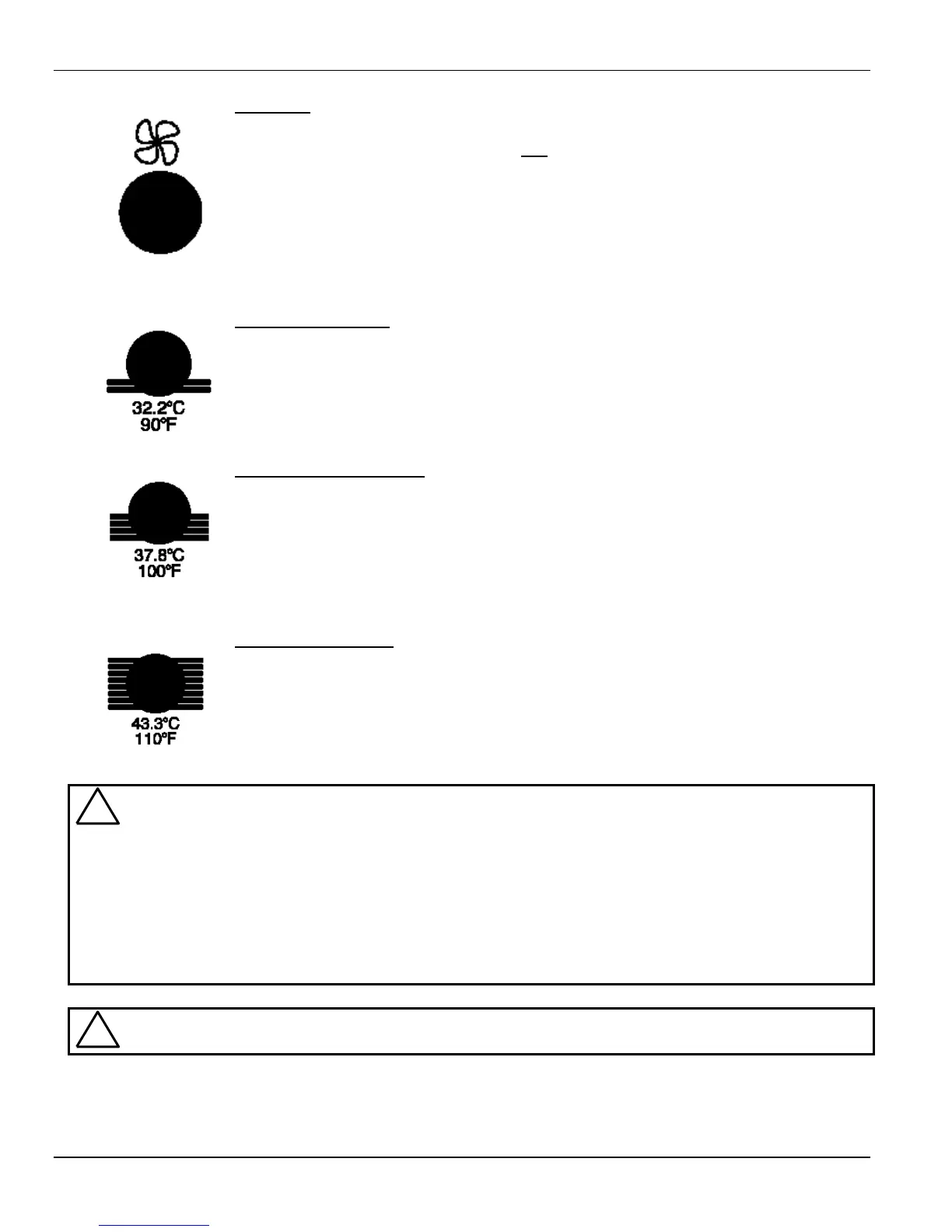
Fan Only Depressing this switch will activate the unit to draw in
ambient room temperature air and deliver it to the patient via the
disposable blanket. The heater will not be activated. The
temperature delivered to the patient will depend on the current
room temperature during operation of the unit. (Air temperature
delivered may be up to three degrees higher than the ambient
temperature due to heat from the blower motor.) The LED will be
activated to indicate that the unit is in the ambient temperature
mode.
Low Temperature. Depressing this switch will activate the unit to
draw in room air, heat the air to 32.2°C +4.0°C/ -2.0°C (90°F
+7.2°F/-3.6°F) and deliver it to the patient via the disposable
blanket. The LED will be activated to indicate that the unit is in the
low temperature mode. The low temperature setting can be used
for long term therapy for temperature maintenance.
Medium Temperature. Depressing this switch will activate the
unit to draw in room air, heat the air to 37.8°C +4.0°C/ -2.0°C
(100°F +7.2°F/-3.6°F) and deliver it to the patient via the
disposable blanket. The LED will be activated to indicate that the
unit is in the medium temperature mode. The medium temperature
setting can be used for immobile patients or for those patients with
poor circulation.
High Temperature. Depressing this switch will activate the unit to
draw in room air, heat the air to 43.3°C +4.0°C/-2.0°C (110°F
+7.2°F/-3.6°F) and deliver it to the patient via the disposable
blanket. The LED will be activated to indicate that the unit is in the
high temperature mode. The high temperature setting is to be used
with close patient observation.
High temperature setting to be used with close patient observation when
treating patients with the following conditions:
a. Significant peripheral vascular disease, occlusive or diabetic in
nature.
b. Low cardiac output.
c. Marginal cutaneous perfusion.
Do not apply heat to lower extremities during arterial cross-clamping.
Thermal injury may occur if heat is applied to ischemic limbs.
Do not attempt to warm patient without a blanket, i.e. with the hose only.
Thermal injury may result.


 To Next Page