results, failure to remove tannin stains or condensation on
glasses. Tannin stains appear to cling to the hard water film
in the drink, which then clings to the surface of the cup or
saucer. With soft water this is not the case.
Some types of hard water do not produce limescale when
heated, but still reduce the performance of washing chemicals, as
mentioned above. This is known as permanent hardness.
Temporary hardness is when the hardness can be largely
removed by conversion into
limescale by boiling.
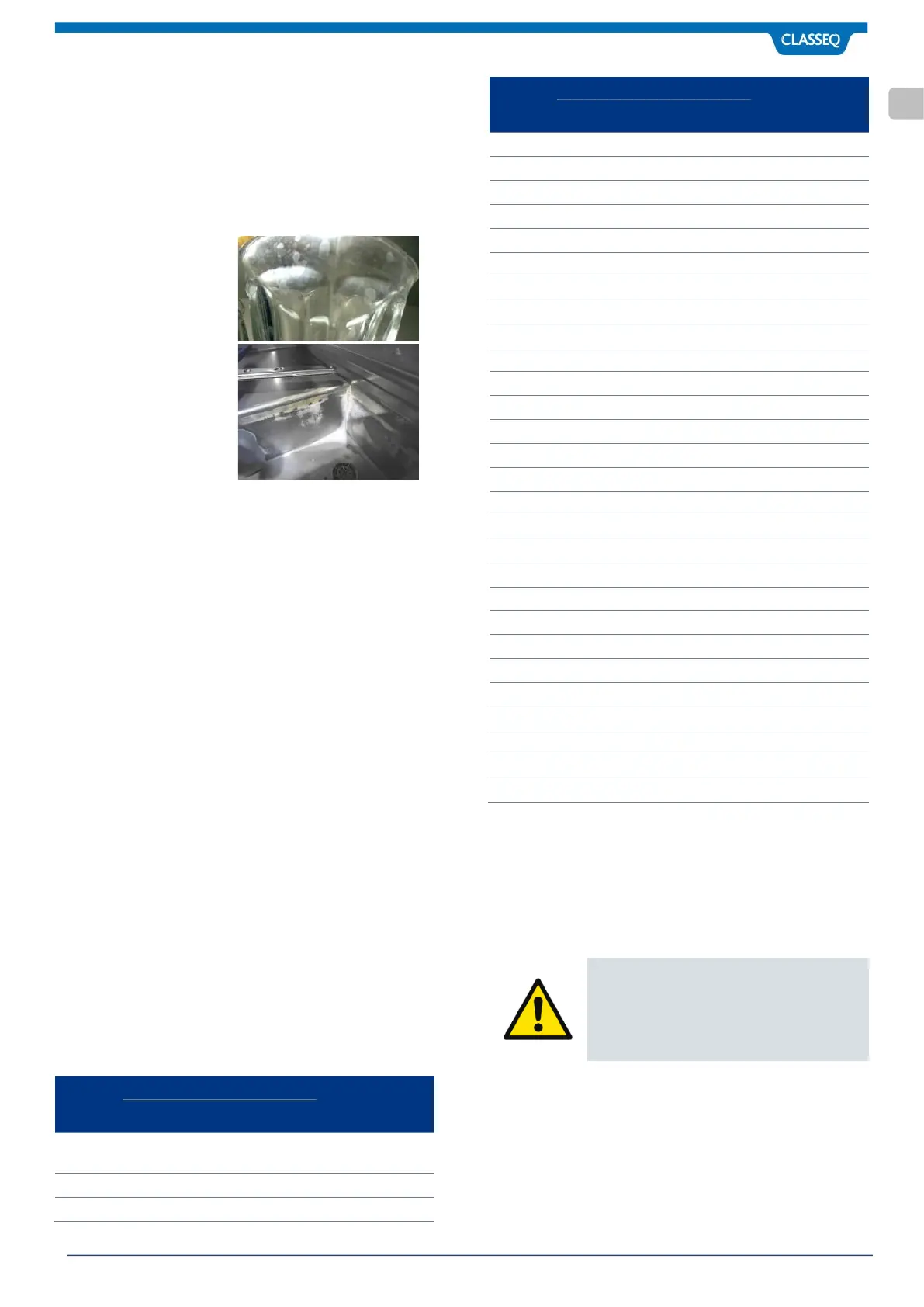
If limescale is produced
inside a warewasher it will
cause several maintenance
problems, for example:
• Coating of heating
elements leading to
slow heating and
eventually, element
failure.
• Blockage of rinse jets,
showing as poor results.
• Wear of bushes in the centre boss, showing as poor results
and possibly wash water passing backwards into the rinse
system.
• Blockage of the rinse aid injection point in the boiler.
• White marks appearing on glasses, dishes, and cutlery.
• Dishes or cups may appear dirty even after a wash.
Especially coffee or teacups.
• Discolouration of the inside of the warewasher, making
cleaning difficult.
• Blockage of hoses due to limescale deposits “furring up” the
inside of the hoses.
When limescale is found, it must be removed with commercial
de-scaling chemicals, used with care in accordance with the
instructions on the product.
The descaling instructions in this manual should always be
followed.
The Rinse Tank is difficult to de-scale and a service engineer may
be required to carry this out.
Your local water board / water supply company should be able to
tell you if the water in your area is hard or soft.
Alternatively, you can establish the hardness of your water supply
yourself using a simple water hardness testing kit.
Water Softener settings:
Your Water Softener needs to be set up to soften the water
supply depending on the water hardness, according to the
following table:
4.5.3 Water supply hose connection
Classeq recommend installing a shut off valve in the mains water
supply line near the warewasher such that it is easily accessible.
Your warewasher is supplied with a new UK Water Regulations
Advisory Scheme (WRAS) approved water inlet hose, requiring a
G¾” (¾” BSP) male threaded connection at the mains water
outlet.



 To Next Page