Classeq Under Counter Range - User Manual
12
Your warewasher must be connected directly to the mains
electricity using the mains electrical cable provided. DO NOT use
electrical extension lead(s) to supply power to your warewasher.
DANGER!
All mains electrical work must be carried out
in accordance with local and national
regulations by a qualified electrician.
4.4.2 Electrical connection specification
Depending on the specification of your warewasher it may be
supplied with or without a moulded mains electrical plug.
When hard wiring the warewasher into the mains outlet, use a
multimeter or voltmeter to ensure that the connection point is
electrically isolated before attempting to make the connections.
4.4.3 Electrical cable specification
If the mains electrical supply cable is damaged or has
deteriorated, it MUST be replaced by a cable or cord assembly
supplied by Classeq, its service agents or suitably qualified
persons to avoid hazards and be to the following minimum
specifications.
Warewasher
rating
(Volts /
Phase /
Amps)
For electrical rating of your warewasher refer to the rating label
(►2.3).
4.4.4 Equipotential bonding
DANGER!
For safety reasons your warewasher MUST be
bonded to adjacent metalwork or earthed so
that it is at the same potential (i.e. voltage).
Consult your distributor, Classeq or a qualified electrician if you
are unsure how to do this.
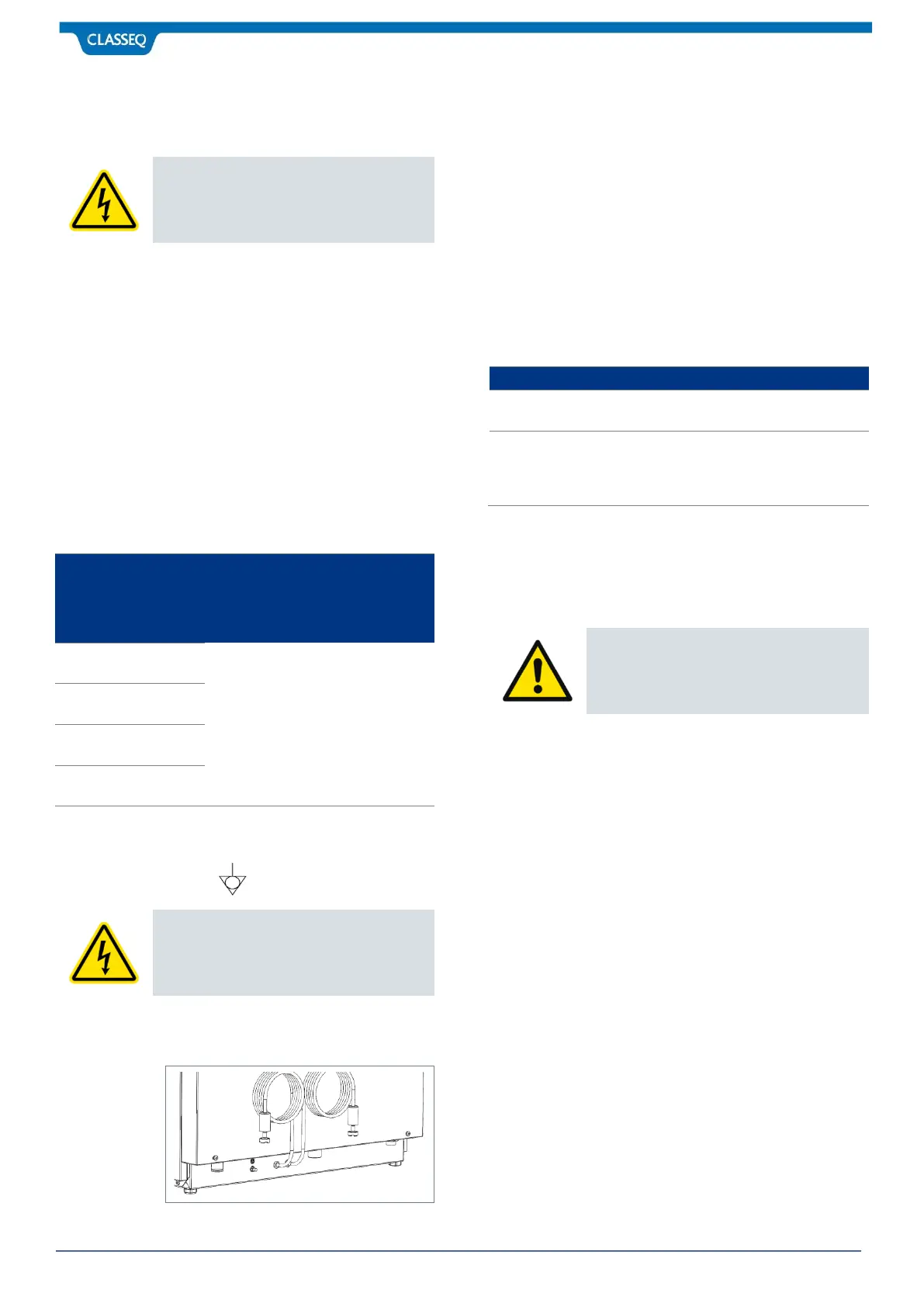
The
equipotential
bonding stud is
located at the
rear of the
warewasher and
is fitted with an
M5 nut. Use the
8mm spanner to connect the bonding wire terminal to this
location and ensure the nut is securely fastened.
4.5 Water Supply and Connection
4.5.1 Water supply restrictions
Commercial warewasher wash results may be affected by
external conditions such as incoming water temperature,
pressure, hardness, and choice of chemicals.
Supply water temperature:
• 4°C minimum
• 55°C maximum
Supply water dynamic pressure:
The dynamic pressure of the water supply will determine
whether your warewasher needs additional equipment to be
installed in the water supply system, as follows:
0 to 2 bar (0 to 200 kPa)
An external rinse booster pump
must be installed
2 to 10 bar (200 to 1000
kPa)
No modifications required -
warewasher can be installed
with a direct hose connection to
the existing water supply.
Minimum supply flow rate:
• With Water Softener: 4 litre/minute.
Water hardness:
Caution
Damage to the warewasher caused by
limescale will NOT be covered by the
manufacturer’s warranty (►0).
For the longevity of your warewasher, and to ensure you get
consistently good washing results, your warewasher must wash
with soft water, i.e., water that contains a low concentration of
ions, in particular ions of calcium and magnesium. There are
three ways to achieve this:
• The supply water must be naturally soft.
• Your warewasher is specified to be fitted with an internal
Water Softener (models C400WS and C500WS).
• Your water supply to the warewasher is from a suitable
external water softener unit.
4.5.2 Water hardness explained
Water hardness occurs because certain chemicals in the rocks
through which the water passes on its way to the consumer
slowly leach out into the water.
The problem shows itself in two forms:
1. When hard water is heated the chemicals come out of the
solution and appear as solid particles (limescale) that are
carried round the warewasher. These particles are formed
most quickly at the hottest part of the warewasher –
typically, the rinse element and the Rinse Tank. Therefore,
the Rinse Tank is the best place to look to judge if limescale
is being formed in a warewasher.
2. Most commercial washing chemicals operate much less
efficiently in hard water, and this will often show as poor



 To Next Page