11
climatemaster.com
Tranquility
®
30 Digital (TE) Series IOM - 60Hz HFC-410A
Rev.: 3 Aug., 2012B
Closed Loop Heat Pump Applications with Internal Flow Controller
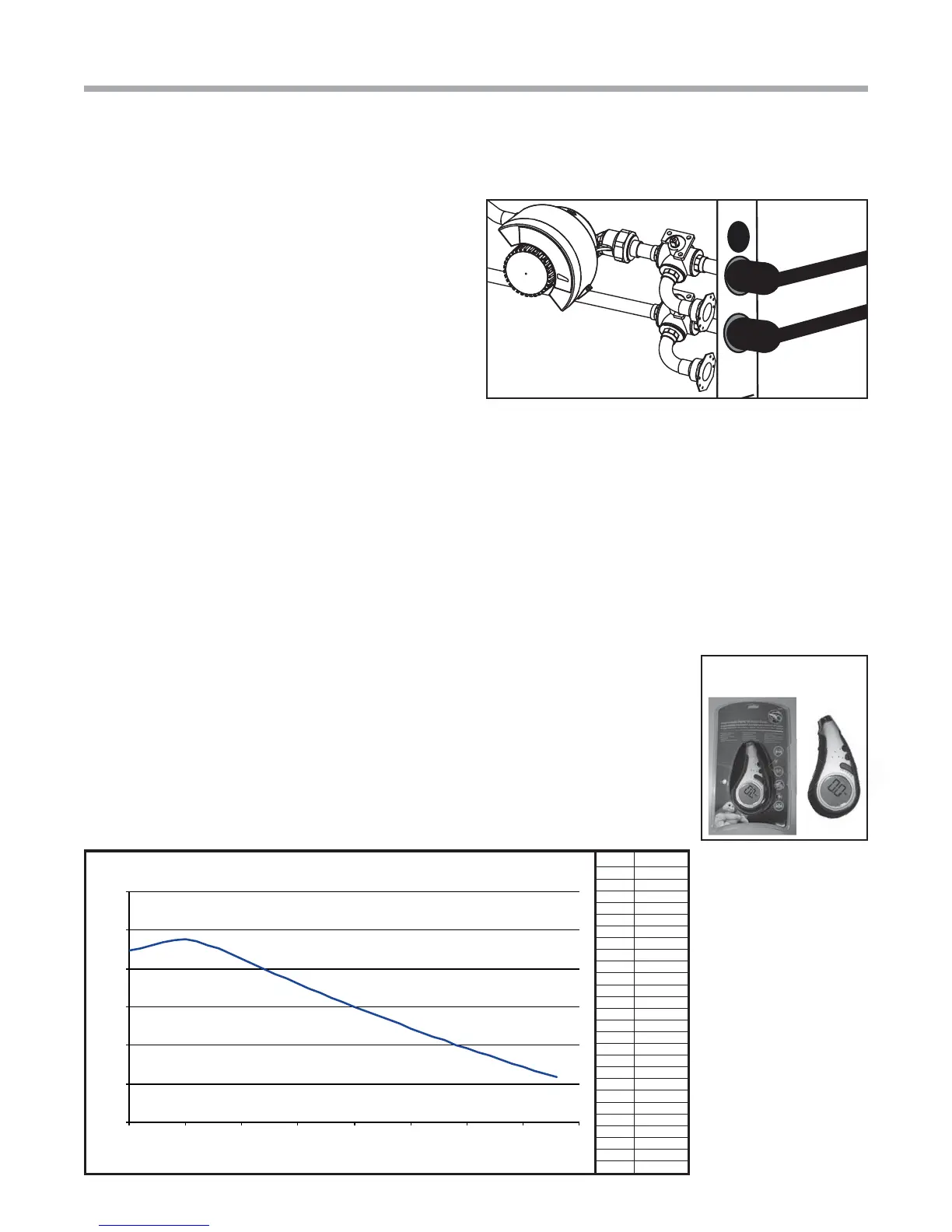
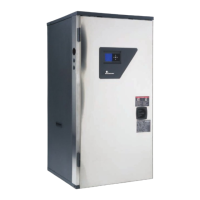
Figure 12: Internal Flow Controller
0
10
20
30
40
50
60
0 5 10 15 20 25 30 35 40
Head (Ft.)
Flow (GPM)
Magna Geo 25-140 Pump Curve
GPM Head (ft)
0.0 44.7
1.0 45.4
2.0 46.1
3.0 46.8
4.0 47.5
5.0 47.7
6.0 47.1
7.0 46.1
8.0 45.3
9.0 43.9
10.0 42.6
11.0 41.2
12.0 39.9
13.0 38.7
14.0 37.4
15.0 36.1
16.0 34.9
17.0 33.7
18.0 32.5
19.0 31.3
20.0 30.1
21.0 28.9
22.0 27.8
23.0 26.7
24.0 25.6
25.0 24.5
Figure 13: Magna Geo 25-140 Pump Performance
Digital Pressure
Gauge
Units with internal fl ow control come with a built-in variable
speed pump, an expansion tank, fl ushing ports and three-
way valves (used to fl ush the unit). The variable speed
pump is controlled by the Communicating DXM2 board
based on the difference between the entering and leaving
water temperature (∆T). For operation outside of the normal
entering water temperature range (50° or 60°F - 110°F
for cooling, 30°F-70°F for heating) the DXM2 controller
may automatically adjust the control ∆T to account for
the abnormal entering water temperatures, maintaining
an appropriate fl ow rate for proper unit operation. When
entering water temperatures are abnormally low for cooling,
or abnormally high for heating, the DXM2 controller will
maintain a constant leaving water temperature which will
allow the unit to operate properly under those conditions.
The internal expansion tank helps to maintain constant loop
pressure despite the natural expansion and contraction of
the loop as the seasons and loop temperatures vary. The
expansion tank also helps to avoid fl at loop callbacks.
Pre-Installation
Prior to installation, locate and mark all existing underground
utilities, piping, etc. Install loops for new construction before
sidewalks, patios, driveways, and other construction has
begun. During construction, accurately mark all ground loop
piping on the plot plan as an aid in avoiding potential future
damage to the installation.
Piping Installation
The typical closed loop ground source system is shown in
Figures 6a and 11a. All earth loop piping materials should be
limited to polyethylene fusion only for in-ground sections of the
loop and it is also recommended for inside piping. Galvanized
or steel fi ttings should not be used at any time due to their
tendency to corrode. All plastic to metal threaded fi ttings
should be avoided due to their potential to leak in ground
loop applications.
Loop temperatures can range between
25 and 110°F [-4 to 43°C]. Flow rates between 2.25 and 3
gpm per ton [2.41 to 3.23 l/m per kW] of cooling capacity is
recommended in these applications.
Test individual horizontal loop circuits before backfi lling.
Test vertical U-bends and pond loop assemblies prior to
installation. Pressures of at least 100 psi [689 kPa] should be
used when testing. Do not exceed the pipe pressure rating.
Test entire system when all loops are assembled.
The following section will help to guide you through fl ushing a
unit with internal fl ow control.
Water Pressure Schrader Ports
The pressure ports built in to the
unit are provided as a means of
measuring pressure drop through
the water-to-refrigerant heat
exchanger. The water pressure
ports are schrader ports smaller
than refrigerant schrader ports.
They are the same size as tire
schrader ports. A digital pressure
gauge is recommended for taking
pressure readings through these
ports. The water fl ow
through the unit can be
determined by measuring
the water pressure at the
“water pressure out” port
and subtracting it from
the water pressure at the
“water pressure in” port.
Comparing the pressure
differential to the pressure
drop table (wpd)/fl ow rate
in Tables 15a through
15d in this manual will
determine the fl ow rate
through the unit.



 To Next Page