SECTION 1: INTRODUCTION
3 of 40
It will then be possible to set program times and
temperatures for all controls
from one location and
copy programs from one control to another.
It will also be possible to read the current status of
all controls from a single station.
1.6 Installation Requirements
1.6.1 Radiant Tube Heaters
The Combat HVAC NRG Control can operate up to
ten burners providing that the electrical load on
each relay does not exceed 7 A inductive.
Mount Combat HVAC NRG Control (or remote
sensor if fitted) on a wall or column at a height of
approximately 1.5 to 1.8 metres from the floor.
The Combat HVAC NRG Control, or sensor, should
be in a position to monitor an average radiant
temperature. Keep clear of cold draughts, direct
sunlight, direct radiant field heaters and areas of
little air movement such as corners. For larger
systems, use two remote sensors to provide closer
temperature control.
1.6.2 Warm Air Heaters
The Combat HVAC NRG Control can operate a
single warm air heater. However up to four heaters
may be controlled from each control if each heater
is provided with interface relays See Page 13,
Section 4.7.
Mount Combat HVAC NRG Control, or remote
sensor, on a wall or column at a height of
approximately 1.5 to 1.8 metres from floor. The
Combat HVAC NRG Control, or sensor, should be
positioned where it will monitor an average room
temperature. Keep clear of cold draughts, direct
sunlight, path of warm air from heater and areas of
little air movement such as corners.
1.6.3 Multiple Unit Considerations
When using control to operate more than one
radiant or warm air heater, careful consideration
should be given to position of control or remote
temperature sensor because single temperature
monitoring point controls all heaters that are
connected. The use of two remote sensors may
provide closer temperature control.
For warm air heaters, the interface relay D 258
must be installed, in accordance with Page 13,
Section 4.7, adjacent to each heater to ensure that
the electrical supply at each heater is isolated for
maintenance.
For larger air heaters, it may not be practical to
operate more than one heater from a single control
due to the larger area covered by these heaters.
Contact Combat HVAC Limited for further advice
on control location and application.
1.6.4 Installation Materials
Shielded cable Belden 8451, General Cable C
2514, or equivalent rated for up to 300 V must be
used for sensors, modulating 0-10 V output, 12 V
DC inputs and network bus connections. Maximum
cable length for each sensor is 100 m. Maximum
cable
length for network is 1,000 m. Keep control cables
away from high current mains circuits to prevent
signal interference.
1.6.5 Electrical Requirements
The c
ontroller must have a 230 V 50 Hz
power supply wired with the Ferrite EMC filter. See
Page 7, Figure 7 in accordance with relevant wiring
diagram from Page 9, Section 4.
1.7 Programming Details
Every control is programmed with default settings
and may be reconfigured to suit the needs of the
installation. See Page 33, Section 5.6.3 and Page
34, Table 1.
When supplied, each Combat HVAC NRG Control
is configured as a stand alone unit.
Each unit must be configured to operate heating
equipment it is controlling. See Page 33, Section
5.6.3 and Page 34, Table 1.
Programming for stand alone units and network
units is similar. However, for network units, they
must be network configured first. See Page 31,
Section 5.6.1.
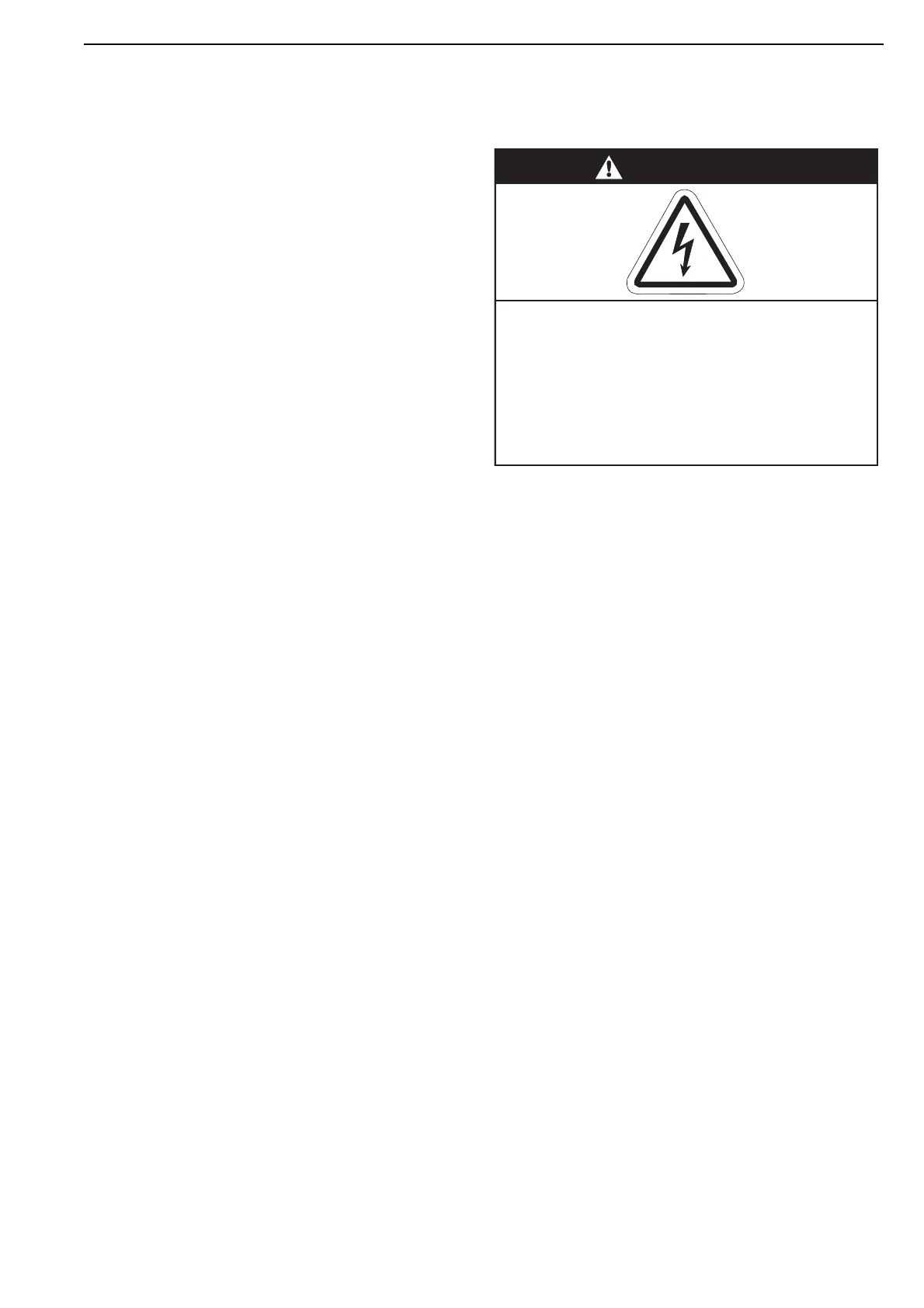
DANGER
Electrical Shock Hazard
Disconnect electric before service.
Controller must be properly grounded to an
electrical source.
Failure to follow these instructions can
result in death or electrical shock.


 To Next Page