56
5.3
ELECTRICITY SUPPLY
The mains voltage may not be interrupted (e.g. by light switches)!
If the water softener is not permanently supplied with power,
/ no regeneration takes place,
/ no alarm is given in case of faults,
/ water losses or even water damage can occur, if there is an interruption during regeneration.
5.4
MOUNTING THE BUILT-IN ROTARY FLANGE (JQE)
Install using the supplied built-in rotary flange. The built-in rotary flange is used as a connecting element
between the pipe and the water softener. It is suitable for both horizontal and vertical pipes. The installa-
tion height depends on the pipe layout.
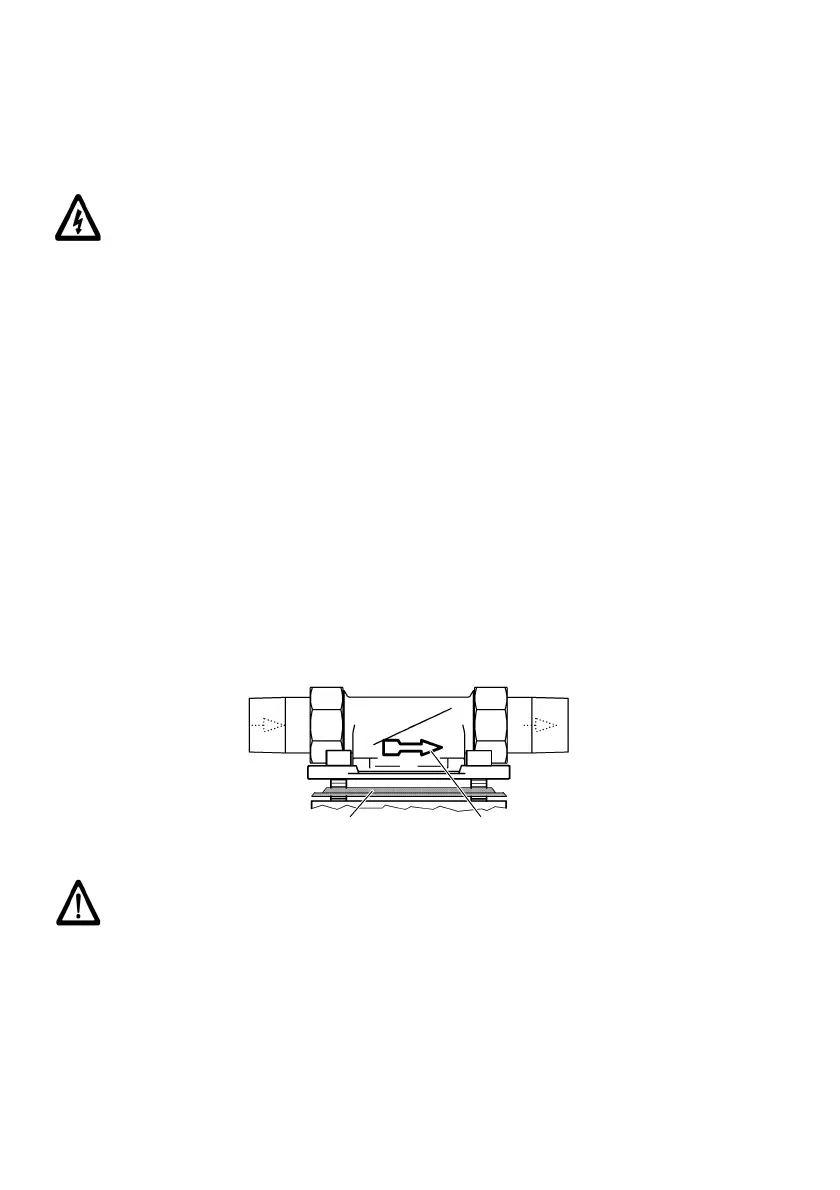
The built-in rotary flange must be installed in the direction of flow. This is marked by a
cast in arrow (see fig. 3).
The built-in rotary flange must be fitted so that mechanical stresses cannot occur!
Otherwise mechanical damage can result, the pipe may burst or the built-in rotary flange can break. This
can result in major water damage. In this case, persons close to the water softener are exposed to a health
risk due to the large quantities of water.
Therefore, during installation, ensure that no large forces act on the pipe, built-in rotary flange and water
softener.
A splash proof socket is required for the power supply, in accordance with the le-
gal regulations for wet rooms!
Fig. 3: Built-in rotary flange
Failure to comply with this means the water softener cannot work.
Profiled flange gasket Flow direction arrow



 To Next Page