Hewlett-Packard and Microsoft proposed the addition of support for a standard color space, sRGB, within the
Microsoft operating systems, HP products, the Internet, and all other interested vendors. The aim of this color space
is to complement the current color management strategies by enabling a third method of handling color in the
operating systems, device drivers and the Internet that utilizes a simple and robust device independent color
definition. This is to provide good quality and backward compatibility with minimum transmission and system
overhead. Based on a calibrated colorimetric RGB color space well suited to Cathode Ray Tube (CRT) monitors,
television, scanners, digital cameras, and printing systems, such a space can be supported with minimum cost to
software and hardware vendors.
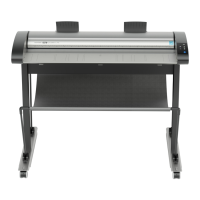
In large format multiple CCD camera scanners, electronic stitching adjusts for overlap in the field of view of adjacent
cameras. Automatic stitching at start of scan ensures that each camera captures the correct number of pixels
independently of mechanical and thermal changes.
The subtractive primary colors: cyan, magenta, yellow. As ink applied to a piece of paper by a printer, these colors
absorb light and alter the colors seen by looking at the printed paper. Cyan ink absorbs the red third of the spectrum,
magenta ink absorbs the green third, and yellow ink absorbs the blue third. This should theoretically cause the viewer
to see a black color, but due to unavoidable impurities in the inks, there is still light reflected and the viewer sees a
muddy brown. The absence of CMY pigments results in white.
Tagged Image File Format. One of the most common graphic file formats for line-art and photographic images.
Tonal Distribution describes the distribution of various bright or dark tones within an image. During the scanning or
image editing stage, tones can be redistributed, lightening a dark image or darkening a light one.
A term used in scanning and image editing that refers to compressing the broad range of tones and colors in an
image down to the narrower range available on a printer.
The shape of the tone transfer curves can be adjusted by the user to alter color or tone correction. The lower left end
of the curve typically represents the dark portions of a picture and an upward bend will typically lighten the shadows.
Similar capabilities exist by working with the middle or highlight parts of the curve. In this way it is possible to alter
only certain tonal ranges of an image without making un-wanted changes to other parts of the image.
Any color or neutral that is denser than white.
True color systems provide eight bits for each of the three components (red, green and blue). Therefore true color is
often referred to as 24-bit color.



 To Next Page