D1091 Rev.M August. 2016
• WARNING: The red diode aiming beam in the sapphire window should be in full contact with the skin before, during,
and after the laser pulse.
o Pay close attention when treating over the nose or curved areas to ensure full contact with the window
where the red aiming beam is present.
o Consider using smaller spot size if you cannot ensure full contact with the sapphire window.
• Apply a thin layer of clear gel (such as ultrasound gel) for increased epidermal
protection and patient comfort.
• Test pulses are always advised. Observe laser-tissue interaction before proceeding.
o Ask the patient to return in 6 weeks to fully assess test pulse results
• Pre-cooling the skin is required to help prevent epidermal damage
• Ensure each pulse receives both pre and post cooling.
• The length of pre and post cooling time required will vary according to size, color, and
depth of the PWS.
o Larger, darker PWS require longer pre and post cooling.
• Always observe the epidermis during the treatment, watching for signs of damage
(blanching or gray coloration).
o If damage is seen, stop the treatment and apply a cool compress and evaluate
the area for possible complications and wound care.
• Tissue response
o Start with a test pulse, pre-cooling well.
o Gradually shorten the pulse duration or increase the fluence over a few pulses
on different spots.
o Consider returning to the area in 10 minutes to re-evaluate tissue response.
• Use the 532 nm wavelength for flat regions.
• When using 532 nm, it is okay to use a slight overlap of 10-15%.
• Use the 1064 nm wavelength for nodular regions.
• When using 1064 nm, do not place pulses adjacent to one another. Leave at least a full
spot size gap in between each pulse.
• Choose 5
°
C window temperature.
o Additional pre and post cooling and anesthetic for darker lesions may be used.
• When treating skin type VI, use a longer pulse duration.
• Do not double-pass.
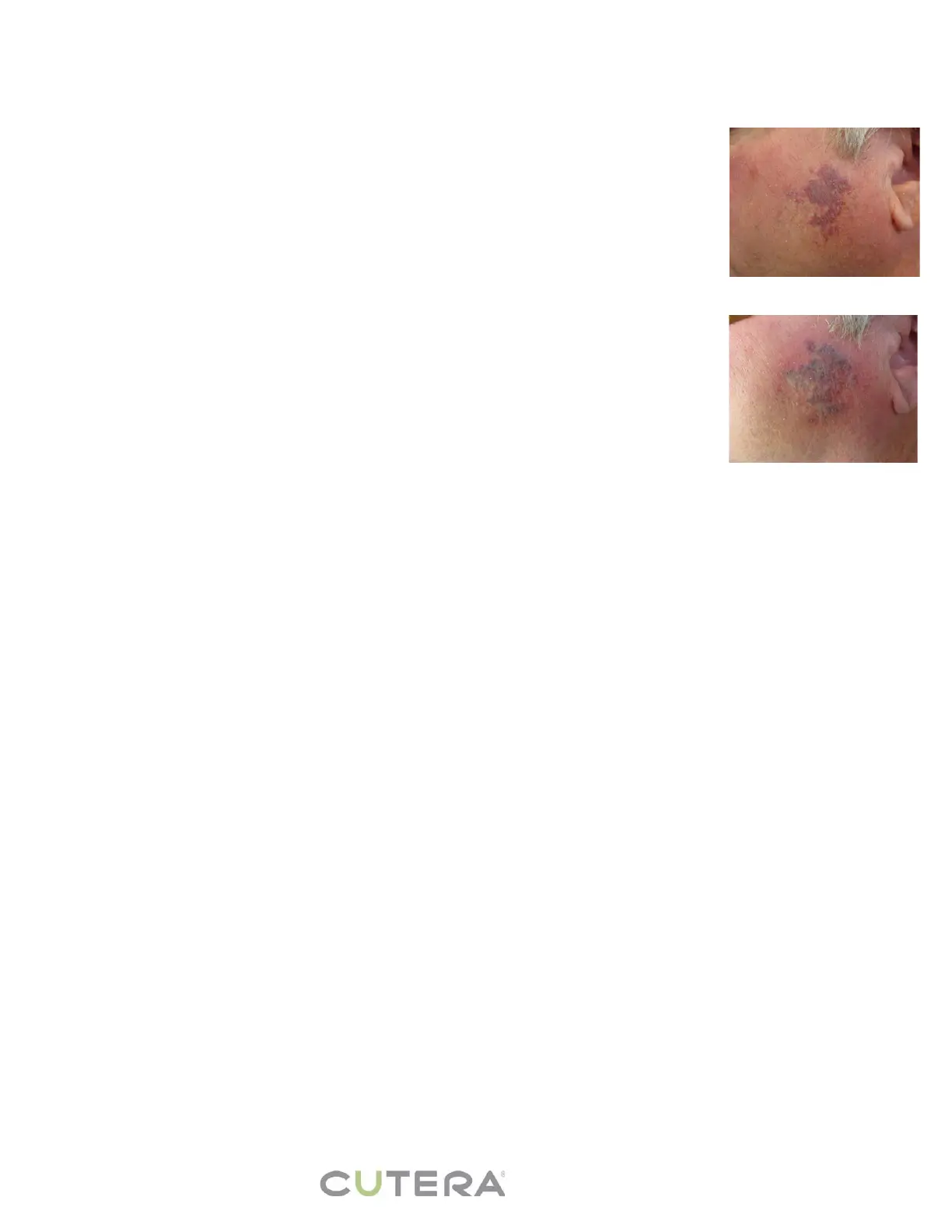
• Common endpoint is purpura which may be delayed.
o Minimal purpura is desired when using 1064 nm.
• Several treatments, spaced at least 6-8 weeks apart are typically required.
Post Treatment Care
• Erythema usually resolves within 24-48 hours.
• Edema usually resolves within 24-72 hours.
• Purpura usually resolves within 7-10 days.
• Cold gel packs or cool compresses are recommended post-treatment.
• If a blister develops, treat as a wound.
• Request that the patient contact your office with any concerns, such as blistering, excessive
redness/swelling/bruising, etc.
-treatment


 To Next Page