D1091 Rev.M August. 2016
ACNE TREATMENTS WITH 1064 NM WAVELENGTH
TREATMENT PARAMETERS – ACNE: 1064 NM WITH COOLVIEW HANDPIECE
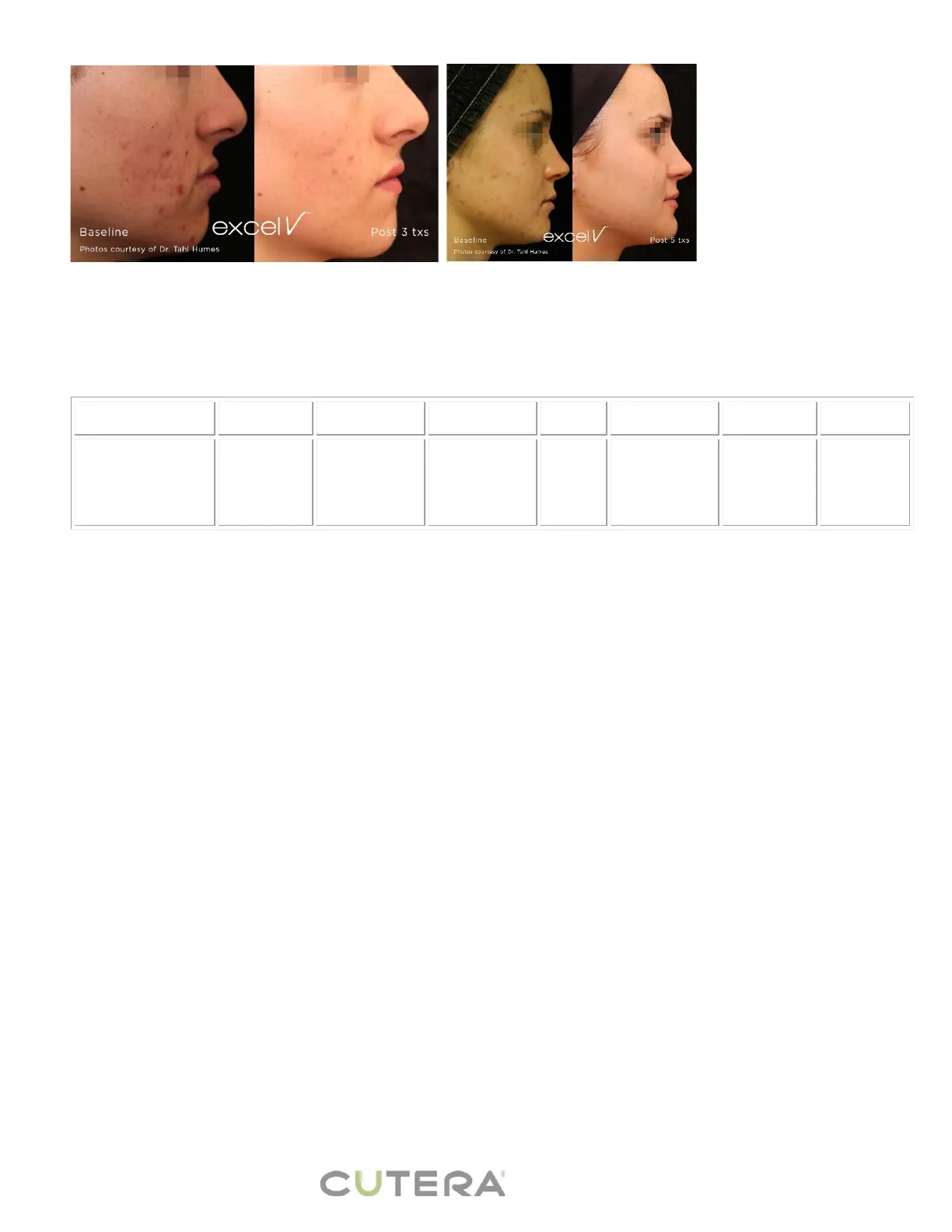
The following parameters are for the treatment of mild to moderate inflammatory acne. These parameters are
provided as a guide only for skin type I-III on the face. Treatment protocols have not been developed for skin types
IV-VI or off the face treatments. Observe laser-tissue interaction and clinical endpoints to determine appropriate
settings.
Inflammatory Acne
TREATMENT TECHNIQUE – ACNE: 1064 NM WITH COOLVIEW HANDPIECE
• WARNING: The red diode aiming beam in the sapphire window should be in full contact with the skin before,
during, and after the laser pulse.
o Pay close attention when treating over the nose or curved areas to ensure full contact with the
sapphire window where the red aiming beam is present.
• WARNING: Do not treat patients who have taken Accutane (isotretinoin capsule) in the past 6 months.
• Technique:
o Apply a thin layer of clear gel (such as ultrasound gel) for increased epidermal protection and patient
comfort and seat the sapphire window gently on the skin.
o Ensure that no large bubbles are present under the aiming beam.
o Do not apply too much pressure on the skin.
o Pre-cool area with sapphire window, depress the foot pedal to fire a pulse, then glide handpiece to
next treatment area and repeat.
o Ensure that handpiece has complete contact with skin during each pulse.
• Always observe the epidermis during the treatment, watching for signs of damage (blanching or gray
coloration).
o If damage is seen, stop the treatment and apply a cool compress and evaluate the area for possible
complications and wound care.
• Treat the individual lesions and surrounding area. This is not a full global treatment so surrounding area
should be limited to affected areas only.
o Overlap pulses by no more than 10 – 20%.
o Only 1 pass recommended.
• Treat to endpoint of mild erythema.
• Treating off the face is not recommended.
• As with other 1064nm treatments, hair reduction in treatment area is a possible reaction to treatment.
• Common treatment intervals are every 2
-4 weeks. Number of treatments varies by patient.


 To Next Page