D1091 Rev.M August. 2016
BENIGN PIGMENTED LESION TREATMENTS WITH 532 NM WAVELENGTH
BENIGN PIGMENTED LESION TREATMENT PROCESS
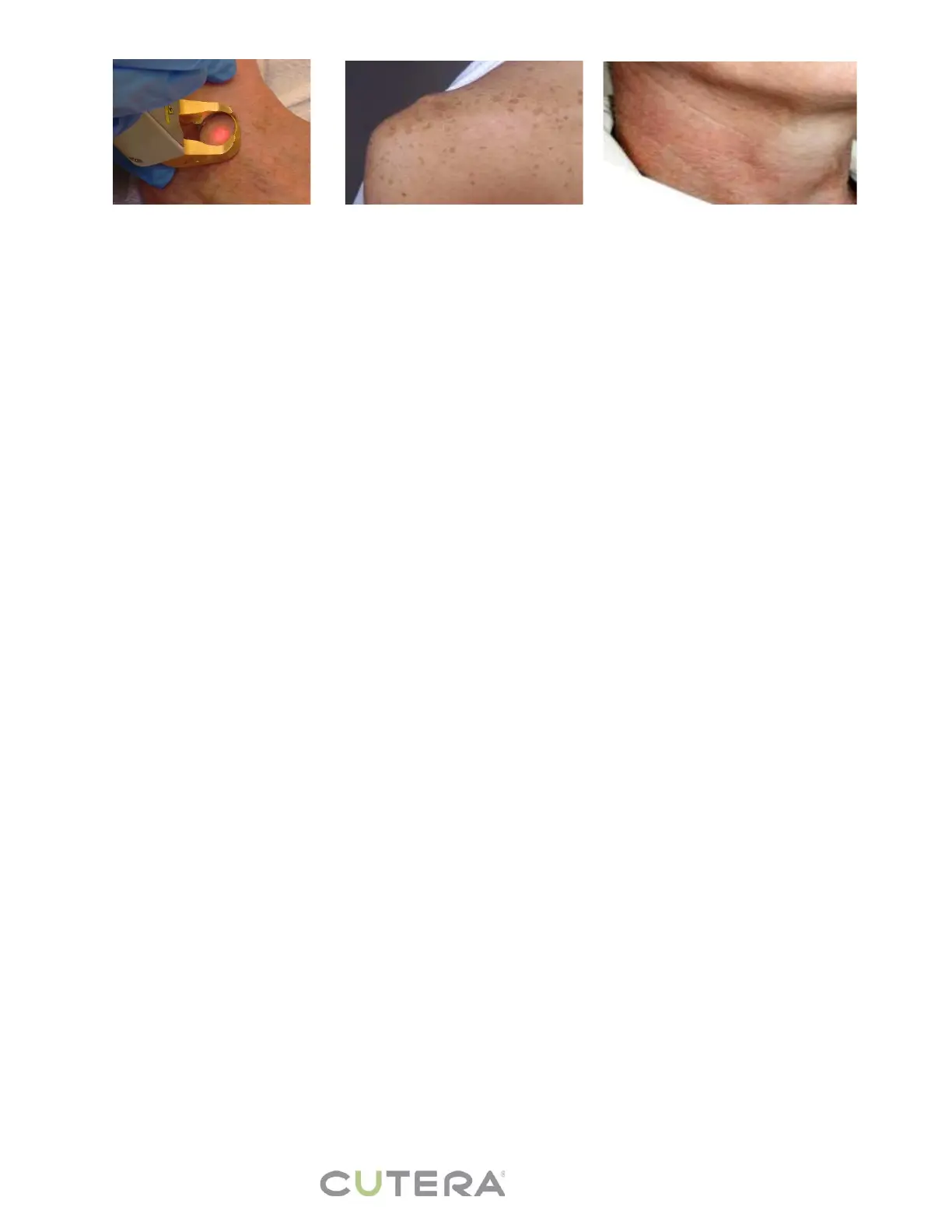
• Laser light is absorbed by superficial melanin in the lesion
• Pigmented cells are denatured, darken, rise to the surface and flake off over a couple of weeks.
SELECTING TREATMENT PARAMETERS FOR BENIGN PIGMENTED LESION TREATMENTS
Select parameters in the order listed below. Always start with the least aggressive settings for a specific lesion.
Observe laser-tissue interaction and clinical response to determine appropriate settings for each patient.
1. Wavelength is measured in nanometers (nm).
• 532 nm wavelength recommended for benign pigmented lesion treatments
2. Fluence is the energy, measured in J/cm
2
. Selection is based on lesion color and location.
• lighter lesion = higher fluence
• darker lesion = lower fluence
• For neck and chest treatments, reduce fluence by 15-20%.
3. Pulse Duration is the length of each pulse, measured in milliseconds (ms). Selection is based on lesion color
and skin
type.
• When possible, shorter pulse durations are generally preferred for treating benign pigmented lesions.
• lighter lesion = shorter pulse duration
• darker lesion = longer pulse duration
4. Window Temperature is measured in
o
Celsius. Four options are available: 5
o
, 10
o
, 15
o
, and 20
o
.
• 10-20
o
is advised for many pigment indications.
• 5
o
is recommended for darker skin types.
• 15
o
-20
o
is recommended for lighter lesions on lighter skin types.
5. Repetition Rate is the number of pulses per second, measured in Hz, with foot pedal depressed.
• For increased epidermal safety, use single pulses (0.0 Hz) with pre and post cooling.
• When treating a global area, experienced practitioners may use higher repetition rates.
8. Contact Cooling – Sapphire window provides pre, parallel, and post cooling.
• Pre-cooling protects the epidermis by reducing initial skin temperature.
• Parallel cooling during the laser pulse protects the epidermis while the laser is firing.
• Post-cooling extracts heat from tissue to help prevent epidermal injury.


 To Next Page