D1091 Rev.M August. 2016
TREATMENT TECHNIQUE – 532 NM BENIGN PIGMENTED LESIONS WITH COOLVIEW HANDPIECE
• WARNING: The red diode aiming beam in the sapphire window should be in full contact with the skin before, during,
and after the laser pulse.
o Pay close attention when treating over the nose or curved areas to ensure full contact with the window
where the red aiming beam is present.
o Consider using smaller spot size if you cannot ensure full contact with the sapphire window.
• Test pulses are always advised.
o Small adjustments in fluence can have a big effect. Adjust in 1 or 2 J/cm
2
increments.
o Pigment is often slow to react.
o The endpoint is typically reached 24-48 hours post-treatment.
o Adverse reactions can take up to 48-72 hours to appear.
• Gel is optional when treating benign pigmented lesions.
o Gel is recommended for darker skin types.
o Gel is recommended when treating with > 10 mm spot size to facilitate gliding.
o If treating individual lesions, efficacy is better without gel.
• Reduce the fluence and lengthen the pulse duration for darker or tanned skin.
• Place extra pressure on the handpiece when using short pulse durations to help prevent purpura.
• Always observe the epidermis during the treatment, watching for signs of damage (blanching or gray
coloration).
o If damage is seen, stop the treatment and apply a cool compress and evaluate the area for possible
complications and wound care.
• When using a 10 – 12 mm spot size for global treatment of large areas, overlap pulses by about 10 – 20%.
• When treating smaller lentigines, choose the best spot size to treat the pigment only and spare the
surrounding skin.
o If parameters were selected using the Navigation Screen, remember to decrease the fluence if
increasing the spot size.
• Lighter lesions may require a second pass.
• If using a small spot size on a large lesion, use a repetition rate such as 1 Hz, trace the
periphery, and then fill in the center.
• To prevent purpura, apply pressure to the handpiece into the skin to help to remove
the hemoglobin chromophore.
• For off the face treatments, reduce the fluence by 15-20%.
• Less cooling and shorter pulse duration help potentiate the effects on epidermal
melanin.
• Warmer temperature of 15-20° C may increase efficacy of lighter pigment.
• The desired endpoint is a slight darkening of pigment, do not over-treat
o Localized erythema (halo) may appear up to 15 minutes or longer after treatment
and should resolve within 24-48 hours.
If erythema is prolonged, reduce the fluence at the next treatment.
o Pigment reacts slowly and becomes darker (i.e., coffee ground appearance)
24 – 48 hours post-treatment.
• Pigment typically sloughs in 1-3 weeks depending on the body part.
• Common treatment intervals are 4 weeks.
POST-TREATMENT CARE – BENIGN PIGMENTED LESIONS
• Cold compresses or chilled gel packs may be applied post treatment.
• If a blister develops, treat as a wound.
• Retreatment of lentigines is not recommended prior to 4-6 weeks.
• Avoid sun exposure, and use a broad spectrum (UVA/UVB) sunscreen to prevent further sun damage.
• Bruising, redness, and swelling are common and resolve with time.
• Treated pigment will turn darker (brown to black) within 24-48 hours.
o Do not pick at treated areas.
o Treated pigment will exfoliate off the face in approximately 1 week.
o Treated pigment will exfoliate off the body in approximately 2-3 weeks.
• Avoid heat (hot tubs, saunas, etc.) for 1-2 days.
• Avoid skin irritants (products containing tretinoin, retinol, benzoyl peroxide, glycolic/salicylic acids,
astringents, etc.) a few days post-treatment.
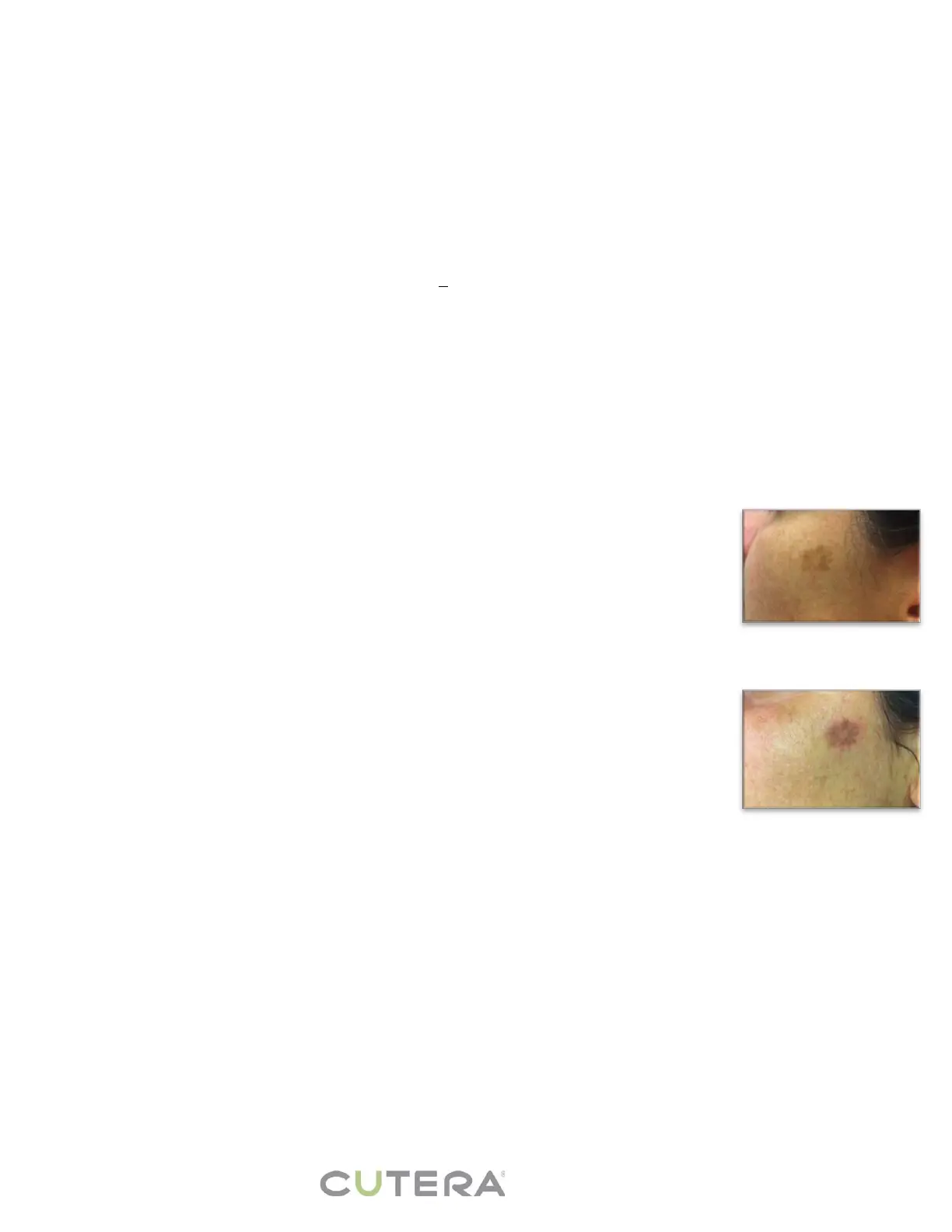
Pigmented lesion
Pre-treatment
immediately


 To Next Page