5 Piping installation
Installation manual
16
EBSH/X(B)11+16P50D
Daikin Altherma 3 R ECH₂O
4P759878-1 – 2024.01
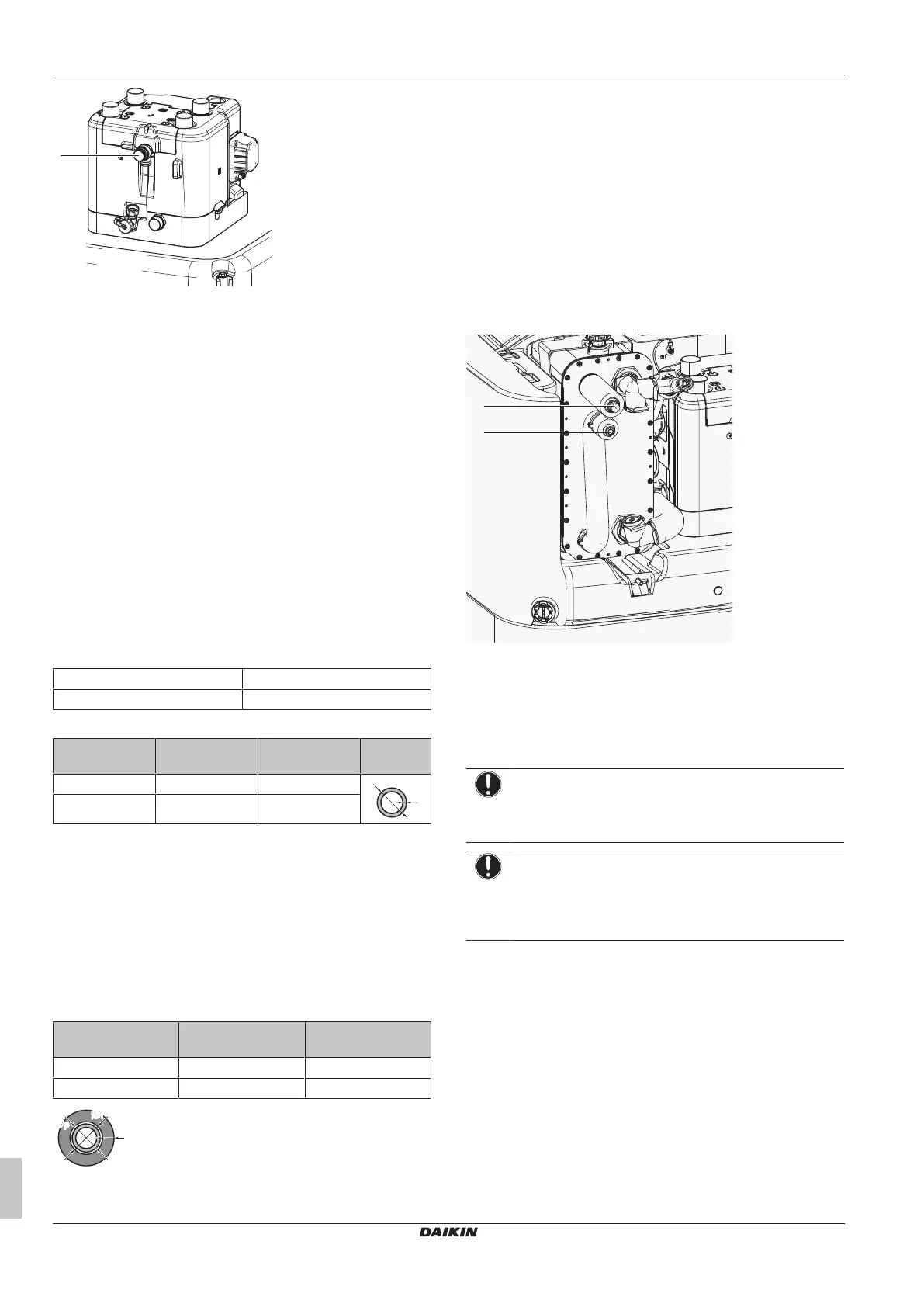
a Pressure relief valve
5 Piping installation
5.1 Preparing refrigerant piping
5.1.1 Refrigerant piping requirements
Also see "4.1.2 Special requirements for R32 units" [4 5] for
additional requirements.
▪ Piping length: See "4.1.1 Installation site requirements of the
indoor unit"[45].
▪ Piping material: phosphoric acid deoxidised seamless copper
▪ Piping connections: Only flare and brazed connections are
allowed. The indoor and outdoor units have flare connections.
Connect both ends without brazing. If brazing should be needed,
take the guidelines in the installer reference guide into account.
▪ Flare connections: Only use annealed material.
▪ Piping diameter:
Liquid piping Ø9.5mm (3/8")
Gas piping Ø15.9mm (5/8")
▪ Piping temper grade and thickness:
Outer diameter
(Ø)
Temper grade Thickness (t)
(a)
9.5mm (3/8") Annealed (O) ≥0.8mm
15.9mm (5/8") Annealed (O) ≥1.0mm
(a)
Depending on the applicable legislation and the maximum
working pressure of the unit (see "PS High" on the unit name
plate), larger piping thickness might be required.
5.1.2 Refrigerant piping insulation
▪ Use polyethylene foam as insulation material:
▪ with a heat transfer rate between 0.041 and 0.052W/mK (0.035
and 0.045kcal/mh°C)
▪ with a heat resistance of at least 120°C
▪ Insulation thickness:
Pipe outer diameter
(Ø
p
)
Insulation inner
diameter (Ø
i
)
Insulation thickness
(t)
9.5mm (3/8") 12~15mm ≥13mm
15.9mm (5/8") 17~20mm ≥13mm
If the temperature is higher than 30°C and the humidity is higher
than RH80%, the thickness of the insulation materials should be at
least 20 mm to prevent condensation on the surface of the
insulation.
5.2 Connecting refrigerant piping
See the installation manual of the outdoor unit for all guidelines,
specifications and installation instructions.
5.2.1 To connect the refrigerant piping to the
indoor unit
1 Connect the liquid stop valve from the outdoor unit to the
refrigerant liquid connection of the indoor unit.
a Refrigerant liquid connection
b Refrigerant gas connection
2 Connect the gas stop valve from the outdoor unit to the
refrigerant gas connection of the indoor unit.
5.3 Preparing water piping
NOTICE
In case of plastic pipes, make sure they are fully oxygen
diffusion tight according to DIN 4726. The diffusion of
oxygen into the piping can lead to excessive corrosion.
NOTICE
Water circuit requirements. Make sure to comply with the
water pressure and water temperature requirements
below. For additional water circuit requirements, see the
installer reference guide.
▪ Water pressure – Domestic hot water. The maximum water
pressure is 10 bar. Provide adequate safeguards in the DHW
circuit to ensure that the maximum pressure is NOT exceeded.
The minimum water pressure to operate is 1bar.
▪ Water pressure – Space heating/cooling circuit. The maximum
water pressure is 3bar (=0.3MPa). Provide adequate safeguards
in the water circuit to ensure that the maximum pressure is NOT
exceeded. The minimum water pressure to operate is 1 bar
(=0.1MPa).
▪ Water pressure – Storage tank. The water inside the storage
tank is not pressurized. Therefore a visual check of the water level
in the storage tank has to be carried out annually.
▪ Water temperature. All installed piping and piping accessories
(valve, connections,…) MUST withstand the following
temperatures:



 To Next Page