5 Piping installation
Installation manual
20
EBSH/X(B)11+16P50D
Daikin Altherma 3 R ECH₂O
4P759878-1 – 2024.01
▪ The domestic hot water heat exchanger
NOTICE
To fill the domestic hot water heat exchanger, use a field
supply filling kit. Make sure you comply with the applicable
legislation.
1 Open the shut-off valve for the cold water supply.
2 Open all hot water taps in the system to make sure that the
tapped water flow is as high as possible.
3 Keep the hot water taps open and the cold water supply running
until no more air is vented from the taps.
4 Check for water leaks.
▪ The bivalent heat exchanger (only for some models)
5 Fill the bivalent heat exchanger with water by connecting the
bivalent heating circuit. If the bivalent heating circuit will be
installed on a later stage, fill the bivalent heat exchanger with a
filling hose until water comes out of both connections.
6 Do air purge on the bivalent heating circuit.
7 Check for water leaks.
5.4.5 To fill the storage tank
NOTICE
Before the storage tank can be filled, the heat exchangers
inside the storage tank have to be filled, see previous
chapters.
Fill the storage tank with a water pressure <6 bar and a
flow speed <15l/min.
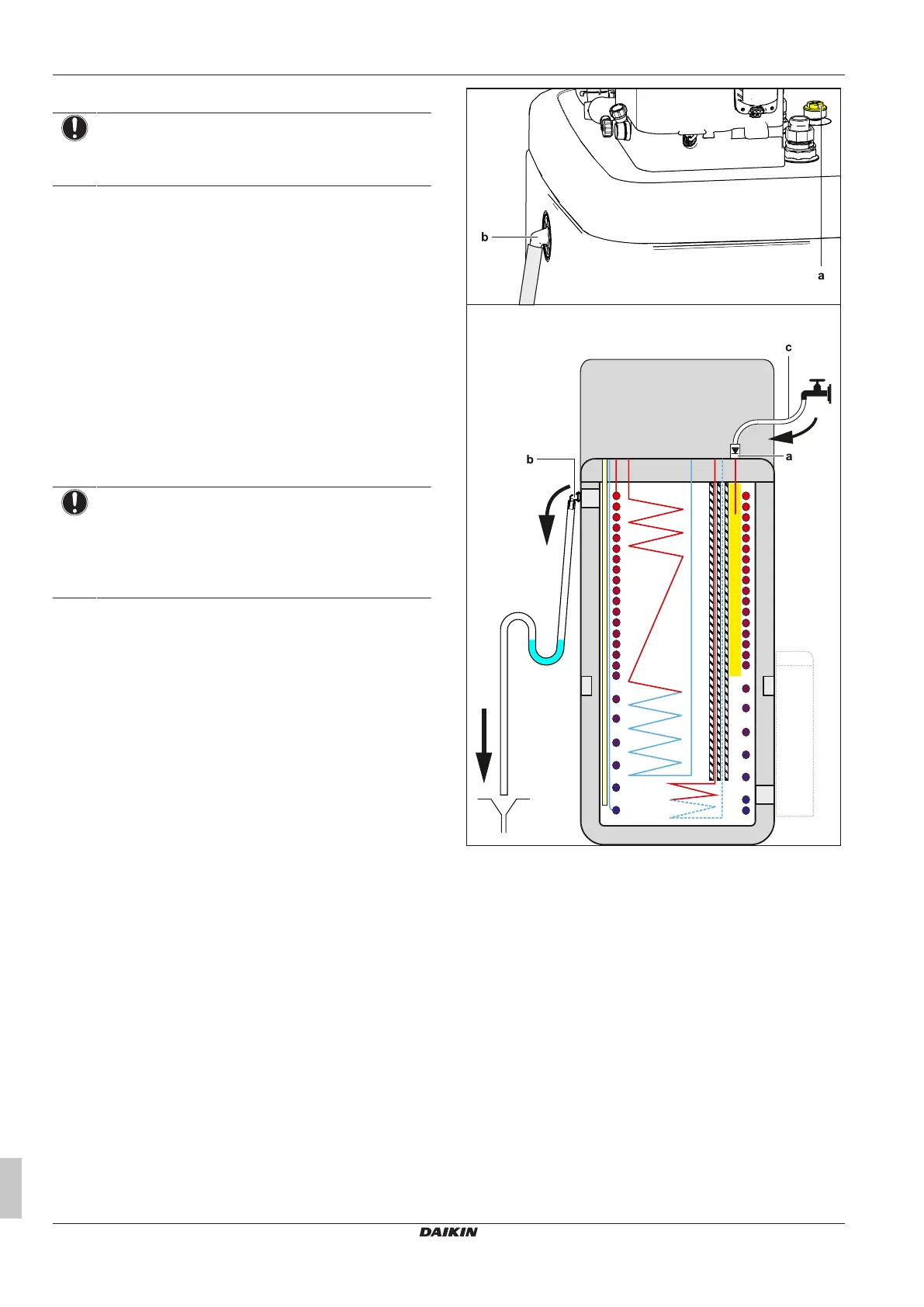
Without installed drainback solar kit (option)
1 Connect a hose with non-return valve (1/2") to the drainback
connection.
2 Fill the storage tank until water spills from the spillover
connection.
3 Remove the hose.
a Drainback connection
b Spillover connection
c Hose with non-return valve (1/2")
With installed drainback solar kit (option)
1 Combine the fill and drain kit (option) with the drainback solar
kit (option) to fill the storage tank.
2 Connect the hose with non-return valve to the fill and drain kit.
Follow the steps described in the previous chapter.
5.4.6 To insulate the water piping
The piping in the complete water circuit MUST be insulated to
prevent condensation during cooling operation and reduction of the
heating and cooling capacity.
If the temperature is higher than 30°C and the humidity is higher
than RH80%, the thickness of the insulation materials should be at
least 20 mm to prevent condensation on the surface of the
insulation.



 To Next Page