7 Installation
Installer reference guide
38
ERGA04~08DAV3(A) + EHBH/X04+08DA
Daikin Altherma – Low temperature split
4P496758-1 – 2017.12
1 Charge the system with nitrogen gas up to a gauge pressure of
at least 200 kPa (2 bar). It is recommended to pressurize to
3000kPa (30bar) in order to detect small leaks.
2 Check for leaks by applying the bubble test solution to all
connections.
3 Discharge all nitrogen gas.
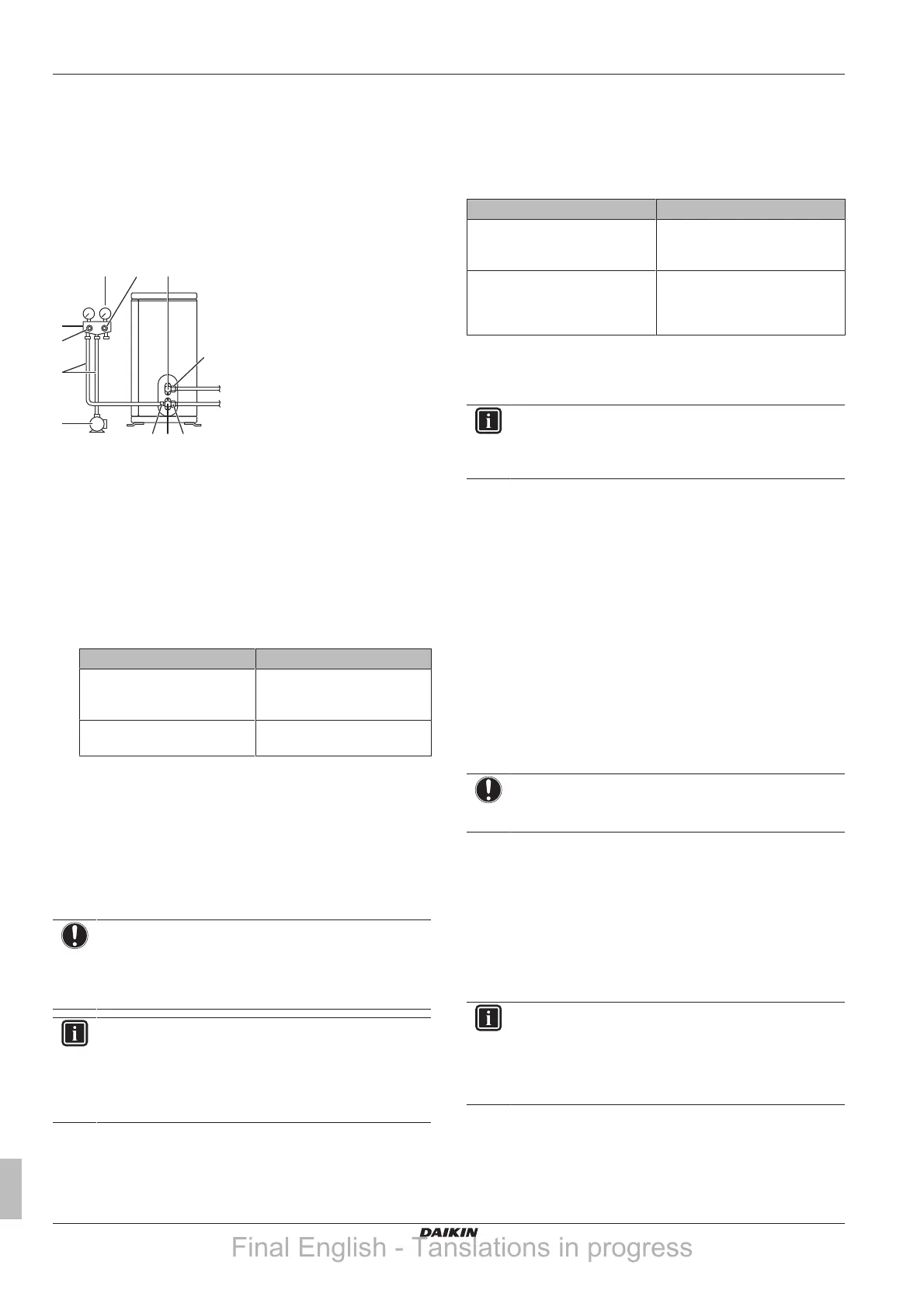
7.6.4 To perform vacuum drying
Connect the vacuum pump and manifold as follows:
a Pressure meter
b Gauge manifold
c Low-pressure valve (Lo)
d High-pressure valve (Hi)
e Charging hoses
f Vacuum pump
g Service port
h Valve lids
i Gas stop valve
j Liquid stop valve
1 Vacuum the system until the pressure on the manifold indicates
−0.1MPa (−1bar).
2 Leave as is for 4-5minutes and check the pressure:
If the pressure… Then…
Does not change There is no moisture in the
system. This procedure is
finished.
Increases There is moisture in the
system. Go to the next step.
3 Vacuum the system for at least 2hours to a manifold pressure
of −0.1MPa (−1bar).
4 After turning the pump OFF, check the pressure for at least
1hour.
5 If you do NOT reach the target vacuum or CANNOT maintain
the vacuum for 1hour, do the following:
▪ Check for leaks again.
▪ Perform vacuum drying again.
NOTICE
Make sure to open the stop valves after installing the
refrigerant piping and performing vacuum drying. Running
the system with the stop valves closed may break the
compressor.
INFORMATION
After opening the stop valve, it is possible that the pressure
in the refrigerant piping does NOT increase. This might be
caused by e.g. the closed state of the expansion valve in
the outdoor unit circuit, but does NOT present any problem
for correct operation of the unit.
7.7 Charging refrigerant
7.7.1 About charging refrigerant
The outdoor unit is factory charged with refrigerant, but in some
cases the following might be necessary:
What When
Charging additional refrigerant When the total liquid piping
length is more than specified
(see later).
Completely recharging refrigerant Example:
▪ When relocating the system.
▪ After a leak.
Charging additional refrigerant
Before charging additional refrigerant, make sure the outdoor unit's
external refrigerant piping is checked (leak test, vacuum drying).
INFORMATION
Depending on the units and/or the installation conditions, it
might be necessary to connect electrical wiring before you
can charge refrigerant.
Typical workflow – Charging additional refrigerant typically consists
of the following stages:
1 Determining if and how much you have to charge additionally.
2 If necessary, charging additional refrigerant.
3 Filling in the fluorinated greenhouse gases label, and fixing it to
the inside of the outdoor unit.
Completely recharging refrigerant
Before completely recharging refrigerant, make sure the following is
done:
1 All refrigerant is recovered from the system.
2 The outdoor unit's external refrigerant piping is checked (leak
test, vacuum drying).
3 Vacuum drying on the outdoor unit's internal refrigerant piping is
performed.
NOTICE
Before completely recharging, perform vacuum drying on
the outdoor unit's internal refrigerant piping as well.
Typical workflow – Completely recharging refrigerant typically
consists of the following stages:
1 Determining how much refrigerant to charge.
2 Charging refrigerant.
3 Filling in the fluorinated greenhouse gases label, and fixing it to
the inside of the outdoor unit.
7.7.2 Precautions when charging refrigerant
INFORMATION
Also read the precautions and requirements in the
following chapters:
▪ General safety precautions
▪ Preparation
Final English - Tanslations in progress




 To Next Page