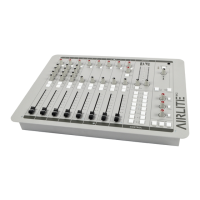
Monitoring with the Cinemix series, you are able to monitor your multitrack by
way of the separate MIX section. The MIX section of the dual path module
allows you to have two usable inputs, both with EQ, both being able to send to
the aux. busses, both with their own volume control, panpots, mutes and solos,
and able to be routed at the same time.
Multiple Modules Assigned to One or Two Tracks
When more than one microphone or line signal has to be recorded on a single
track or in stereo on two tracks, a submix facility is required. This can be done
easily on the CINEMIX by way of the internal subgroup amplifiers located on
every channel module and controlled by the ARM system.
Simply route to one of the 24 subgroups by activating routing switches in the
master's ARM section on as many input modules as required. Decide on which
track you wish to record these signals and activate the related number. The
channel metering will show the subgroup level which can be changed overall by
applying a PowerVCA's subgroup fader. In order to monitor these tracks on the
modules, the master tape switch should be in the off position for monitoring
pre-tape (console out) and in the On position for monitoring post-tape (master
tape switch lites).
Insert Channel / Group
For high dynamic range types of inputs, a signal processor such as a compressor
/ limiter can be inserted in the channel insert or in the MIX insert or activate the
optional Dynamics package.
Headphone (Cue)
During recording it is essential that the talent hears an independent mix of what
the engineer and producer are hearing. Headphone mixes are usually derived
from pre-fader auxiliaries.
In the CINEMIX the Aux 1/2 and Aux 7/8 are ideal for this purpose.
The best way to build a mix for the headphones is to have the MIX section of the
dual line module feed Aux busses 7/8. When there is limited time to set up a
headphone mix, give the talent the CRM mix (L/R) in the Control Room section
of the master modules and build up an independent headphone mix on aux. 7/8
when time allows.
Effect Sends
All unused Aux. sends can be used to send signals to signal processors such as
the D&R "Qverb" 16 bit digital reverb, effects processors, and digital delays.
The aux. sends are usually post-fader in order that the right balance between
untreated and treated signals is maintained however, it is possible to switch to
pre-fader.
Effects Returns
In the modern recording or MIDI studios of today, there is a demand for many
effect returns and inputs for MIDI related gear.
Cinemix manual page: 44



 To Next Page