EasyManua.ls Logo

Datron 1061 - Filtering; Lnput Current Compensation; Test

Default Icon
197 pages
Print Icon
To Next Page IconTo Next Page
To Previous Page IconTo Previous Page
Loading...
T
21
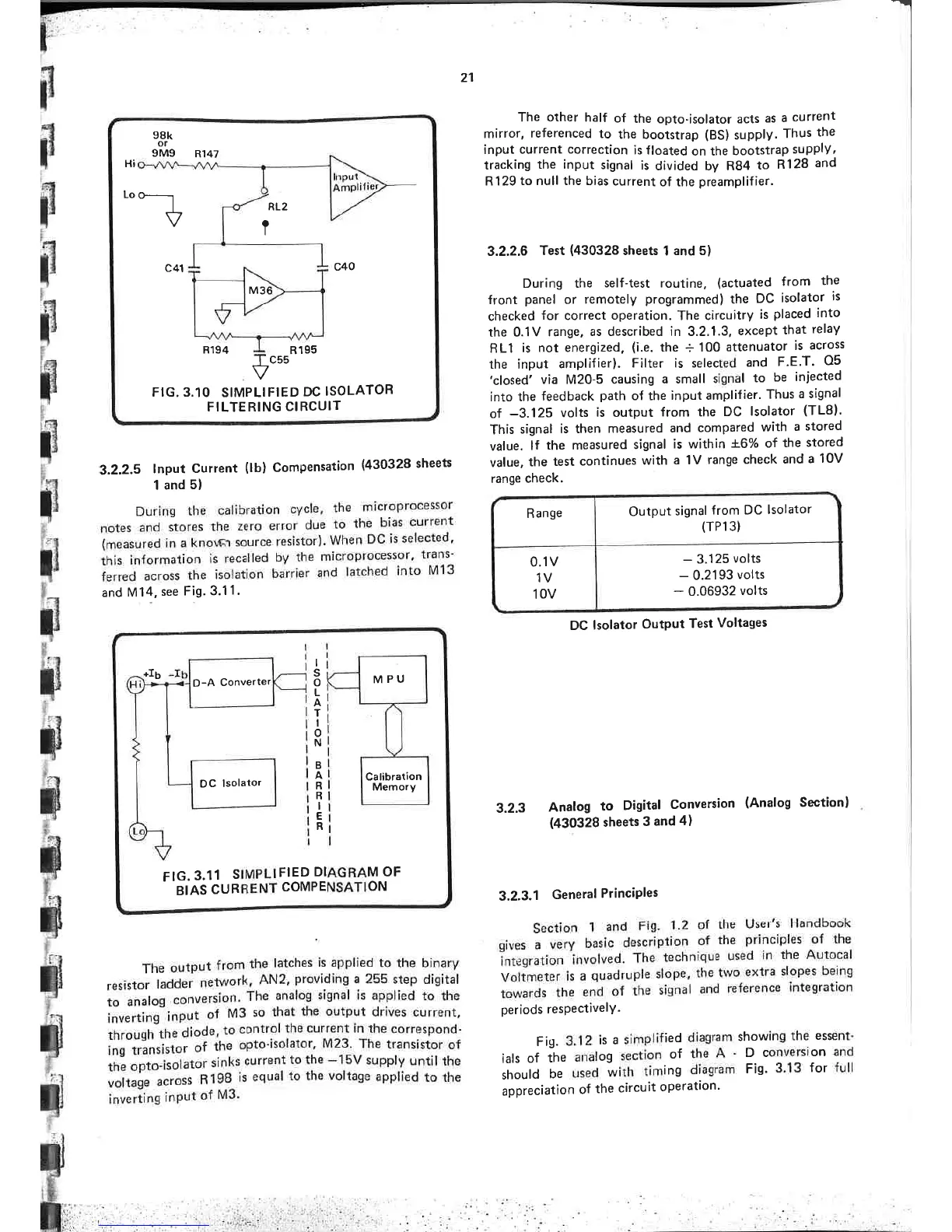
3.2.2.5
lnput
Current
(lb)
Compensation
(430328
sheets
1
and
5)
During
the
calibration
cycle,
the
microprocessor
notes
and
stores
the
zero error
due
to
the
bias
current
(measured
in a
knolGr
source
resistor)'
When
DC
is
selected'
this
information
is
recalled
by
the
microprocêssor'
trans-
ferred
across
the
isolation
barrier
and
latched
into
M13
and M
14,
see
Fig'
3.1
1
.
The
other
half
of
the
opto-isolator
acts
as
a
current
mirror,
referenced
to
the bootstrap
(BS)
supply.
Thus
the
input
current
correction
is floated
on the
bootstrap
supply,
tracking
the input
signal
is
divided by R84
to
R128
and
R129
to null the
bias current
of
the
preamplifier.
3.2.2.6
Test
(430328
sheets
1
and
5)
During
the
self-test
routine,
(actuated from
the
front
panel
or
remotely
programmed)
the
DC
isolator
is
checked
for
correct
operation.
The circuitry
is
placed
into
the
0.1V
range,
as described in 3.2.1.3,
except
that
relay
RLI
is
not energized,
(i.e.
the + 100
attenuator
is
across
the input
amplifier).
Filter is selected
and
F.E'T.
05
'closed'
via M20-5
causing
a small
signal
to
be
iniected
into the
feedback
path
of
the
input amplifier.
Thus
a signal
of
-3.125
volts
is
output
from the
DC
lsolator
(TLBI.
This
signal
is then
measured
and
compared
with
a
stored
value.
lf the
measured
signal
is
within
t.6% of
the
stored
value,
the
test
continues
with a
1V
range
check
and
a
l0V
range
check.
Output
signal
from DC
lsolator
(TP13)
-
3.'125
volts
-
0.2193
volts
-
0.06932
volts
R
ange
0.1v
1V
10v
DC
lsolator
OutPut
Test
Voltages
3.2.3
Analog
to
D¡gital
Conversion
(Analog
Section)
(430328
sheets
3
and
4)
The
output
from
the
latches
is applied
to
the binary
resistor
ladder
network,
AN2,
providing
a 255
step digital
to analoq
conversíon.
The
analog
signal is
applied
to the
inu"iting-input
of
M3
so
that
the output
drives
current,
if'rough
tt
t
diode,
to
control
the current
in
the
correspond'
i.ro-trätirto,
of
the
opto'isolator,
M23'
The
transistor
of
iiã ooto-¡tolutor
sinks
current
to the
-15V
supply
until
the
;;lü"
across
R198
is
equal
to the
voltage
applied
to the
inveri¡ng
¡nPut
of
M3'
3.2.3.1
General
PrinciPles
Section
1
and
Fig.
1'2
of
the
User's
Handbook
gives
a
very
basic
description
of
the
p.rinciples
of
the
intugrrtion
involved'
The
technique
used
in
the Autocal
Volimeter
is a
quadruple
slope,
the
two
extra
slopes
being
towards
the
end
of
the
signal
and
reference
integration
periods
resPectivelY.
Fig.
3.12
is a
simplified
diagram
showing
the essent'
ials of
ihe
analog
section
of
the
A
-
D conversion
and
rr'tori¿
¡t
used
with
timing
diagram
Fig'
3'13
for full
appreciation
of
the
circuit
operation'
M36
FIG.3.10
SIMPLIFIED
DC
¡SOLATOR
FILTERING
CIRCUIT
R195
R147
R194
c41
98k
or
9M9
c40
RL2
1
-+
Hi
Lo
T css
V
DC
lsolator
D-A
Converter
I
s
o
L
A
T
I
o
N
B
A
R
R
I
E
R
FIG.3.11
S¡MPLIFIED
DIAGRAM OF
BIAS
CURRENT
COMPENSAT!ON
Calibration
Memory
MPU
+rb

Table of Contents