EasyManua.ls Logo

Datron 1061 - Currentmeasurements; Test; Bear Input;Ratio Input; General

Default Icon
197 pages
Print Icon
To Next Page IconTo Next Page
To Previous Page IconTo Previous Page
Loading...
32
RANGE
CONTROL
FIG.3.32
SIMPLIFIED
DIAGRAM
OF
CUBRENT ASSEMBLY
To DC lsolator
or AC Assembly
Lo Out
Hi
Out
I+H
I-o---o
RL3
RL3
Analog
lntorlaco
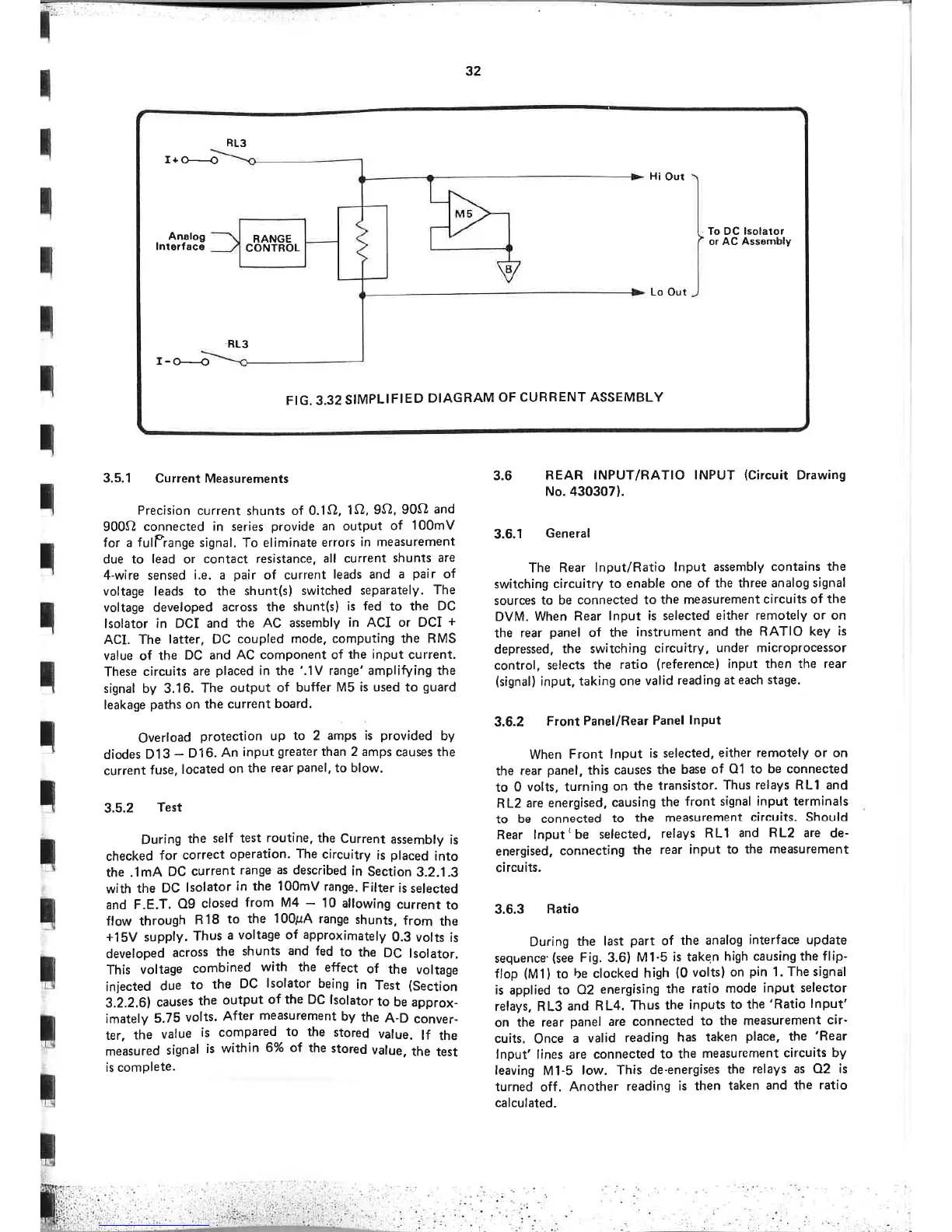
3.5,1 CurrentMeasurements
Precision
current
shunts of
0.1O,
1O,
gfl,
90O
and
900Q connected
in series
provide
an
output
of
100mV
for a fulÊrange signal.
To
eliminate
errors
in measurement
due to lead or
contact resistance,
all current
shunts
are
4-wire sensed
i.e. a
pair
of current
leads
and
a
pair
of
voltage leads
to the shunt(s)
switched
separately.
The
voltage
developed
across the
shunt(sl
is
fed
to the
DC
lsolator
in DCI
and the AC
assembly
in ACI or DCI
+
ACI. The
latter, DC
coupled mode, computing
the RMS
value
of
the
DC and
AC component of
the input
current.
These
circuits
are
placed
in
the
'.1V
range' amplifying the
signal
by 3.16.
The
output of
buffer M5
is used to
guard
leakage
paths
on
the
current
board.
Overload
protection
up
to 2 amps is
provided
by
diodes
D13
-
D16.
An
input
greater
than
2
amps
causes the
current
fuse,
located
on
the
rear
panel,
to blow.
3.5.2
Test
Duríng
the
self
test
routine,
the
Current
assembly
is
checked
for
correct
operation.
The
circuitry
is
placed
into
the .1mA
DC
current
range
as
described
in
Section
3.2.1 .3
with
the
DC
lsolator
ín the 100mV
range.
Filter
is
selected
and F.E.T.
09
closed
from M4
-
10
allowing
current
to
flow through
R18
to
the 100¡rA range
shunts,
from
the
+15V
supply.
Thus
a
voltage
of approximately
0.3
volts
is
developed
across
the
shunts and fed
to
the
DC
lsolator.
This
voltage
combined
with the
effect
of
the
voltage
injected
due
to
the
DC
lsolator
being
in
Test
(section
3.2.2.61
causes
the
output
of the DC
lsolator
to
be
approx-
imately
5.75
volts.
After
measurement
by
the
A-D
conver-
ter,
the
value
is compared
to
the
stored
value.
lf
the
measured
signal
is
within
6% of
the
stored
value,
the
test
is complete.
3.6
REAR
INPUT/RATIO INPUT
(Circuit
Drawing
No.430307).
3.6.1
General
The
Rear lnput/Ratio
lnput
assembly contains
the
switching
circuitry
to
enable one
of the three analog
signal
sources
to be
connected to
the measurement
circuits of
the
DVM.
When Rear
lnput
is selected
either remotely or on
the
rear
panel
of the
instrument
and the RATIO key
is
depressed,
the sw¡tching
circuitry,
under microprocessor
control,
selects
the
ratio
(referenc¡)
input then the
rear
(signal)
input,
taking one
valid
reading
at each
stage.
3.6.2
Front
Panel/Rear
Panel
Input
When
Front
lnput
is
selected,
either remotely or
on
the
rear
panel,
this
causes
the
base of
O1 to be connected
to
0 volts, turning
on
the transistor.
Thus relays RL1 and
RL2
are energised,
causing
the
front signal input terminals
to be
connected
to
the measurement
circuits. Should
Rear lnput'be
selected,
relays
RLI
and RL2 are
de-
energised,
connecting
the
rear
input to the
measurement
ci rcu
its.
3.6.3
Ratio
During
the
last
part
of
the analog
interface
update
sequence'(see
Fig. 3.6)
M1'5
is takqn
high causing
the flip-
flop
{M1)
to be clocked
high
(0
volts)
on
pin
1.
The signal
is
applied
to 02
energisíng
the
ratio mode
input selector
relays, RL3
and
RL4.
Thus
the
inputs
to the'Ratio
lnput'
on
the rear
panel
are connected
to the
measurement
c¡r'
cuits.
Once
a
valid
reading
has
taken
place,
the
'Rear
lnput' lines are connected
to the
measurement
circuits by
leaving
M1-5
low.
This de-energises
the
relays as 02
is
turned
off.
Another
reading
is then
taken
and the
ratio
calculated.

Table of Contents