EasyManua.ls Logo

Datron 1061 - RMS Converter

Default Icon
197 pages
Print Icon
To Next Page IconTo Next Page
To Previous Page IconTo Previous Page
Loading...
--
A28
CBB
and
C89
decouole
R160
and
R162
except
on
the
100mV
range,
when
oäg ano
o34
are
switched
off
to
provide
greater
open
loop
gain.
To
ensure
stability
at
the
higher
feedback
levels
requ-ired for
the
10V,
100V,
and
1000v
ranges;
c73
is
switàhed in
by
o32
to
decouple
M22
non-inverting
input,
further
reducing
the
open
loop
gain.
The unity
gain
f requency-compensation
amplif
ier
includes
a
stable
DC
path
M20,
and
a
fast
AC
path
O28
and
O29. The
capacitance
of varicap
diode
Dl4
is
deter.
mined
by
the
bias
voltage
at
J1-1,|.
The
bootstrap
circuit
of
A17/A21
ensures
that
both
halves
of the
varicap
are
subjected
to
the
same
AC
signal,
removing
the
non-linearity
of
the
voltage-capacitance
characteristic.
RL4
R142
Fig. A3.23 SIMPLIFIED
DIAGRAM OF
THE AC
PREAMPLIFIER
SCALING
R121
R122
To Frequency
R146
Rt 43
RL5
1KV
10v
c77
Compensation
Section
BLl
10OmV
RL6
100v
RL3
RL3
Lo
\--<2
Hi
c--{
RL2
o23
100mV
M21,M22
031-036
R167
to
R170
43.3.3
RMS Converter
(430552
Sheets 2 & 3l
log
v
vx
Vt
Fig.43.25
BLOCK
DIAGRAM
OF
RMS
CONVERSION
TECHNIOUE
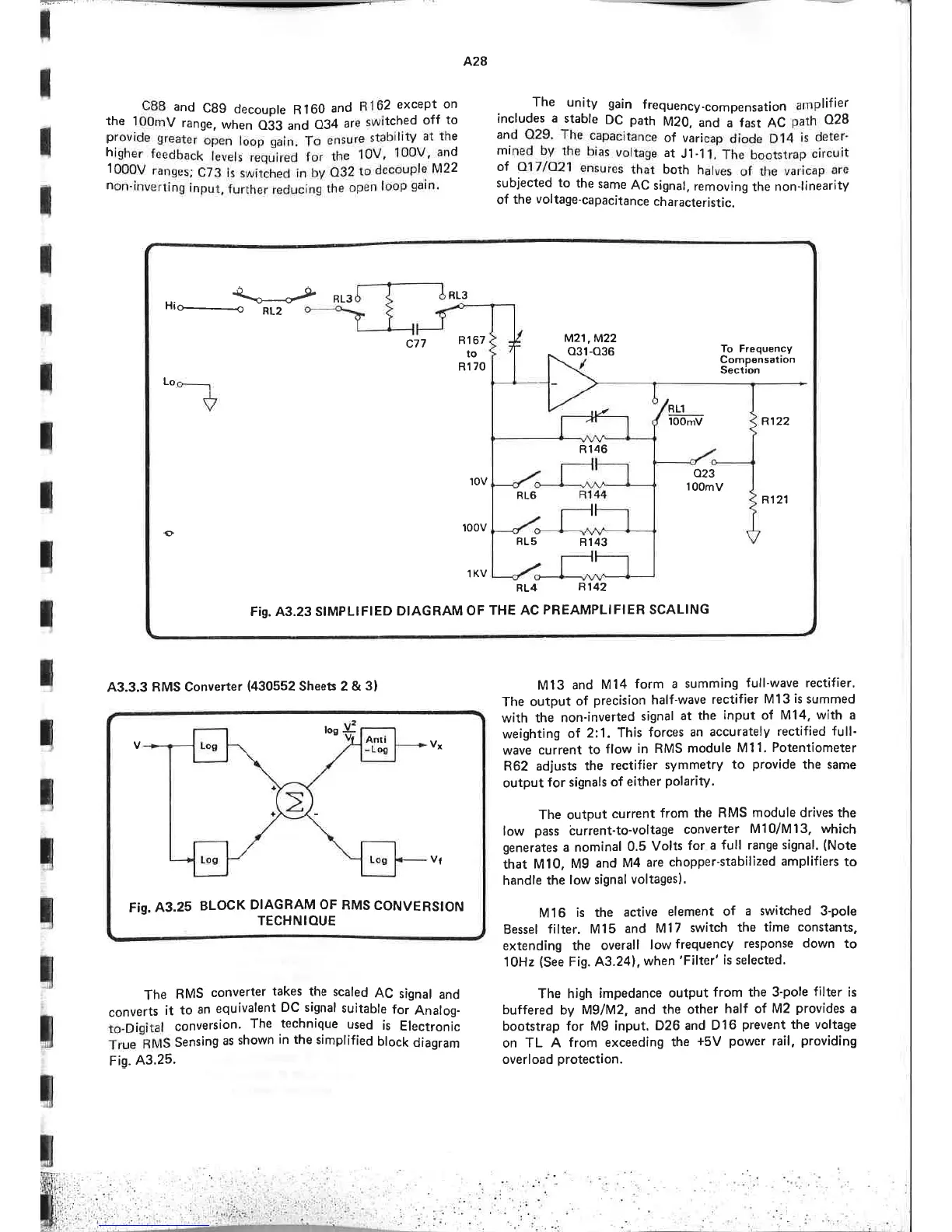
The
RMS
converter
takes
the
scaled
AC
signal
and
converts
it
to
an
equívalent
DC signal
suitable
for
Analog-
to-Digital
conversion.
The
technique
used
is
Electronic
true
Rlvls
Sensing
as
shown
in
the simplified
block
diagram
Fis.43.25'
M13 and
M14
form a
summing
full'wave rectifier'
The
output
of
precision
half-wave
rectifier
M13
is
summed
with the
non-inverted
signal
at
the
input
of
M14, with a
weighting
of 2:1 .
This
forces
an
accurately
rectified
full'
wave
current
to
flow
in RMS
module
M11.
Potentiometer
R62 adjusts
the
rectifier
symmetry
to
provide
the same
output
for
signals
of either
polarity.
The output
current
from
the RMS
module drives
the
low
pass
burrent-to-voltage
converter
M10/M13,
which
generates
a nominal
0.5
Volts
for.
a full range
signal.
(Note
that M10,
M9
and
M4
are chopper-stabilized
amplifiers
to
handle
the
low signal
voltages).
M16
is the
active
element
of a
switched 3-pole
Bessel
filter. M15
and
M17
switch
the
time constants,
extending the
overall
low
frequency
response
down
to
10Hz
(See
Fig. 43.24),
when
'Filter'
is
selected.
The high
impedance
output
from the 3-pole
filter
is
buffered by M9/M2,
and
the other
half
of
M2
provides
a
bootstrap
for M9 input.
D26 and
D16
prevent
the voltage
on
TL A
from exceeding
the
+5V
power
rail,
providing
overload
protection.

Table of Contents