EasyManua.ls Logo

Datron 1061 - Keyboard LED Data Decode

Default Icon
197 pages
Print Icon
To Next Page IconTo Next Page
To Previous Page IconTo Previous Page
Loading...
43
cD4
0
1
0
I
0
1
0
1
0
1
1
0
1
17
16
5
c
0
0
1
1
0
0
1
1
0
0
0
1
15
c
0
0
0
0
1
1
I
1
0
0
t
1
M7
14
cD7
0
0
0
0
0
0
0
0
1
1
1
1
1
KEY
100
10
1
000
lOMQ
1
.1
10Q
AUTO
DC
KQ
KEYBOARD
I
INPUT
ZERO
M10
17
cD0
0
1
0
1
0
1
0
1
0
1
0
16
CDl
0
0
1
1
0
0
1
1
0
0
1
0
1
15
CD2
0
0
0
0
1
1
1
1
0
0
0
14
cD3
0
0
0
0
0
0
0
0
1
1
1
1
1
KEY
HOLD
RATIO
TEST
SPEC
(A_B)
dB
MAX
MIN
RESET
MAN
INPUÏ
FILTER
AC
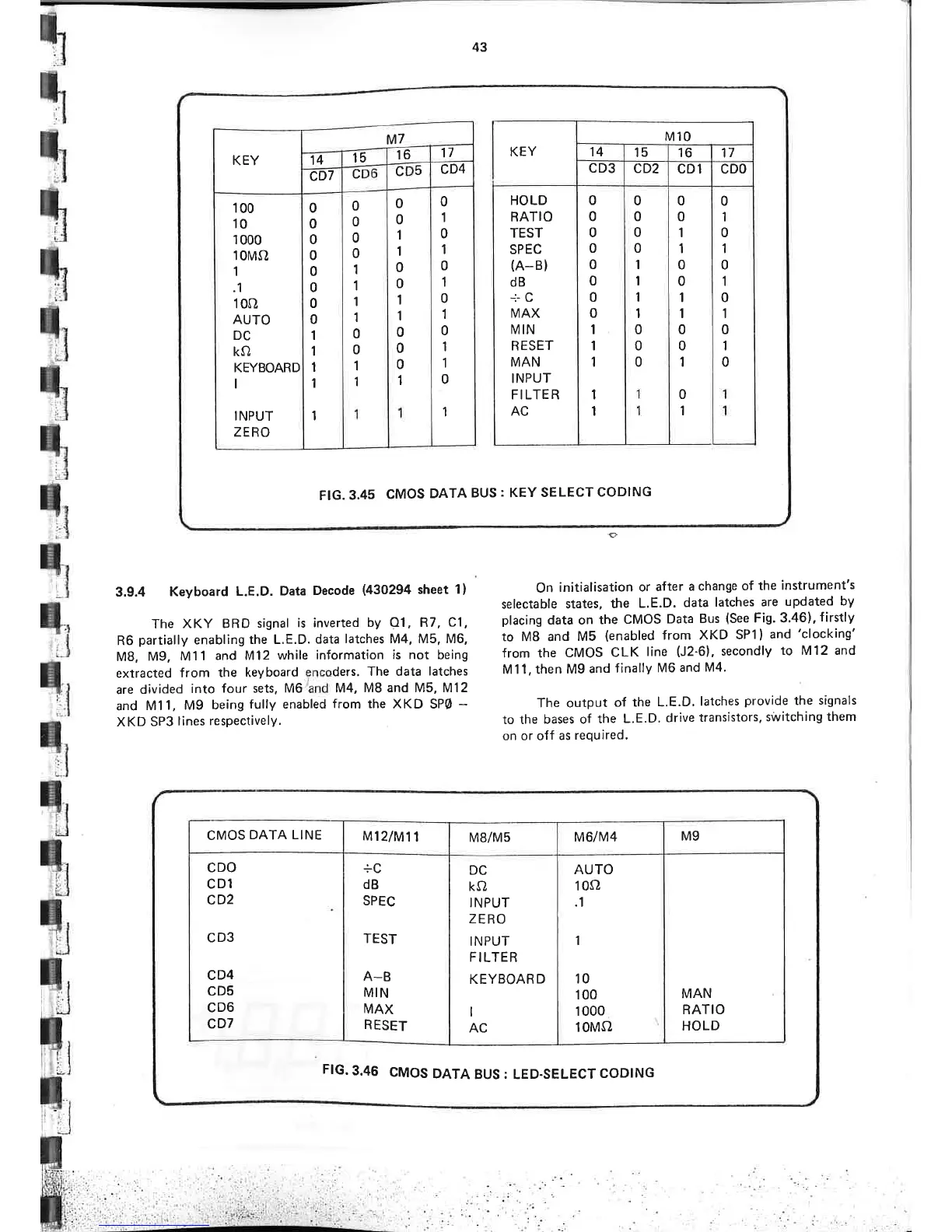
FIG.3.45
CMOS
DATA
BUS
:
KEY
SELECT
CODING
ç
3.9.4
Keyboard
L.E.D.
Data
Decode
@30294
sheet 1)
The XKY
BRD signal
is inverted
by 01, R7, C1,
R6
partially
enabling
the L.E.D.
data
latches
M4,
M5, M6,
M8,
M9, M'l
1
and M12
while
information
is not
being
extracted
from
the keyboard
encoders.
The
data latches
are divided
into
four sets, M6'and
M4,
M8 and M5, M12
and
Ml1,
M9
being
fully enabled
from the
XKD SPø
-
XKD
SP3
lines
resPectivelY'
On
initialisation
or
after
a change
of
the
instrument's
selectable
states,
the
L.E.D.
data
latches
are
updated
by
placing
data
on
the CMOS
Data
Bus
(See
Fig. 3'46),
f irstly
to M8 and
M5
(enabled
from XKD
SPl
l
and
'clocking'
from the
CMOS
CLK
line
(J2-6),
secondly
to
M12 and
M11, then
M9
and
finallY
M6
and
M4'
The output
of the
L.E.D.
latches
provide
the
signals
to the
bases of
the
L.E.D.
drive
transistors,
switching
them
on
or off
as
required.
M9
MAN
RATIO
HOLD
M6/M4
AUTO
10s¿
.1
1
10
100
1 000
1oMo
M8/M5
DC
kç¿
INPUT
ZERO
INPUT
F
I LTER
KEYBOARD
I
AC
M12/M11
dB
SPEC
TEST
A_B
MIN
MAX
RESET
CMOS
DATA LINE
cDo
cDl
cD2
CD3
cD4
cD5
cD6
cD7
F|G.3.46
CMOS
DATA
BUS: LED-SELECT
cODlNc

Table of Contents