EasyManua.ls Logo

Datron 1061 - Page 65

Default Icon
197 pages
Print Icon
To Next Page IconTo Next Page
To Previous Page IconTo Previous Page
Loading...
54
4.3.3
OPTION
10
AC
Assembty
Equipment
Required:
SmV/Div
oscilloscope.
e.g. Telequipment
D83'
5% digit
DVM
with
Ohrni...g.
oation
1065,
1061'
DC calibrator.
e.g.
Datron 4000 or
40004.
AC calibrator.
e.g.
Datron
4200.
Asymmetric
signal,
1V
RMS,
Crest
Factor
5:1
*O'O2Yo,
reversible
polarity.
Select AC
l00OV
range
and
HOLD'
Short
Hi
to Lo'
Connect
DVM
to TL7,
Lo
to
TPB
and
note
read'
ing.
Select
1V range
and
adiust
R121
(bias
current)
to
give
same
reading *.1O¡rV.
Select
100mV range,
AC
+
DC
and
adjust
R112
(offset
adjustl
for an
indication
of
zero
!50PV
on
the
DVM.
3.
Repeat
steps
1'
and
2. until
readings
are
within
the
specified
limits.
4.
Select
10V
range
and
HOLD.
Connect
oscilloscope
Hi
to
TP5,
Lo to
TP8
and
adjust
R90
(rectifier
zero)
for maximum
noise
about
zero.
Remove
the
oscillo'
scope.
Connect
DVM
Hi
to TP2,
Lo to
TPB
and
adjust
R75
(linearity)
for an
indication
on the
DVM
of
1.8mV
+1oo/o.
Select
AC,
1V
range,
FILTER
and apply 1V
500H2.
Connect
DVM
to
TLs, Lo to
TP8. lf reading
is
+3.157V 1.0.01V
Proceed
to
step
8.
Disconnect
input
signal and switch
off
instrument,
Make
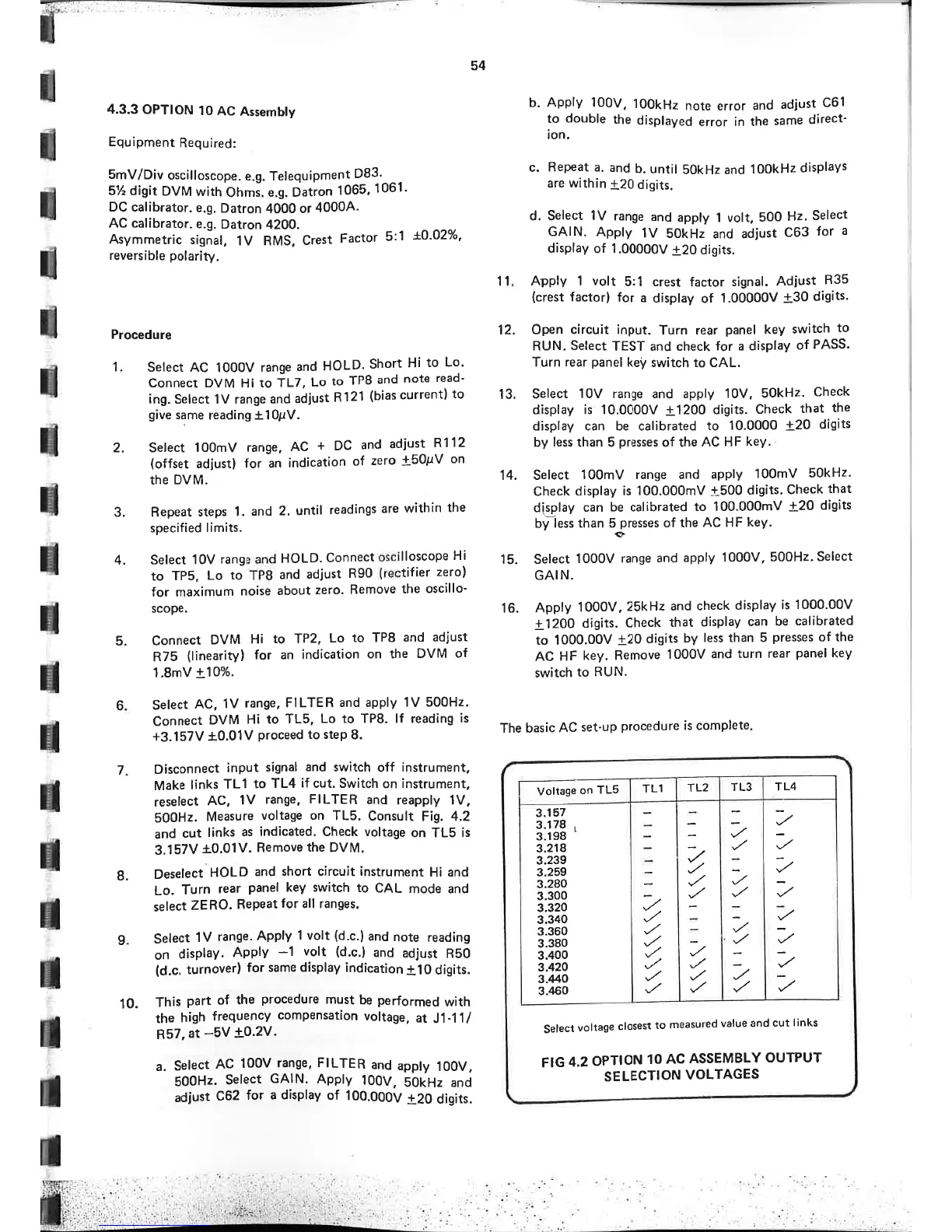
links
TL1
to
TL4 if cut. Switch
on instrument,
reselect
AC,
lV
range, FILTER
and
reapply lV,
500H2.
Measure
voltage
on TLS.
Consult
Fig. 4.2
and
cut
links
as
indicated.
Check voltage
on TLS
is
3.157V
t0.01V.
Remove
the
DVM.
Deselect
HOLD
and short
circuit instrument
Hi
and
Lo.
Turn
rear
panel
key switch
to CAL
mode and
select
ZERO.
Repeat
for all ranges.
Select
1V
range.
Apply
1 volt
(d.c.)
and
note
reading
on
display.
Apply
-1
volt
(d.c.)
and
adjust
R50
(d.c.
turnover)
for same display indication
+
10 digits.
10.
This
part of
the
procedure
must
be
performed
with
the
high
frequency
compensation
voltage,
at
J1-111
Rb7,
at
_SV
+0.2V.
a.
Select
AC
100V
range, FILTER
and
apply
100V,
S00Hz.
Select
GAIN. Apply
100V,
S0kHz
and
adiust
C62
for
a display
of
100.000V
+20
digits.
b.
Apply 100V,
100kHz
note
error
and
adjust
C61
to
double
the
displayed
error in the
same
direct-
ion.
c.
Repeat a.
and
b.
until
50kHz and
100kHz
displays
are
within +20
disits.
d. Select
1V
range
and
apply
1 volt,
500
Hz.
Select
GAIN.
Apply
lV
50kHz
and adjust
C63
for
a
display
of 1.00000V +20
digits.
11
Apply 1 volt
5:1 crest
factor signal.
Adjust
R35
(crest
factor)
for
a display
of
1.00000V
+30
digits.
12.
Open
circuit
input.
Turn rear
panel
key
switch
to
RUN.
Select
TEST and
check
for
a
display
of
PASS.
Turn
rear
panel
key sw¡tch to CAL.
13.
Select
10V
range and apply
10V, 50kHz.
Check
display
is
'10.0000V
+'1200
digits.
Check
that
the
display can be calibrated
to 10.0000
+20
digits
by less than 5
presses
of the
AC HF
key.
14. Select
100mV range and
apply
100mV
50kHz.
Check
display
is 100.000mV
-+-500
digits'
Check
that
display
can be
calibrated
to 100.000mV
+20
digits
by less
than Slcresses of
the
AC HF
key.
15.
Select
1000V
range
and
apply 1000V,500Hz.Select
GAIN.
16.
Apply
1000V,
25kHz
and
check
displav
is 1000.00V
+1200
digits.
Check
that
display
can
be calibrated
to 1000.00V
+20
digits
by
less
than 5
presses
of
the
AC
HF
key.
Remove
1000V
and
turn rear
panel
key
switch
to
RUN.
The
basic
AC
set'up
procedure is
complete
Procedure
1
2.
5.
b
7
8.
I
TL4
7
/
/
7
TL3
:
{
a
7
a
TL2
:
7
{
TLl
:
-
7
Voltage
on
TL5
3.157
3.174
3.198
3.218
3.239
3.259
3.280
3.300
3.320
3.340
3.360
3.380
3.400
3.420
3.440
3.460
Select
voltage
closest
to
measured
value
and
cut
l¡nks
F'G
4.2
OPTION
1O
AC
ASSEMBLY
OUTPUT
SELECTION
VOLTAGES

Table of Contents