20
Specific Applications
Side-chain applications
Frequency-weighted com pression
It is possible to separate certain vocals and in-
struments from a mix by frequency-weighted com-
pression. With an equalizer inserted ahead of the
detector input (but not in the audio path), the
equalization settings do not shift the timbre or fre-
quency response of the audio signal. They merely
alter the threshold response of the compressor on a
"freq uency-weighted" basis (see Figure 15).
/;
EQ
IN DETECTOR
•
SOURCE
,7
'
IN
AUDIO
OUT
.
160XT
Figure 15: Frequen cy-Weighted Compression
With this arrangement, raising certain frequen-
cies on the equalizer causes them to be suppressed
in the audio signal. A relatively high THRESHOLD
setting can allow normal sounds to be unaffected
while solo and very loud sounds are held back. (Of
course , when compression does occur, the level of
the entire program is affected.) Depending on the
THRESHOLD set ting , lower level fundamentals or
Specific Applications
De-Essing
To apply de-essing to vocals (i.e., a reduction of
sibilance), use a param etric equalizer in the lev el
detector circuit and set it for high frequency boost
in the specific frequency range where the vocal
"hiss" or lisp occurs (generally in the 4-6kHz re-
gion). This pre-emphasizes the al~ady ~'hissy"
vocal input to the detector. Used 1n conJunct1on
with a moderate to high threshold and compres-
sion ratio, this arrangement greatly attenuates the
"essing" without affecting the basic sound quality
or balance of the voice. While it is true that all fre-
quencies are lowered in level when the compressor
is triggered, generally the "sss" sound occurs
alone, before or after the dominant tone in the
voice.
Increasing Sustain
To increase the sustain of a musical instrument
(e.g., a guitar or bass), use an equ~lizer in th<: level
detector circuit and boost the EQ 1n the dorrunant
frequency range of the instrument, along with_a
fairly low threshold and a moderate compression
ratio .
Using a Filter in the Level Detector Circuit
The results of inserting a filter in the leve l detec-
tor circuit are basically the same as ob tained with
an equalizer, as previou~ly descri~. Those fre-
quencies passed by the f1lte~ are subJec~ to compres-
sion (or at least they are subiect to cons iderably
harmonics will not cause compression, and the pro-
gram is not subject to the phase shift normally
caused by program equalization.
During the recording of cymbals and tom-toms,
a compressor with an equalizer in the detector path
can help prevent tape saturation. The equalizer can
be adjusted for boost with a peak of about 5kHz,
causing the cymbal to be compressed on a very
loud crash, stopping tape saturation at high fre-
quencies , where there is less headroom. However,
gentle tapping of a drumstick or brushing of the
cymbal will not be held back. Assuming the tom-
tom is a lower frequency instrument and can be
better tolerated by the tape, it has less need for
compression. The equalization in the detector cir-
cuit means that the compressor is not triggered as
readily by a loud tom-tom beat as by an equally
loud cymbal crash.
The converse of the above EQ technique may be
used: dipping the equalizer bands causes any
sound with dominant energy in the affected regis-
ter to pull the level up because the 160XT will de-
tect a need for less compression.
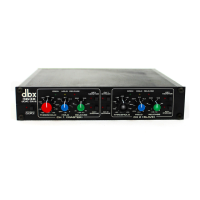
dbx 160XT
more compression than those frequencies outside
the passband). Because a passive filter can have in-
sertion loss, it may be necessary to lower the
160XT's THRESHOLD setting to maintain a given
amount of gain reduction wi~hin the filter _ .
passband; this can be determined by mon1tonng
the 160XT's threshold indicator LEDs.
Multi-way speaker systems
If a single compressor is to be used with a multi-
way speaker system (i.e., before the crossover, after
EQ), the system operator is faced with the pr?blem
of keeping levels below the point of destruction of
the most sensitive part of the system. If, for exam-
ple, mid -range drivers are frequently damaged, the
whole system must be operated at a lower sound-
pressure level, or additional mid-range drivers
must be added. By inserting an equalizer in the de-
tector path to the 160XT, it can be made more sensi-
tive to frequencies in the range handled by the
sensitive driv ers. The system can then be run at
higher levels and will only be dropped back when
damaging signals are present.
Pre-emphasis for broadcast applications
By inserting a pre-emphasis filter network in the
detector path of a 160XT proces sing p~-ei:npha-
sized audio, higher levels can be run withi~ the
headroom limitations of the broadcast chain.
21


 To Next Page