36
Glossary
puts are tape machine "play" outputs, tuner
outputs, and dbx "play" outputs. Mic-level or
phono-level signals are considerably lower in
level than aux inputs (approx -60 to -40dBu), so
they will not produce adequate volume when
connected to an aux input: Moreover, phono
cartridge outputs require RIAA equalization
that is not provided by aux inputs.
Bandwidth
Bandwidth refers to the "space" between two
specific frequencies that are upper and lower
limits; alternately, bandwidth refers to the abso-
lute value of the range of frequencies between
t~ose limits. Thus, a filter that passes frequen-
oes from lkHz to lOkHz may be said to have a
bandwidth of lkHz- lOkHz, or it may be said
to have a 9kHz bandwidth (lOkHz minus lkHz
equals 9kHz).
Bandwidth is not necessarily the same as fre-
quency response. Bandwidth may be measured
at low levels, and frequency response at higher
level~. Mo~ver, bandwidth may refer only to
certain portions of the circuitry within a piece
of equipment, whereas frequency response
mar refer to the overall performance of the
equipment. Thus, while the overall input-to-
outpu_t frequency response of dbx Type II equip-
ment 1s 20Hz to 20kHz, the bandwidth of the
RMS detection circuitry within that equipment
is 60Hz to lOkHz.
Glossary
The frequency of the bias signal is approxi-
mately 4 times the highest frequency of the
tape recorder's Record/Reproduce response.
The bias energy level has a direct effect on re-
corded level, background noise and the distor-
tion. For optimum _performance, it is
recommended that the tape recorder be cali-
brated each time a different tape type is used.
Most, if not all professional tape recorder manu-
facturers feature bias presets to accommodate
the different tape types. Many consumer tape
machines offer bias select swi tches to optimize
for most of the High bias cassette tapes avail-
able today.
Clipping
Clipping is a very distorted sound. It occurs
when the output capabilities of an amplifier are
exceeded, and the amplifier can no longer pro-
duce anymore voltage, regardless of how much
additional gain or how much more input signal
is present. Clipping is relatively easy to see on
an oscilloscope, and is sometimes audible as an
increase in harmonic distortion. In severe cases
of clipping (hard clippin g), sine waves begin to
resemb le square waves, and the sound quality
is very poor. Often, the maximum output level
of an amplifier is defined as that level where
clipping begins to occur. There is a phenome-
non known as input clipping, and this may
occur where the input signal is so high in level
that it exceeds the level-handling ability of the
Bass
The low audio frequency range below approxi-
mately SOOHz. For the purpose of discussion or
analysis, the bass range may be further divided
into upper bass (250 to SOOHz), mid bass (100 to
200Hz), low bass (50 to lOOHz) and ultra-low
bass (20 to SOHz).
Bass Boost
An accentuation of the lower audio frequencies
(bass frequencies), whereby they are made
louder than other frequencies.
Biamplified
Descriptive of a sound system that utilizes a
low level crossover network to divide the full-
spectrum audio signal into low and high fre-
quency ranges. These ranges are then fed to
separate power amplifiers, which in turn feed
low frequency speakers (woofers) and high fre-
quency speakers (tweeters).
Bias
Bias, as the term used in tape recording, is a
very high frequency signal (usually over
lOOkHz) that is mixed with the program being
recorded in order to achieve linear magnetiza-
tion of the tape. If only the audio program were
applied to the recording head, a very distorted
recording would result because lower-energy
portions of the program would not be able to
overcome the initial magnetization threshold of
the tape (known as hysteresis).
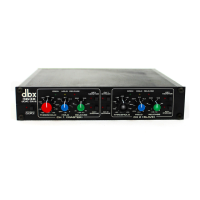
dbx 160XT
transformer and/ or of the input amplifier. Clip-
ping also occurs when tape is saturated by ex-
cessive record levels.
So-called "soft clipping" is usually the result of
transformer saturation, and it may be some-
what less objectionable than the "hard clip-
ping" that occurs when output voltage limits
are reached. Aside from degrading the sound
quality, clipping can damage loud speakers.
Output clipping can be avoided by reducing
the level of the input signal, reducing the gain
of the amplifier, or using a larger amplifier.
Input clipping may be avoided by reducing the
input level.
Clipping Level
This is the signal level at which clipping just be-
gins to occur. Clipping level is not always easy
to define. It may be a matter of visually judging
the waveform on an oscilloscope as the level is
increased; alternately, clipping may be defined
as the level at which harmonic distortion
reaches a given value. Tape clipping, or satura-
tion, is defined as the 3% harmonic distortion
level.
Compression
Compression is a process whereby the dynamic
range of program material is reduced . In other
words, the difference between the lowest and
highest audio levels is "squeezed" into a
37


 To Next Page