Preliminary
941322_VMS Instruction Book 2006.pdf2009-09-07
No. Name Range Default Description/optionsNo. Name Range Default Description/options
0 = no acidic cleaning0 = no acidic cleaning
1 = one alkaline, one acidic cleaning1 = one alkaline, one acidic cleaning
2 = two alkaline, one acidic cleaning2 = two alkaline, one acidic cleaning
3 = etc.3 = etc.
Maintenance an calibration
The following points are important to sustain
correct dosing of etergents. Note that
these two tasks should be performed by an
authorised DeLaval service engineer.
• The tubes in the peristaltic pumps should
be replaced at least two times a year.
• The dosing volume (P6-P8) of the
detergent pumps should be checked
every third month. The dosing capacity
(P32-P34) may need to be adjusted.
Starting cleaning or rinsing
from the touch screen
Note: Any ongoing backflush process must
first be finished before cleaning or rinsing
can be started.
1. Ensure that the milking station is in
manual mode.
2. Remove any cow that might be in the
milking station.
After treatment window
Note: Both gates should be closed to
prevent a cow from entering before the
system cleaning has been started. Closing
and opening gates is done in the Stall
control window.
3. Press the tab After Treatment on the
touch screen to display the After treatment
window.
4. In the After treatment window, press the
Cleaning and Rinsing button. This will open
the Cleaning and rinsing window.
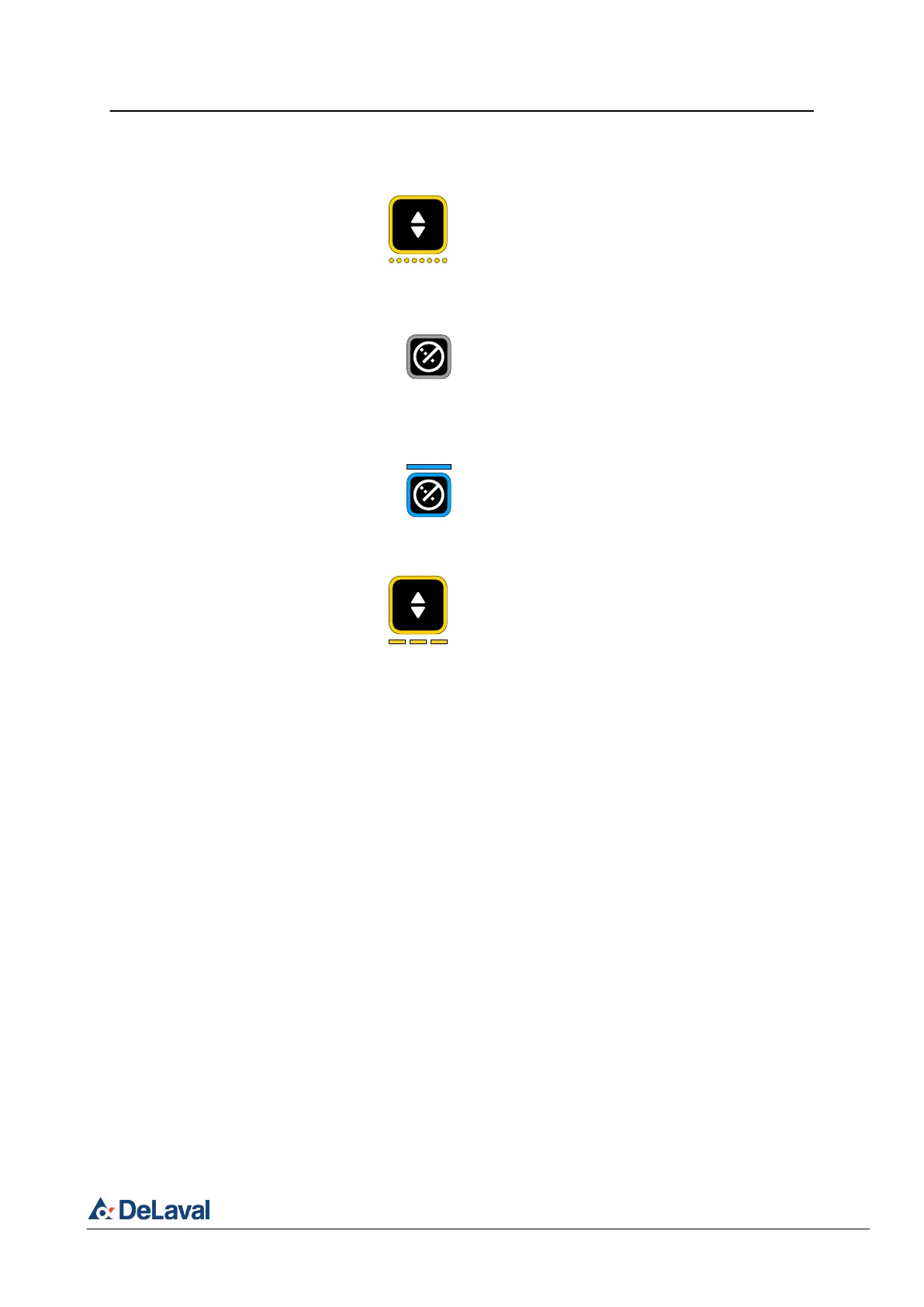
If the large button indicator light is flash-
ing rapidly yellow, the expected milk
yield or the minimum milking time limit
is not reached (by default 90 seconds
after cluster release). Check if a reat-
tach is needed, see
Ä
Chapter 4.4
"Reattaching a cluster" on page 45.
9. If the animal has a high milk flow already at
the start of the milking, press the [Force
vacuum] button to activate a high vacuum
level immediately if the system has two
vacuum levels (Duovac).
Note! The activation can be triggered
either manually or automatic.
ð
The indicator light turns into a steady
cyan indicating that the high forced
vacuum function is active. The activa-
tion can be triggered either manually or
automatic.
10.Check for any alarms during milking. A
number of milking alarms share the same
indication on the button module, see table
below.
Note! If the large button indicator is solid
yellow, a general milking alarm is active.
The general milking alarms are specific to
the settings made on the farm. The general
alarm can be a reminder for the specific
animal, to check something, give a treat-
ment, or do a manual attach, and so on.
Note! Further information regarding the
condition of the milking alarm is available
on the IDD.
Note! Cluster take-off can be implemented
immediately on detection of a milking alarm
according to farm settings, unless if manual
milking is active.
Note! Cluster attachment can be blocked
after cluster take-off on detection of a gen-
eral milking alarm, according to farm set-
tings.
Note! On rotaries using retention bars,
when a milking alarm is detected, the reten-
tion bar will lower immediately on detection
or at the confirmed point according to farm
settings.
DeLaval milking automation MA200 (Test installation)
Operation
© DeLaval 2019.
2019-05-31, Version 1 38 (62)



 To Next Page