
 Need help?
Do you have a question about the Delfield F18DC48P-RCPR and is the answer not in the manual?
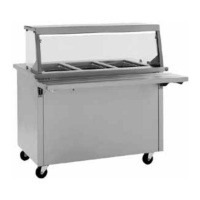
This document outlines the installation, operation, and maintenance procedures for the Delfield Refrigerated Catch Pan Raised Rail Pizza Table, a commercial appliance designed for food preparation and storage in professional kitchen environments.
The Delfield Refrigerated Catch Pan Raised Rail Pizza Table is a specialized refrigeration unit designed to maintain specific temperatures for food products, particularly in pizza preparation settings. It features a refrigerated base for general storage and a raised rail with catch pans for holding ingredients at optimal temperatures during use. The unit is engineered to provide fresh solutions for commercial kitchens, ensuring food safety and quality. It is not intended for continuous mass production of food but rather for commercial applications such such as restaurants, canteens, hospitals, bakeries, and butcheries. The appliance operates within a marked rated voltage range without adjustment and is classified for ambient conditions of 30°C and 55% relative humidity.
The pizza table is equipped with several features to facilitate efficient and safe operation. The refrigerated base is designed to maintain an operational temperature between 36°F to 40°F (2°C to 4°C), while the raised rail maintains temperatures between 33°F to 41°F (0°C to 5°C) with pans recessed 2 inches (5cm) at 86°F (30°C) ambient room temperature.
For operation, the main ON/OFF switch for the cabinet is located behind the louvered door, which must be in the ON position for the top rail/catch pan switch to function. A separate ON/OFF switch is provided for the rail, controlling only its refrigeration. It is recommended to turn on the rail switch an hour before filling it with product to allow it to reach the desired temperature.
The unit is designed to maintain, not lower, product temperatures. Therefore, food items should be pre-cooled to 41°F (5°C) or below before being placed in the refrigerator. For optimal product quality in the rail, it is recommended to rotate products every four hours. The catch pan and top rail areas are designed to meet NSF 7 criteria, which may involve a layer of frost building up on the walls, a normal and necessary condition for maintaining desired temperatures. Excess food product in the catch pans should be emptied after two hours of use to achieve the best temperatures, though the catch pans can maintain temperatures for up to four hours if needed.
At the end of the day, the top rail/catch pan switch should be turned OFF, while the cabinet main switch remains ON if product is still held in the refrigerated base. This allows the rail frost to melt and drain. Product in the rails must be removed daily to allow for defrosting, which saves energy and helps maintain product quality. A minimum of one hour of off-time per day with pans removed is required for proper top rail defrosting. If pans are left in the top rail, defrosting may take up to four hours.
A drain valve, also located behind the louvered door, controls both the top rail and catch pan drain lines. It should be turned ON to allow drainage into a customer-provided waste container during cleaning. After cleaning, the drain valve should be turned OFF.
The unit incorporates an ERC112 Temperature Control system. Upon initial start-up or reconnection of power, the control enters a defrost mode, indicated by "dEF" on the display. The compressor and condenser fan remain off during this initial defrost, which can take up to 35 minutes. The display continues to show "dEF" for an additional 30 minutes while the unit cools to the set temperature, after which it displays the box temperature. The temperature control cycles the compressor, evaporator fan, and condenser fan to maintain the set temperature. The control also monitors evaporator temperature and compressor run time to initiate positive defrost cycles as needed, turning off the compressor and condenser fan to clear accumulated frost. Defrost cycles can occur every 60 minutes under heavy usage and last a minimum of 2 minutes, with the compressor remaining off until the evaporator coil temperature exceeds 41°F (5°C) or a time limit of 75 minutes is reached.
The factory setting for the rail set-point is 10°F (-12°C), and for the base set-point, it is 36°F (2°C). The rail temperature displayed is for refrigeration set-point purposes only and does not reflect air or product temperatures in the unit. The control panel allows users to view and adjust set-points, initiate defrost, and monitor for alarms. The display can be switched between Fahrenheit and Celsius by accessing a password-protected menu.
Proper installation, care, and maintenance are crucial for maximum performance and trouble-free operation. Maintenance procedures are not covered by the warranty.
Daily maintenance includes cleaning the interior, gaskets, and exterior, and ensuring the drain is clear. Weekly maintenance also includes these tasks, while monthly maintenance adds cleaning the condenser coil. After prolonged shutdown and at start-up, a more comprehensive check of the interior, gaskets, exterior, drain, drawers/doors, and condenser coil is recommended.
For interior cleaning, soap and warm water are suitable; for stubborn stains, ammonia and water or a non-abrasive liquid cleaner can be used. Gaskets should be cleaned regularly with water and mild soap (non-citrus based) to prevent mold and mildew and maintain elasticity. Sharp tools or knives should not be used on gaskets. Gaskets are dart style and can be easily removed and replaced. Placing gaskets in warm water makes them more pliable for installation.
To prevent blower coil corrosion, acidic items like pickles and tomatoes should be stored in sealable containers, and spills should be wiped up immediately.
Exterior cleaning involves wiping surfaces with a damp cloth rinsed in water, rubbing with the "grain" of the stainless steel to avoid marring the finish. For greasy residue, a mild dish soap and water solution can be used. Steel wool, abrasive pads, chlorinated, citrus-based, or abrasive cleaners should be avoided as they can damage the clear coating on stainless steel panels. Daily cleaning can be followed by applying a stainless steel cleaner to eliminate water spotting and fingerprints. Early signs of stainless steel breakdown, such as small pits and cracks, require thorough cleaning and the application of stainless steel cleaners to restore the steel. Casters should be wiped with a damp cloth to prevent corrosion.
Drains should be checked to ensure they are free of obstructions and properly connected. Over time, heavy-use doors may cause hinges to loosen, which should be tightened to prevent damage to the doors and frame.
The condenser coil fins must be cleaned of dust, dirt, and grease regularly to maintain proper refrigeration performance. Monthly cleaning is recommended, but frequency should increase if conditions cause the condenser to block more quickly. A vacuum cleaner or stiff brush can be used, or a commercial condenser cleaner for extremely dirty coils. Failure to maintain a clean condenser coil can lead to high temperatures, excessive run times, compressor failure, and void any associated warranties.
Safety precautions emphasize reading the manual thoroughly, using appropriate safety equipment during installation and servicing, and ensuring all utility connections comply with local and national codes. The unit must be grounded, and a separate fuse/circuit breaker provided for each unit. The use of GFCI/GFI circuit protection is not recommended by Welbilt due to intermittent nuisance trips, but local codes must be followed if required. The unit should be installed on a level, stable, non-combustible surface, free from obstructions, and in an indoor area with recommended air temperatures between 50°F and 100°F (10°C and 38°C). Proper air supply for ventilation is critical, and air vents must not be blocked. The unit should not be installed directly over a drain to prevent steam damage. Hot surfaces are indicated by a symbol. The product utilizes Ecomate blowing agent methyl formate.
 General
| Model | F18DC48P-RCPR |
|---|---|
| Category | Commercial Food Equipment |
| Brand | Delfield |
| Width | 48 inches |
| Height | 34 inches |
| Number of Doors | 2 |
| Door Type | Solid |
| Exterior Finish | Stainless Steel |
| Interior Finish | Aluminum |
| Voltage | 115V |
| Hertz | 60Hz |
| Phase | 1 |
| Certification | NSF, UL |



 To Next Page