EasyManua.ls Logo

Delta DTK Series - User Manual

Delta DTK Series
11 pages
Print Icon
To Next Page IconTo Next Page
Loading...
1
2015/4/8
Series Temperature Controller Instruction Sheet
Precaution
DANGER! Caution! Electric Shock! Do not touch the AC terminals while the power is supplied to the controller to prevent electric
shock. Make sure power is disconnected while checking the unit inside.
This controller is an open-type temperature controller. Be sure to evaluate any dangerous application in which a serious human
injury or serious property damage may occur.
1. Always use recommended solder-less terminals: Fork terminal with isolation (M3 screw, width is 7.2 mm). Make sure all wires are
connected to the correct polarity of terminals.
2. Do not allow dust or foreign objects to fall inside the controller to prevent it from malfunctioning. Never modify or disassemble the
controller. Do not connect anything to the "No used" terminals.
3. To prevent interference, keep away from high voltage and high frequency when installing. Do not install and/or use the controller in
places subject to:
(a) Dust or corrosive gases and liquid; (b) High humidity and high radiation; (c) Vibration and shock;
4. Power must be off when wiring and replacing a temperature sensor.
5. Be sure to use compensating wires that match the thermocouple types when extending or connecting the thermocouple wires.
6. Please use wires with resistance when extending or connecting a platinum resistance thermometer (RTD).
7. Please keep the wire as short as possible when wiring a platinum resistance thermometer (RTD) to the controller and please route
power wires as far as possible from load wires to prevent interference and induced noise.
8. This controller is an open-type unit and must be placed in an enclosure away from high temperature, humidity, dripping water,
corrosive materials, airborne dust, and electric shock or vibration.
9. Make sure power cables and signals from instruments are all installed properly before energizing the controller, otherwise serious
damage may occur.
10. Do not touch the terminals in the controller or try to repair the controller when power is on, in order to prevent electric shock.
11. Wait at least one minute after power is disconnected to allow capacitors to discharge, and please do not touch any internal circuit
within this period.
12. Do not use acid or alkaline liquids for cleaning. Please use a soft, dry cloth to clean the controller.
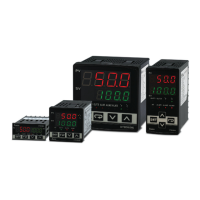
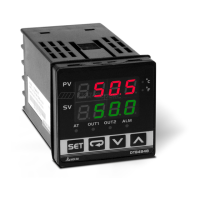
Display, LED & Pushbuttons
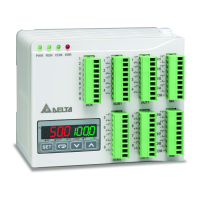
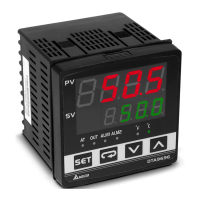
PV: Present value
SV: Set value
Ԩ, Ԭ: Celsius or Fahrenheit LED
1, 2: ALM1/ALM2 alarm output LED
A/M: Auto-Tuning and manual mode LED
OUT1, OUT2: Output LED
: "Select" and "Set up" keys
: "Set value tuning" keys
Question and Answer IconNeed help?

Do you have a question about the Delta DTK Series and is the answer not in the manual?

Summary

Precaution

Safety and Installation Guidelines

Safety warnings for electrical shock, installation environment, and proper wiring.

Display, LED & Pushbuttons

Controller Interface Overview

Description of the controller's display indicators, LEDs, and function buttons.

Ordering Information

Product Series and Options

Details on controller series, panel sizes, output, and communication options.

Specifications

Key Technical Specifications

Summary of electrical, sensor, control, and environmental specifications.

Parameter Settings for Operation Mode

Operation Mode Parameter Configuration

Settings for RUN/STOP, alarms, outputs, and other operational parameters.

Parameter Settings for Initial Setting Mode

Initial Setting Mode Parameter Configuration

Parameters for input type, temperature units, control modes, and communication setup.

Parameter Settings for Regulation Mode

Regulation Mode Parameter Tuning

Parameters for auto-tuning, PID, hysteresis, filters, and output adjustments.

Initial Start-up and Display Settings

Sensor Type Selection and Display Configuration

Guide to sensor selection and configuring display units.

Input Value Limits and Signal Processing

Input Value Limits and Signal Processing

Setting input value limits, digital filters, and linear compensation.

Analog Output and Firmware Check

Analog Output and Firmware Check

Compensating analog outputs and checking firmware version.

Output Control and Mode Settings

Output Control and Mode Settings

Configuring output control, dead band, and control modes.

Tune Function and Limits

Tune Function and Limits

Auto-tuning, limiting output range, and temperature range settings.

Restore Factory Settings and Key Lock

Restore Factory Settings and Key Lock

Restoring factory settings and managing panel key lock.

Alarm Outputs

Alarm Outputs Configuration

Configuring various alarm types, delays, and advanced settings.

RS-485 Communication

RS-485 Communication Setup and Usage

Configuring RS-485, using commands, and CRC check.

Panel Cutout and Wiring Diagram

Physical Installation Details

Physical cutout dimensions and wiring configurations.

Overview

The Delta DTK Series Temperature Controller is an open-type device designed for precise temperature regulation. It is crucial to exercise caution during installation and operation, particularly regarding electrical safety. Users are warned against touching AC terminals when power is supplied and must ensure power is disconnected before internal checks. The controller is not intended for applications where serious human injury or property damage could occur without additional safety evaluations.

Function Description

The DTK Series Temperature Controller manages temperature through various control modes, including PID, manual, and ON/OFF. It features a clear LCD display for both the Process Value (PV) in red and the Set Point (SV) in green. The device supports a wide range of temperature sensors, including various thermocouple types (K, J, T, E, N, R, S, B, L, U, TXK), 3-wire Platinum RTDs (Pt100, JPt100), and resistance sensors (Cu50, Ni120).

It offers multiple output options: relay output (250 VAC, 8A), voltage pulse output (12VDC +/-15%), and DC current output (4-20 mA). The controller can be configured for single or dual alarm outputs, with various alarm modes such as deviation upper/lower limit, absolute value upper/lower limit, and hysteresis alarms. Communication is supported via RS485, allowing for remote monitoring and control.

The device includes an auto-tuning function for automatic generation of PID parameters, simplifying setup and optimizing control performance. It also allows for digital filtering and linear compensation of input signals to enhance display stability and accuracy. Analog output compensation is available for fine-tuning current output signals.

Important Technical Specifications

  • Input Voltage: AC 100-240 V, 50/60 Hz
  • Power Consumption: 5VA max.
  • Display Method: LCD display (PV: Red, SV: Green)
  • Sensor Types: Thermocouple (K, J, T, E, N, R, S, B, L, U, TXK), 3-wire Platinum RTD (Pt100, JPt100), Resistance (Cu50, Ni120)
  • Control Modes: PID, manual, ON/OFF
  • Control Output:
    • Relay output: Max. load 250VAC, 5A resistive load
    • Voltage pulse output: DC 12V, Max. output current 40 mA
    • Current output: DC 4-20 mA (Load resistance: Max. 600Ω)
  • Alarm Output Type: Relay output: Max. load 250VAC, 5A resistive load
  • Display Accuracy: 0 or 1 digit to the right of the decimal point (selectable)
  • Sampling Rate: Thermocouple or platinum resistor: 0.1 sec
  • Vibration Resistance: 10 to 55 Hz, 10 m/s² for 10 min, each in X, Y, and Z directions
  • Shock Resistance: Max. 300 m/s², 3 times in each of 3 axes, 6 directions
  • Ambient Temperature: 0°C to +50°C
  • Storage Temperature: -20°C to +65°C
  • Altitude: Max. 2000 m
  • Relative Humidity: 35% to 80% RH (non-condensing)
  • Communication: RS485 (Modbus ASCII or RTU protocol) with baud rates from 2400 to 38400 bps.

Usage Features

The controller operates in three main modes: operation, regulation, and initial setting, accessible via the SET key.

  • Operation Mode: This is the default mode upon power-up, displaying PV and SV. Users can adjust the temperature set point using the up/down keys.
  • Regulation Mode: Accessed by pressing SET for less than 3 seconds from operation mode. This mode allows adjustment of various parameters like alarm limits, output values, and filter settings.
  • Initial Setting Mode: Accessed by pressing SET for more than 3 seconds from operation mode. This mode is used for fundamental configurations such as input type, temperature unit, upper/lower temperature limits, control mode, and communication settings.

Key features include:

  • Temperature Set Point (SV) Adjustment: Easily set the desired temperature using the up/down keys.
  • Decimal Point Setting: Configure the display to show integral numbers or one decimal place.
  • Setting Lock Mode: Prevent unauthorized changes by locking settings, with options to allow only SV adjustment or full lock.
  • Alarm Configuration: Set up to two independent alarms with various modes (deviation, absolute, hysteresis), options (reverse output, standby, hold), and delay times.
  • Output Control: Adjust output values for both primary and secondary output groups, including maximum and minimum percentages.
  • Heating/Cooling Selection: Configure the controller for heating, cooling, or dual-output heating and cooling, with a dead band setting to prevent frequent switching.
  • PID Parameter Adjustment: Manually set proportional (P), integral (I), and derivative (D) values, or use the auto-tuning function for automatic optimization.
  • Manual Control: Force a fixed output value, often used in conjunction with PID control switchover.
  • Digital Filter: Adjust the filter factor and range to stabilize PV display against input signal interferences.
  • Linear Compensation: Compensate for PV display deviations and adjust gain for more accurate temperature readings.
  • Analog Output Compensation: Fine-tune analog current outputs (4-20 mA) by adjusting upper and lower limits.
  • Key Lock Function: Secure settings with a password to prevent accidental or unauthorized modifications.
  • Firmware Version Display: Upon power-up, the controller displays its firmware version, output type, and input type for quick identification.

Maintenance Features

  • Cleaning: Use a soft, dry cloth for cleaning. Avoid using acid or alkaline liquids.
  • Power Disconnection: Always disconnect power before wiring or replacing sensors. Wait at least one minute after power disconnection for capacitors to discharge before touching internal circuits.
  • Environmental Protection: The controller is an open-type unit and must be placed in an enclosure away from high temperature, humidity, dripping water, corrosive materials, airborne dust, and electric shock or vibration.
  • Wiring: Use recommended solder-less fork terminals (M3 screw, width 7.2 mm). Ensure correct polarity. Use compensating wires for thermocouples and resistance wires for RTDs. Keep wires as short as possible and route power wires away from load wires to prevent interference.
  • Troubleshooting: The RS-485 communication interface provides error codes for various issues, such as initial process, sensor not connected, incorrect sensor type, or ADC input error, aiding in diagnostics.
  • Restore Factory Settings: A function is available to reset the controller to its default factory settings, useful for resolving configuration issues or preparing the device for a new application. This involves a specific key sequence and password entry.

Delta DTK Series Specifications

General IconGeneral
BrandDelta
ModelDTK Series
CategoryTemperature Controller
LanguageEnglish

Related product manuals