26
Digimet Printer or viewed on the
computer screen, the AVE. VACUUM
figure will be the average for the last 1/2
second of the Graph period.
Vacuum Fluctuation
Vacuum Fluctuation represents the
difference from the absolute minimum and
maximum vacuum levels for a given time
period. This time period is the currently
set Fluctuation Time Frame, described in
section on the Measurement Constants.
The calculation of Vacuum Fluctuation
uses a set of absolute minimum and
maximum vacuum values. These values
are automatically "reset" with each
Fluctuation Time Frame. Thus they
represent the overall maximum and
minimum vacuum levels for each single
Time Frame. At the end of each Time
Frame, the Vacuum Fluctuation for that
time frame is calculated as the difference:
Vacuum Fluctuation = Maximum Vacuum -
Minimum Vacuum. This measurement is
not calculated until the vacuum level has
been monitored for one Fluctuation Time
Frame period.
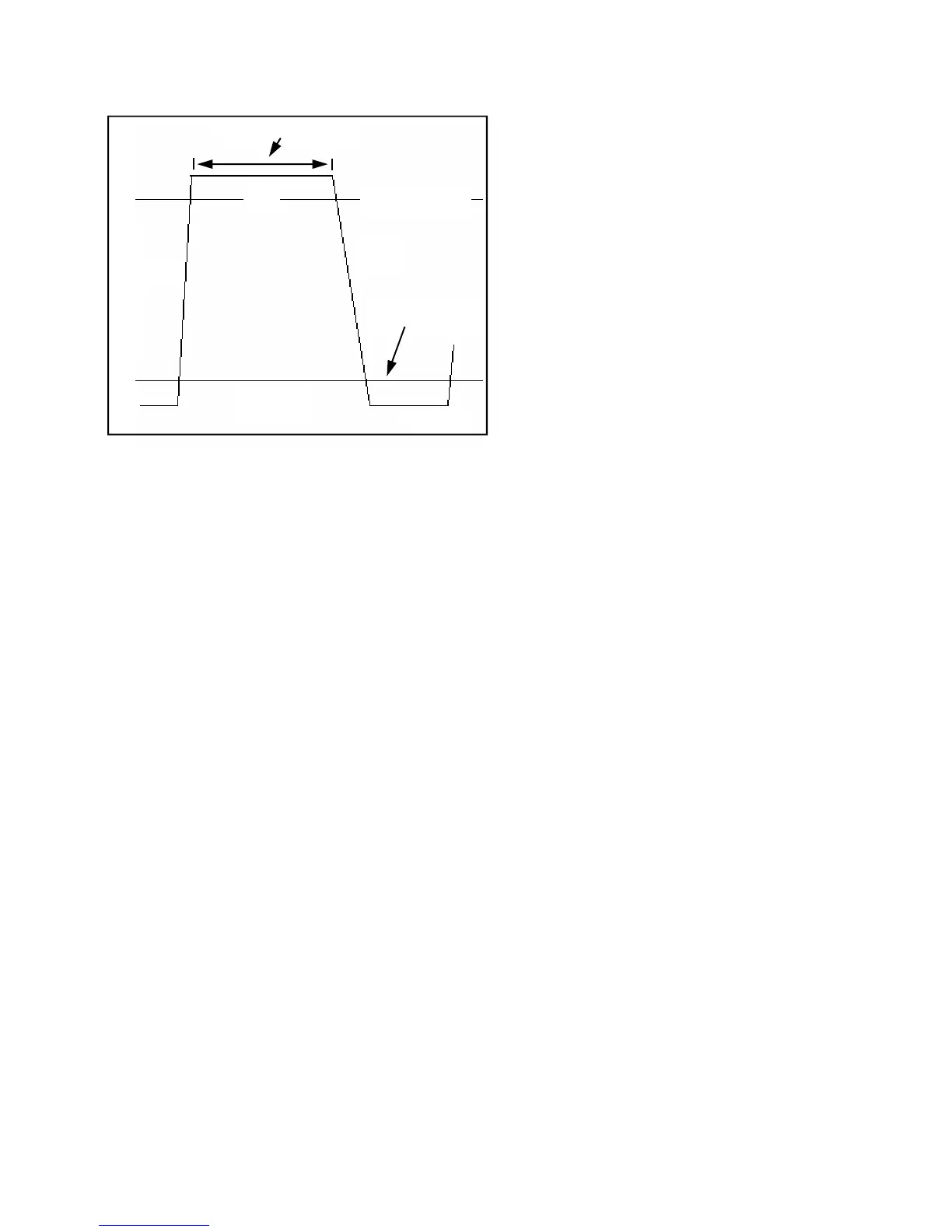
Pulsator Ratio
The Pulsation measurements are
calculated based on four time intervals
called A, B, C and D. These intervals
indicate the various phases of pulsation
which are marked by a crossing of the
vacuum levels 1.2" Hg above the minimum
and 1.2" Hg below the maximum vacuum
of the single pulsation cycle. A typical
pulsation cycle and the A-B-C-D points are
depicted above.
For pulsation measurements, the
beginning of a pulsation is considered to
be the point that begins the A phase of the
curve, at time a. Calculations are as
follows:
Total Time = a' - a
Pulses Per Minute = 60 seconds / Total
Time
Min / P = Minimum vacuum per pulse
Max / P = Maximum vacuum per pulse
B Fluc = Fluctuation in the B phase
A(time) = b - a
B(time) = c - b
C(time) = d - c
D(time) = a' - d
A+B(time) = A(time) + B(time)
C+D(time) = C(time) + D(time)
A% = A(time) / Total Time * 100%
B% = B(time) / Total Time * 100%
C% = C(time) / Total Time * 100%
D% = D(time) / Total Time * 100%
A+B% = A+B(time) / Total Time *100%
C+D% = C+D(time) / Total Time *100%
Setting Pulsator Ratio Limits
Limits for the individual pulsation
parameters can be set for the Pulsator
Ratio Function.
See page 40 for default settings.
The Digimet 3000 Version 4.0 allows users
to set limits for pulsator ratio
parameters, like a high and low value for
the B phase of pulsation. When a user is
collecting data with the Digimet 3000, the
A
B
Max.-1.2”Hg
Min.+1.2”Hg
C
D
Time
V
a
c
u
u
m
B Fluc time period



 To Next Page